<?xml version="1.0" encoding="utf-8"?>
<feed xmlns="http://www.w3.org/2005/Atom">
  <title type="text">issarice.com</title>
  <updated>2017-10-18T09:40:41-07:00</updated>
  <author>
    <name>Issa Rice</name>
  </author>
  <id>https://issarice.com/</id>
  <link href="https://issarice.com/atom.xml" rel="self" type="application/atom+xml" />
  <link rel="alternate" type="application/rss+xml" hreflang="en" href="http://issarice.com/rss.xml" />
  <generator uri="https://github.com/riceissa/issarice.com/blob/master/generator/atom.sh">atom.sh</generator>
  <entry>
    <title>Text width (2017-10-17)</title>
    <link href="https://issarice.com/text-width"/>
    <id>tag:issarice.com,2017-10-17:/text-width</id>
    <updated>2017-10-17T00:00:00-07:00</updated>
    <content type="html"><![CDATA[
<p>When reading something continuously, it is nice to have the text width of the page rather short, so that the reader’s eyes don’t have to travel too far to find the next line.</p>
<p>When scanning a page, looking for information, it is nice to have the text width <em>wide</em> so that more content fits on the page. This allows the eyes to scan more content looking for the spot to begin reading. Otherwise the reader has to scroll the page while also scanning with the eyes.</p>
    ]]></content>
  </entry>
  <entry>
    <title>Rationality community (2017-10-17)</title>
    <link href="https://issarice.com/rationality-community"/>
    <id>tag:issarice.com,2017-10-17:/rationality-community</id>
    <updated>2017-10-17T00:00:00-07:00</updated>
    <content type="html"><![CDATA[
<p>The rationality community or rationalist community is a community that was once centered around the group blog <a href="./lesswrong">LessWrong</a>; the community still exists but is much more spread out across multiple websites (known as the “rationalist diaspora”). This page describes my involvement with the rationality community.</p>
<h2 id="personal-involvement">Personal involvement</h2>
<p>I discovered <a href="./lesswrong">LessWrong</a> in 2010 or 2011; the first record I have of mentioning LessWrong dates to October 2011. I remember discovering it twice: the first was when Vaniver on the xkcd forums linked to the site, and the second was when I was searching for textbooks and found <a href="http://lesswrong.com/lw/3gu/the_best_textbooks_on_every_subject/">Luke Muehlhauser’s post on the subject</a> (however I write this in October 2017, six years after the initial record, and did not record details of my discovery, so I could be making details up).</p>
<p>After discovering LessWrong, I read a bunch of posts in a haphazard order. I mostly did not keep records of which posts I read, so it is hard to say what exactly I read. I think I read a lot of the highly upvoted posts as well as most of the Sequences (but skipping the quantum mechanics sequence). During this period I discovered that there was a Seattle LessWrong meetup group, and considered attending, but ended up never attending due to some combination of being shy and traveling to Seattle being cumbersome (as I was located on the <a href="https://en.wikipedia.org/wiki/Eastside_(King_County,_Washington)">Eastside</a>).</p>
<p>I created my account on LessWrong in July 2012.</p>
<p>On January 1, 2014, I emailed <a href="./cognito-mentoring">Cognito Mentoring</a> after seeing its post on LessWrong.</p>
<p>Since late 2014, I’ve become more involved with the <a href="./effective-altruism">effective altruism</a> community rather than spending time on LessWrong specifically.</p>
<p>I have neither attended a Center for Applied Rationality workshop nor read <em>Harry Potter and the Methods of Rationality</em>.</p>
<h2 id="external-links">External links</h2>
<p>Here are some related timelines that I have written:</p>
<ul>
<li><a href="https://timelines.issarice.com/wiki/Timeline_of_the_rationality_community">Timeline of the rationality community</a></li>
<li><a href="https://timelines.issarice.com/wiki/Timeline_of_Machine_Intelligence_Research_Institute">Timeline of Machine Intelligence Research Institute</a></li>
<li><a href="https://timelines.issarice.com/wiki/Timeline_of_Center_for_Applied_Rationality">Timeline of Center for Applied Rationality</a></li>
<li><a href="https://timelines.issarice.com/wiki/Timeline_of_decision_theory">Timeline of decision theory</a></li>
<li><a href="https://timelines.issarice.com/wiki/Timeline_of_friendly_artificial_intelligence">Timeline of friendly artificial intelligence</a></li>
</ul>
    ]]></content>
  </entry>
  <entry>
    <title>Sleep schedule (2017-10-16)</title>
    <link href="https://issarice.com/sleep-schedule"/>
    <id>tag:issarice.com,2017-10-16:/sleep-schedule</id>
    <updated>2017-10-16T00:00:00-07:00</updated>
    <content type="html"><![CDATA[
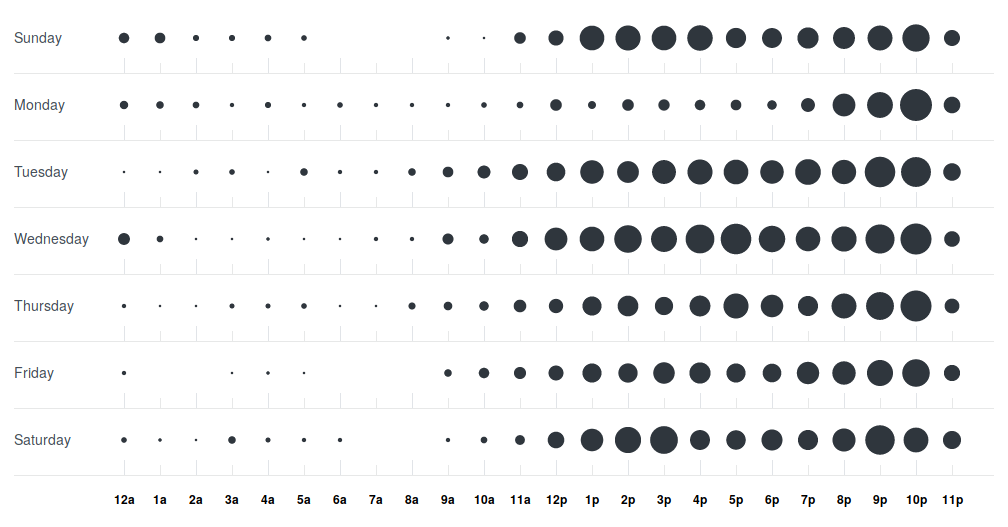
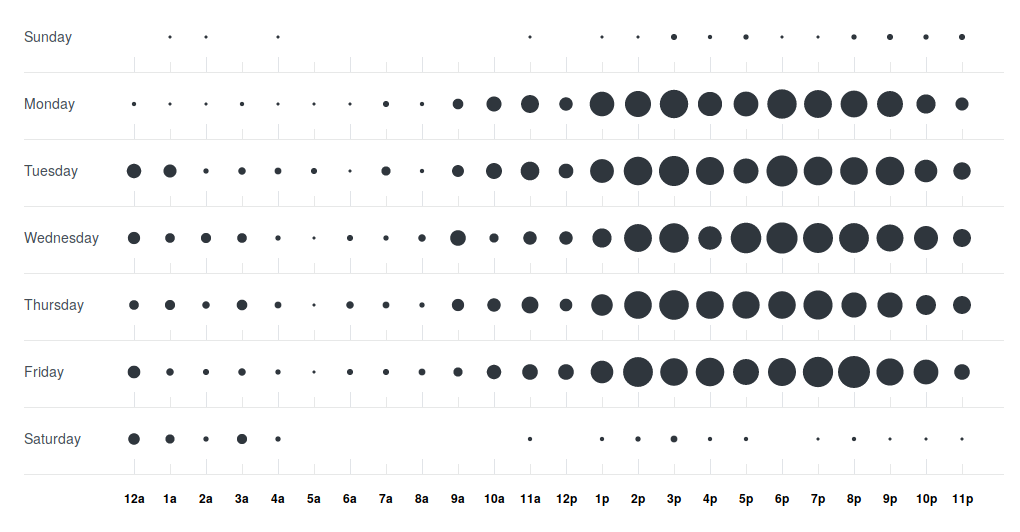
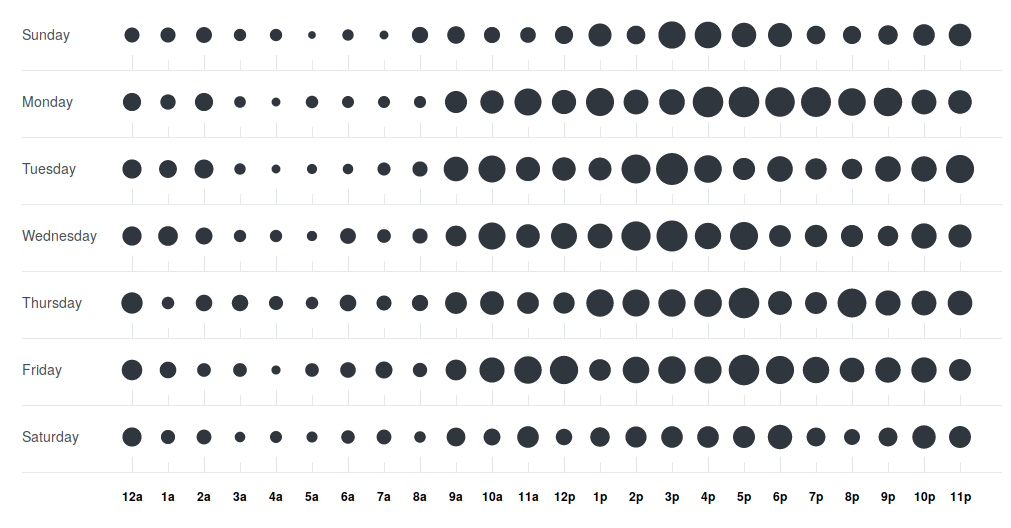
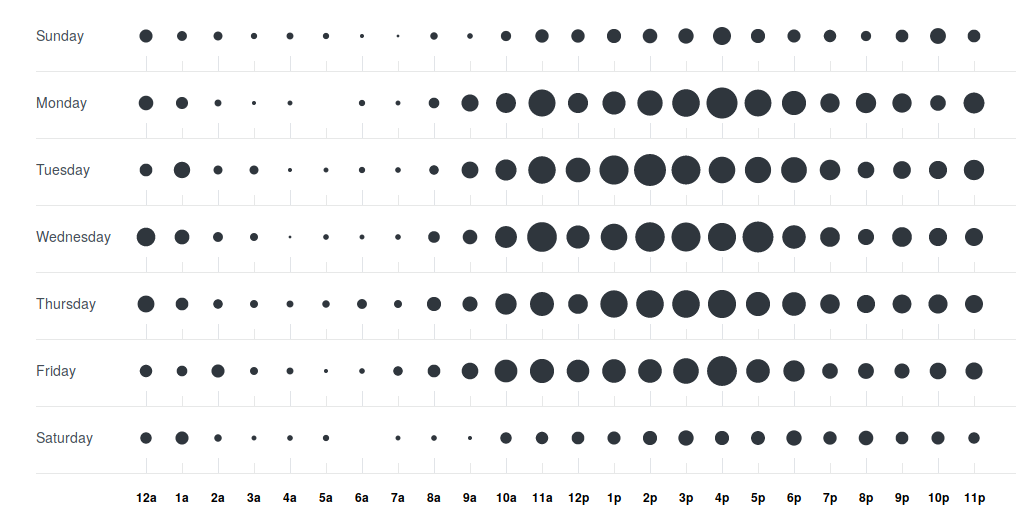
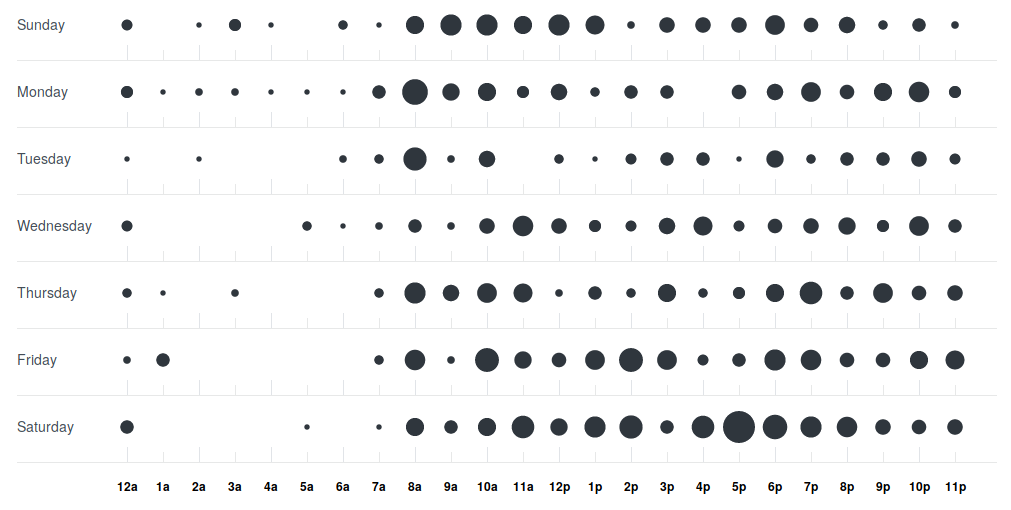
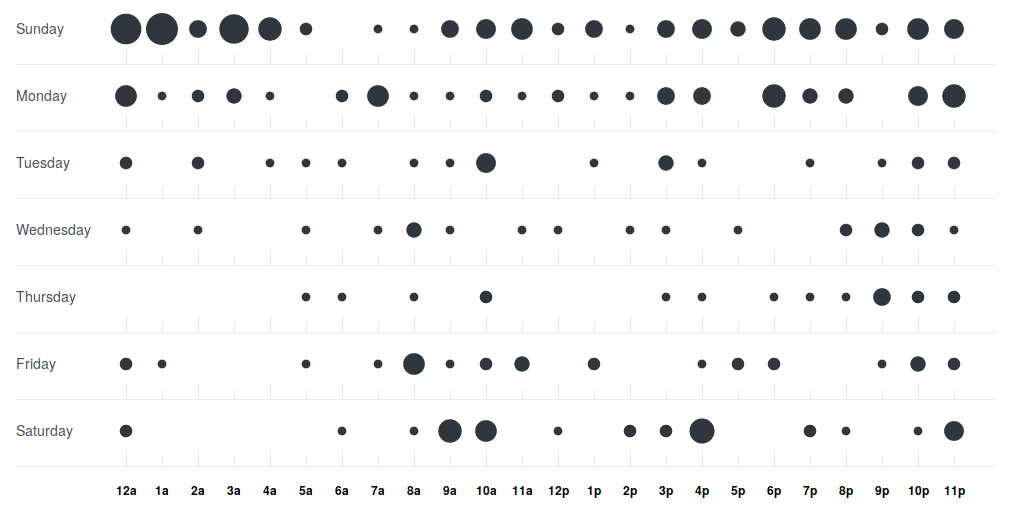
<p>This page is about my sleep schedule, i.e. the times of day during which I sleep.</p>
<p>As of October 2017, I’ve been going to sleep between 10 PM and 11 PM and waking up between 7 AM and 9 AM. I have been roughly keeping this schedule for several months, although I don’t have a record of when exactly it began.</p>
<p>Prior to this, I had tried many times to get up and go to sleep early, but invariably tended to stay up late (to 2–4 AM), which forced me to wake up late (10 AM–12 PM) as well.</p>
<p>I sleep anywhere from 5 to 11 hours per night (less sleep during school, since I would be forced to wake up early even if I stayed up late).</p>
<p>At some point I used to regularly nap in the afternoon (and even had a period where I wanted to experiment with polyphasic sleep), but as of October 2017 I rarely nap, and all my sleep is in one continuous block at night.</p>
<p>I somewhat regularly take melatonin to make me sleepy at night. I bought a bottle of 3 mg melatonin a couple of years ago, and each night I nibble off perhaps 1/8 to 1/4 of a pill.</p>
    ]]></content>
  </entry>
  <entry>
    <title>Effective altruism (2017-10-16)</title>
    <link href="https://issarice.com/effective-altruism"/>
    <id>tag:issarice.com,2017-10-16:/effective-altruism</id>
    <updated>2017-10-16T00:00:00-07:00</updated>
    <content type="html"><![CDATA[
<p><a href="https://en.wikipedia.org/wiki/Effective_altruism">Effective altruism</a> (EA) is “a philosophy and social movement which applies evidence and reason to determining the most effective ways to improve the world”. On this page I describe my personal involvement with and thoughts on EA.</p>
<h2 id="personal-involvement">Personal involvement</h2>
<p>I’ve been involved with the effective altruism community for some time. I first heard about EA through <a href="./lesswrong">LessWrong</a> (I think it was a post about GiveWell). I remember reading <a href="http://lesswrong.com/lw/cbs/thoughts_on_the_singularity_institute_si/">Holden Karnofsky’s critique of the Singularity Institute</a> (now <a href="https://timelines.issarice.com/wiki/Timeline_of_Machine_Intelligence_Research_Institute">MIRI</a>) right when it came out (May 2012), and I remember it reaching the status of “most upvoted LW post ever”. Although I was <a href="https://www.quora.com/As-someone-who-is-intellectually-in-agreement-with-effective-altruism-but-hasnt-started-earning-money-of-my-own-how-can-I-best-contribute-to-the-Effective-Altruism-Forum">intellectually in agreement with effective altruism</a>, I didn’t actually do anything about it, thinking that working hard in school would be a form of altruism (i.e. that in the long term, working hard in school and having more opportunities would allow me to best contribute to the world).</p>
<p>In January 2014, I contacted <a href="./cognito-mentoring">Cognito Mentoring</a> for the first time. Although I myself didn’t seem to ask directly about EA (looking back at our correspondence), a friend contacted them regarding effective career choice, and this roused my interested in effective altruism as well.</p>
<p>In <a href="https://www.facebook.com/events/266352430227314/">July 2014, I attended a Seattle Effective Altruists meetup</a>; although I didn’t contribute much to the discussion, my interest in EA increased. Part of the reason I attended was due to my interest, but part of it too was that I was working on a research project at the University of Washington over the summer, and the July meetup was conveniently situated next to campus – so the activation energy had been considerably lowered. The topic of the meetup was also “Donating vs. Working directly for impact”, which was a topic of particular interest to me going into college.</p>
<p>Following my first meetup was a period of several months where I frequently attended Seattle EA meetups. I also became more involved in online discussions of EA, and eventually in November 2014 started the <a href="http://causeprioritization.org/">Cause Prioritization Wiki</a> as a place to store my research on <a href="./cause-prioritization">cause prioritization</a>. Also around this time, I tried to start an <a href="https://www.facebook.com/groups/EffectiveAltruismUW">effective altruism group at the University of Washington</a>. The group didn’t get much traction, and as of August 2016, it had only had one meetup in November 2014. During the 2016–2017 school year, Rohin Shah and Ethan Bashkansky restarted the group, with meetings taking place throughout the school year. I have attended multiple meetings but have played only a minor role in this revival.</p>
<p>I continue to be involved in online discussions of EA, but have since become much less involved in Seattle EA meetups.</p>
<p>From March 2016 or so to May 2017, I did more concentrated work in global health, working with <a href="https://vipulnaik.com/">Vipul Naik</a>. As part of this work, I made several <a href="wikipedia#global-health">Wikipedia pages related to global health</a>.</p>
<p>Starting in May 2017, I’ve been working (again with Vipul) on broader topics including infrastructure and economic growth.</p>
<h2 id="beliefs">Beliefs</h2>
<p>Although I think effective altruism is pretty cool, I’ve only been consistently impressed with a few people associated with the movement. Indeed, I often find that the most impressive people hang out in the periphery of the movement without necessarily calling themselves “effective altruists”. I think EA uses a <a href="http://effective-altruism.com/ea/df/the_outside_critics_of_effective_altruism/26u">clever definition</a> to make it irrefutable in some sense, which makes discussion and criticism of it difficult. However if nothing else, I think effective altruism still does to philanthropy what <a href="http://econlog.econlib.org/archives/2012/08/the_subtle_valu.html">Bastiat does to economics</a> (although <a href="is-effective-altruism-new">now I don’t think EA is as new as I used to</a>).</p>
<p>I’m highly uncertain about what the best causes are, which is part of the reason I’m interested in cause prioritization.</p>
<p>Overall, I’m not comfortable considering myself part of the “EA movement”. However, I’m happy to interact and collaborate with people who do consider themselves part of the movement.</p>
<h2 id="see-also">See also</h2>
<ul>
<li>I have a collection of <a href="./effective-altruism-links">Effective altruism links</a> that might interest people.</li>
<li><a href="./effective-altruism-and-asperger-syndrome">Effective altruism and Asperger syndrome</a></li>
</ul>
<h2 id="external-links">External links</h2>
<ul>
<li><a href="https://cse.google.com/cse/publicurl?cx=003462416774124900295:tgoyrxzwiha">Google Custom Search with an effective altruism label that I maintain</a></li>
<li><a href="http://econlog.econlib.org/archives/2017/04/whats_wrong_wit_22.html">Bryan Caplan weighs in on the rationality community</a> (the rationality community has close ties with the EA community)</li>
</ul>
    ]]></content>
  </entry>
  <entry>
    <title>Emacs (2017-07-18)</title>
    <link href="https://issarice.com/emacs"/>
    <id>tag:issarice.com,2017-07-18:/emacs</id>
    <updated>2017-07-18T00:00:00-07:00</updated>
    <content type="html"><![CDATA[
<p>I use the text editor GNU Emacs for various tasks that my main text editor, <a href="vim">Vim</a>, does not handle well.</p>
<p>As I have written <a href="http://vim.wikia.com/wiki/Working_with_long_lines?useskin=monobook">elsewhere</a>, Vim does a poor job of handling files with long lines. When programming or writing prose under my control, this is not a problem: the programming languages I tend to use have ways of forcing a linebreak, and markup languages like Markdown and LaTeX allow single linebreaks within paragraphs.</p>
<p>However, I still manage to encounter some files with long lines, most prominently when editing the English Wikipedia, where it is standard for paragraphs to consist of a single long line. For simple edits, just using the browser’s text field suffices, but for more involved editing tasks I’ve found it useful to learn Emacs. With a bit of practice, Emacs becomes much more efficient than the standard CUA keybindings will allow.</p>
<p>I also use Org mode. Ever since <a href="https://contractwork.vipulnaik.com/worker.php?worker=Issa+Rice">taking up contract work</a>, I’ve found a need to schedule many tasks days or weeks in advance, to the point where I can’t keep all of it straight in my head. In junior high and high school I had used paper planners, but since I now have no artificial restriction on computer use (in school, some teachers would not allow laptops in class, and taking a laptop around to all my classes would have been annoying), it makes sense to track my tasks in a version-controlled plain text file. Prior to using Org mode, I had used a text file where lines began with the scheduled date, so that I could sort the file to make the imminent tasks “float” up to the top, but then I wanted to add intervals so that I could say something like “reschedule this task one month after I complete it” – and reasoned that there ought to be someone who automated this in a plain text environment.</p>
<p>I almost always use the graphical version of Emacs rather than the terminal version. This is because the terminal version is limited in multiple respects (Emacs relies on a lot of chording that doesn’t come through on a terminal emulator, the terminal version doesn’t allow mouse interaction, the terminal version makes access to the menu – which I like for modes I am not familiar with – cumbersome, doesn’t allow easy access to the system clipboard). Note that this situation is the opposite of that in Vim: in Vim, the graphical version is rather limited because it cannot access a full terminal emulator (moreover, Vim doesn’t rely on a lot of chording, allows mouse access even from the terminal, and so on, so the caveats of terminal Emacs do not apply).</p>
<p>You can view my <a href="https://github.com/riceissa/dotfiles/blob/master/.emacs.d/init.el"><code>init.el</code></a> in my dotfiles repository.</p>
<h2 id="org-mode-routine">Org mode routine</h2>
<p>The following is how I usually use Org mode. Since I don’t know many of the more complicated features of Org mode, I tend to stick to the basics.</p>
<ul>
<li><p>I have a single Org file called <code>todo.org</code>.</p></li>
<li><p>Several times each day, I do <code>C-c a a</code> to open the agenda split window. I then use <code>n</code> and <code>p</code> to move between tasks, and usually hit <code>TAB</code> to open the task in another split. From there, I can edit or reschedule (<code>C-c C-s</code>) or mark the task as done (<code>C-c C-t d</code>). After marking as done I archive with <code>C-c C-x C-a</code> (as long as there are no clocked periods for the task; otherwise I like to keep done tasks around so that the clock table shows a more complete picture).</p></li>
<li><p>I create new tasks with <code>C-c t</code>.</p></li>
<li><p>I also use Org mode for clocking tasks as I work. I move to the item being clocked with <code>C-c C-x C-j</code>. To clock in, I use <code>C-c C-x C-i</code> and to clock out I use <code>C-c C-x C-o</code>. I used to have a separate “Timesheet” section containing all clocked tasks with general task names like “Miscellaneous Wikipedia work”, but these days I just clock tasks on the specific tasks themselves. (It sounds obvious in retrospect.)</p></li>
<li><p>I have a clock table with <code>:block today</code> that shows the time tracked for the current day. I update this table with <code>C-c C-c</code>. I have a second clock table with the current month’s interval, e.g. <code>:tstart &quot;&lt;2017-07-01&gt;&quot; :tend &quot;&lt;2017-08-01&gt;&quot;</code>. This way I can get a rough idea of how much I have been working for the current month.</p></li>
<li><p>The whole file is tracked in <a href="git">Git</a>. I have a mapping to quickly snapshot the current state of the file.</p></li>
</ul>
<h2 id="see-also">See also</h2>
<ul>
<li><a href="software">More software I use</a></li>
</ul>
    ]]></content>
  </entry>
  <entry>
    <title>Software (2017-06-19)</title>
    <link href="https://issarice.com/software"/>
    <id>tag:issarice.com,2017-06-19:/software</id>
    <updated>2017-06-19T00:00:00-07:00</updated>
    <content type="html"><![CDATA[
<p>This page lists software I use or have used. This page is a placeholder for now.</p>
<ul>
<li><a href="./tmux">tmux</a></li>
<li><a href="./firefox">Firefox</a> for the vast majority of daily browsing; I also use Google Chrome for Facebook and Gmail, and occasionally for some other JavaScript-heavy sites that I don’t want to view with Firefox. For most JavaScript-heavy web apps, often the easiest way to use them is to run them under an incognito Chrome window, rather than manually enabling a bunch of domains on NoScript or uMatrix.</li>
<li><a href="./vim">Vim</a> with various plugins for most text editing.</li>
<li><a href="./git">Git</a></li>
<li><a href="./elinks">ELinks</a>, Links, or Lynx for lightweight browsing depending on what I want. ELinks has tabbed browsing which I find easy to use, but Links can show images with the <code>-g</code> flag. Lynx seems to do correct checking for SSL certificates and additionally has <code>-localhost -dump</code> that is suitable for producing plain text dumps of webpages.</li>
<li><a href="./exuberant-ctags">Exuberant Ctags</a></li>
<li><a href="./music-on-console">Music On Console</a></li>
<li><a href="./newsbeuter">Newsbeuter</a></li>
<li>Ubuntu on laptop and Ubuntu and Debian on server</li>
<li>MATE as a desktop environment</li>
<li>KeePassX</li>
<li>Bash for my shell</li>
<li>Pandoc</li>
<li><a href="./mutt">mutt</a> for sending mail sometimes</li>
<li>I use a modified version of Solarized Light as a colorscheme in my terminal. By default, Solarized has various shades of gray in its 16-color palette, which makes some console programs difficult to use; I therefore replace those colors with the equivalents from Tango. You can see the <a href="https://github.com/riceissa/dotfiles/blob/3631d8f2a129daab502682557fd37580ad656519/.Xresources#L29-L93">resulting values</a>.</li>
<li>IPython (now called Jupyter Qt console)</li>
<li>htop</li>
<li>rxvt-unicode a.k.a. urxvt No strong preference for the most part, except that I dislike it when the terminal emulator intercepts Alt key mappings, like <code>Alt</code>-<code>f</code>.</li>
<li>Virtualbox</li>
<li>PDF.js or MuPDF for most PDF files. For short PDFs, PDF.js suffices, but for longer PDFs I usually store a persistent copy and read them on MuPDF. This is partly because PDF.js has a bug where if I open a long PDF, then go do stuff in other tabs, then return to the PDF and scroll down, later pages just show a spinning wheel without actually loading. As for MuPDF, I like the simple aesthetic and speed, but I don’t care for the rectangular selection (which can only copy to the primary selection and not the clipboard?) and wish there was a tabbed interface and a way to show partial pages when scrolling down.</li>
<li>Still looking for a good epub reader. I currently use FBReader but find the scrolling mechanism annoying.</li>
<li><code>youtube-dl</code></li>
<li>GNU userland, mainly because that’s what comes with Debian and Ubuntu and is what I’m most used to. I also install moreutils for <code>sponge</code>.</li>
<li><a href="rsync" class="uri">rsync</a></li>
<li>LibreOffice Calc for converting between CSV and XLS. I know almost nothing about it, but it seems to do what I want.</li>
<li>I often use <code>less</code> (e.g. instead of <code>tail -f</code> I use <code>less +F</code>)</li>
<li>fzf, mostly for recalling commands in bash with CTRL-R.</li>
<li><a href="emacs">Emacs</a> org mode</li>
</ul>
<p>Programs in trial mode:</p>
<ul>
<li>ag</li>
<li><code>mpsyt</code></li>
<li>arbtt</li>
<li><code>cmark-gfm</code> for Markdown processing; I’ve now used it for at least one blog post, and it is now <a href="https://githubengineering.com/a-formal-spec-for-github-markdown/">used on GitHub</a>. If more extensions are written for CommonMark (math, tables, metadata headers), and if the standard is adopted more widely, it probably makes sense to stop using Pandoc’s Markdown.</li>
</ul>
<h2 id="see-also">See also</h2>
<ul>
<li><a href="./colophon">Colophon</a></li>
<li><a href="account-names">Account names</a>, for SaaS</li>
</ul>
<h2 id="external-links">External links</h2>
<ul>
<li><a href="https://www.gwern.net/Choosing%20Software" title="gwern. “Choosing Software - Gwern.net”.">“Choosing Software”</a> by gwern</li>
</ul>
    ]]></content>
  </entry>
  <entry>
    <title>My Quora answers (2017-06-04)</title>
    <link href="https://issarice.com/my-quora-answers"/>
    <id>tag:issarice.com,2017-06-04:/my-quora-answers</id>
    <updated>2017-06-04T00:00:00-07:00</updated>
    <content type="html"><![CDATA[
<h2 id="introduction">Introduction</h2>
<p>My main contributions to <a href="./quora">Quora</a> are through my questions, but I don’t think my answers are especially bad, so here they are.</p>
<p>Reverse chronological order</p>
<h2 id="how-many-edits-have-been-made-to-wikipedia">How many edits have been made to Wikipedia?</h2>
<p><a href="https://www.quora.com/How-many-edits-have-been-made-to-Wikipedia/answer/Issa-Rice">Mirror</a></p>
<p>For <strong>total edits</strong>, see <a href="https://en.wikipedia.org/wiki/Special:Statistics">Special:Statistics</a>.</p>
<p>For the <strong>current month</strong>, I recommend Erik Zachte’s <a href="https://stats.wikimedia.org/EN/SummaryEN.htm">“English Wikipedia at a glance”</a>page, which has pretty plots for other metrics as well.</p>
<p>For <strong>edits by month</strong>, see the <a href="https://stats.wikimedia.org/EN/TablesDatabaseEdits.htm">Wikipedia Statistics table for this</a>. (Warning: large page that might take a while to load.)</p>
<h2 id="does-mediawiki-have-a-git-bisect-equivalent">Does MediaWiki have a git-bisect equivalent?</h2>
<p><a href="https://www.quora.com/Does-MediaWiki-have-a-git-bisect-equivalent/answer/Issa-Rice">Mirror</a></p>
<p>MediaWiki itself does not have a git-bisect equivalent, but there are various web-based tools with varying amounts of flexibility that implement the most important parts of git-bisect. The two that seem to work are:</p>
<ul>
<li><a href="https://en.wikipedia.org/wiki/User:Flominator/WikiBlame">User:Flominator/WikiBlame - Wikipedia</a>, which is available from the “Revision history search” link of the revision history page of each article. This tools does both linear and binary search. The source seems to be available on GitHub: <a href="https://github.com/FlominatorTM/wikiblame">FlominatorTM/wikiblame</a>.</li>
<li><a href="https://tools.wmflabs.org/xtools/blame/">Article blamer</a>, which is part of X!’s tools. This tool seems to do a linear search <a href="https://github.com/x-tools/xtools/blob/c49a5e3db99b941393564a0a2f6a37c0e7d49f34/public_html/blame/index.php#L53-L82">x-tools/xtools</a>.</li>
</ul>
<p>See also <a href="https://en.wikipedia.org/wiki/Wikipedia:Tools#Finding_the_responsible_user">Wikipedia:Tools § Finding the responsible user</a>.</p>
<h2 id="will-all-dropbox-urls-become-link-rot-december-2016">Will all Dropbox URLs become link rot? (December 2016)</h2>
<p><a href="https://www.quora.com/Will-all-Dropbox-URLs-become-link-rot-December-2016/answer/Issa-Rice">Mirror</a></p>
<p>“All” is too strong of a quantifier, but something close to it can happen.</p>
<p>As far as I can tell, a Dropbox link can stop working for any of the following reasons:</p>
<ul>
<li>Dropbox goes out of business (remember <a href="http://archiveteam.org/index.php?title=Ubuntu_One">Ubuntu One</a>?).</li>
<li>The sharing link uses <a href="http://db.tt/">db.tt</a> (Dropbox’s own URL shortener) and Dropbox somehow drops support for it.</li>
<li>The file associated with the link is copyrighted, the person who shared the file isn’t legally allowed to distribute it, and Dropbox decides to delete the file or prevent sharing (<a href="https://www.dropbox.com/en/help/20">Can I share files with non-Dropbox users?</a>).</li>
<li>The person who shared the file deleted the file or folder containing the file (<a href="https://www.dropbox.com/en/help/45">Why did my shared link stop working?</a>).</li>
<li>The person who shared the file set an expiration date for the shared link (<a href="https://www.dropbox.com/help/5888">How can I set an expiration for a shared link?</a>).</li>
<li>Dropbox bans the link for generating too much traffic (<a href="https://www.dropbox.com/help/4204">Banned links or file requests</a>), though this is temporary.</li>
<li>The account of the person who shared the file becomes inactive. Dropbox considers an account inactive after 12 months of no sign-ins, and deletes files 90 days after that (<a href="https://www.dropbox.com/en/help/9080">I received an email about an inactive Dropbox account—what do I need to do?</a>).</li>
<li>A subset of the cases in the above bullet point is if the user dies and nobody claims the account afterwards (<a href="https://www.dropbox.com/en/help/488">Can I access the Dropbox account of someone who has passed away?</a>).</li>
</ul>
<p>In other words, unless a user takes special steps to keep the shared file available, to ensure the account is preserved after death, and so forth, the link will eventually stop working.</p>
<p>I’m not aware of any studies of link rot that are specific to Dropbox.</p>
<h2 id="why-isnt-effective-altruism-called-effective-utilitarianism">Why isn’t effective altruism called effective utilitarianism?</h2>
<p><a href="https://www.quora.com/Why-isnt-effective-altruism-called-effective-utilitarianism/answer/Issa-Rice">Mirror</a></p>
<p><a href="https://www.quora.com/profile/Linchuan-Zhang">Linchuan</a> is quite right about point 1. The 2014 EA survey <a href="https://eahub.org/sites/effectivealtruismhub.com/files/survey/2014/results-and-analysis.pdf">https://eahub.org/sites/effectiv…</a> shows that about 70% of respondents hold consequentialist moral philosophies. The 2015 EA survey <a href="https://eahub.org/sites/eahub.org/files/SurveyReport2015.pdf">https://eahub.org/sites/eahub.or…</a> breaks down consequentialism into utilitarian and non-utilitarian types, and finds that 56% of respondents are utilitarian. It would therefore be strange to call the movement “effective utilitarianism”.</p>
<h2 id="is-there-anyone-else-like-gwern">Is there anyone else “like Gwern”?</h2>
<p><a href="https://www.quora.com/Is-there-anyone-else-like-Gwern/answer/Issa-Rice">Mirror</a></p>
<p>A2A.</p>
<p>It depends on what qualities you are interested in, but some people who are similar in various ways are:</p>
<ul>
<li>muflax</li>
<li>Carl Shulman (see my comment on this question)</li>
<li>Scott Alexander (also listed in the answer by Anonymous)</li>
</ul>
<h2 id="what-should-someone-do-if-their-dog-develops-romantic-feelings-towards-them">What should someone do if their dog develops romantic feelings towards them?</h2>
<p><a href="https://www.quora.com/What-should-someone-do-if-their-dog-develops-romantic-feelings-towards-them/answer/Issa-Rice">Mirror</a></p>
<p>Nothing.</p>
<h2 id="what-is-your-review-of-university-of-washington">What is your review of University of Washington?</h2>
<p><a href="https://www.quora.com/What-is-your-review-of-University-of-Washington/answer/Issa-Rice">Mirror</a></p>
<p>★</p>
<p>My experience at UW has been worse than my experience at my high school, which you can read here: <a href="https://www.quora.com/What-is-your-review-of-Inglemoor-High-School/answer/Issa-Rice">Issa Rice’s answer to What is your review of Inglemoor High School?</a></p>
<p>About 99.99% of the positive value I derived from UW came from befriending Ethan Bashkansky. And yes, I really do mean it in the sense that if you divide all of the positive value I derived from UW into 10,000 equal parts, then all but one is due to Ethan.</p>
<h2 id="how-common-is-it-for-people-to-check-alex-k.-chens-questions-page-after-they-talk-to-him-to-see-if-he-asked-qs-in-response-to-their-interaction">How common is it for people to check Alex K. Chen’s questions page after they talk to him (to see if he asked q’s in response to their interaction)?</h2>
<p><a href="https://www.quora.com/How-common-is-it-for-people-to-check-Alex-K-Chens-questions-page-after-they-talk-to-him-to-see-if-he-asked-q%E2%80%99s-in-response-to-their-interaction/answer/Issa-Rice">Mirror</a></p>
<p>I have done this a few times (say, between 2 and 10 times). Given that I’ve known Alex for over two years (and have interacted with him frequently over those years), this isn’t a very common occurrence.</p>
<h2 id="are-there-urls-one-cannot-send-over-facebook-messenger-due-to-its-broken-url-parsing">Are there URLs one cannot send over Facebook messenger due to its broken URL parsing?</h2>
<p><a href="https://www.quora.com/Are-there-URLs-one-cannot-send-over-Facebook-messenger-due-to-its-broken-URL-parsing/answer/Issa-Rice">Mirror</a></p>
<p>This answer has moved to <a href="./url-parsing">URL parsing</a>.</p>
<h2 id="what-is-epistemic-soundness">What is epistemic soundness?</h2>
<p><a href="https://www.quora.com/What-is-epistemic-soundness/answer/Issa-Rice">Mirror</a></p>
<p>In LessWrong/rationality parlance, “epistemic soundness” means the same thing as “epistemic rationality”. To quote the LW Wiki:</p>
<blockquote>
<p>Epistemic rationality is that part of rationality which involves achieving accurate beliefs about the world. It involves <a href="https://wiki.lesswrong.com/wiki/Updating">updating</a> on receiving new <a href="https://wiki.lesswrong.com/wiki/Evidence">evidence</a>, mitigating cognitive biases, and examining why you believe what you believe. It can be seen as a form of instrumental rationality in which knowledge and truth are goals in themselves, whereas in other forms of instrumental rationality, knowledge and truth are only potential aids to achieving goals. Someone practising instrumental rationality might even find falsehood useful.</p>
</blockquote>
<p>(<a href="https://wiki.lesswrong.com/wiki/Rationality#Epistemic_rationality">Rationality - Lesswrongwiki</a>)</p>
<p>Further, Eliezer Yudkowsky says:</p>
<blockquote>
<p><strong>Epistemic rationality</strong>: believing, and updating on evidence, so as to systematically improve the correspondence between <a href="http://yudkowsky.net/rational/the-simple-truth">your map and the territory</a>. The art of obtaining beliefs that correspond to reality as closely as possible. This correspondence is commonly termed “truth” or “accuracy”, and we’re happy to call it that.</p>
</blockquote>
<p>(<a href="http://lesswrong.com/lw/31/what_do_we_mean_by_rationality/">What Do We Mean By “Rationality”?</a>)</p>
<p>The idea of “epistemic soundness” has over time become associated with certain other ideas like betting on beliefs and having good calibration (<a href="https://en.wikipedia.org/wiki/Calibrated_probability_assessment">Calibrated probability assessment</a>).</p>
<h2 id="does-alex-k.-chen-come-off-as-socially-awkward-when-he-asks-people-too-many-questions-irl">Does Alex K. Chen come off as socially awkward when he asks people too many questions IRL?</h2>
<p><a href="https://www.quora.com/Does-Alex-K-Chen-come-off-as-socially-awkward-when-he-asks-people-too-many-questions-IRL/answer/Issa-Rice">Mirror</a></p>
<p>Yes (though I’ve only met Alex a few times in person).</p>
<p>This isn’t to say it’s a bad thing (in fact, I very much enjoy watching Alex ask people questions).</p>
<h2 id="if-i-incorrectly-included-my-failure-to-file-penalty-on-line-79-of-form-1040-how-should-i-amend-this">If I incorrectly included my failure-to-file penalty on line 79 of Form 1040, how should I amend this?</h2>
<p><a href="https://www.quora.com/If-I-incorrectly-included-my-failure-to-file-penalty-on-line-79-of-Form-1040-how-should-I-amend-this/answer/Issa-Rice">Mirror</a></p>
<p>You should fill in Form 843, as described here: <a href="http://money.stackexchange.com/a/66829/44690">How should Form 1040 be amended if error was introduced on lines 78 and 79?</a></p>
<h2 id="what-are-all-of-the-websites-vipul-naik-has-created-or-contributed-significantly-to">What are all of the websites Vipul Naik has created or contributed significantly to?</h2>
<p><a href="https://www.quora.com/What-are-all-of-the-websites-Vipul-Naik-has-created-or-contributed-significantly-to/answer/Issa-Rice">Mirror</a></p>
<p>Here are the ones I know about:</p>
<ul>
<li><a href="https://whatisresearch.wordpress.com/">What Is Research?</a>, his old math research blog</li>
<li><a href="http://olympiadsandi.blogspot.com/">Olympiads and I</a>, his old Olympiads blog</li>
<li><a href="http://spideroftheweb.blogspot.com/">The Web Crawler</a>, another old Blogger blog that only has one post</li>
<li><a href="http://vipulnaik.com/">Vipul Naik</a>, his current personal site</li>
<li><a href="https://web.archive.org/web/20130518071716/http://www.cmi.ac.in/%7Evipul/">Vipul Naik’s Home Page: Main Page</a>, his old personal/academic site from CMI</li>
<li><a href="https://web.archive.org/web/20120516191221/http://math.uchicago.edu/%7Evipul">Vipul Naik’s Home Page – University of Chicago</a>, his academic site from UChicago</li>
<li><a href="https://thinkingbeyondcompetition.wordpress.com/">Thinking Beyond Competition</a>, his old ethics/philosophy/econ blog</li>
<li><a href="http://wikipediaviews.org/">Wikipedia Views</a>, a site to tabulate pageviews of Wikipedia pages</li>
<li><a href="http://www.vipulsclassroom.org/">Vipul’s Classroom</a>, the site for his math YouTube videos</li>
<li><a href="http://openborders.info/">Open Borders: The Case</a>, the open borders advocacy site he started</li>
<li><a href="http://subwiki.org/wiki/Main_Page">Subwiki</a>, the site where he puts all of his subject-specific wikis. Out of these, the most developed is <a href="http://groupprops.subwiki.org/wiki/Main_Page">Groupprops</a>, the group theory wiki</li>
<li><a href="http://cognitomentoring.org/">Cognito Mentoring</a>, an experimental mentoring service he started with Jonah Sinick, which also has the <a href="http://info.cognitomentoring.org/wiki/Main_Page">Cognito Mentoring Info Wiki</a></li>
<li><a href="http://vipulnaik.com/wikipedia/">Wikipedia</a> (various topics)</li>
<li>See also <a href="http://vipulnaik.com/service/">Service</a> for his various online profiles</li>
</ul>
<h2 id="im-now-18-and-heading-into-my-senior-year-of-high-school-next-year-and-still-a-virgin.-should-i-be-worried">I’m now 18 and heading into my senior year of high school next year and still a virgin. Should I be worried?</h2>
<p><a href="https://www.quora.com/Im-now-18-and-heading-into-my-senior-year-of-high-school-next-year-and-still-a-virgin-Should-I-be-worried/answer/Issa-Rice">Mirror</a></p>
<p>No.</p>
<h2 id="what-are-issa-rices-favorite-tvtropes-articles">What are Issa Rice’s favorite tvtropes articles?</h2>
<p><a href="https://www.quora.com/What-are-Issa-Rices-favorite-tvtropes-articles/answer/Issa-Rice">Mirror</a></p>
<p>I haven’t explored TV Tropes that much so it’s hard to say. Here are some articles I’ve referred to that I liked:</p>
<ul>
<li><a href="http://tvtropes.org/pmwiki/pmwiki.php/Main/OrdinaryHighSchoolStudent">Ordinary High-School Student - TV Tropes</a></li>
<li><a href="http://tvtropes.org/pmwiki/pmwiki.php/Main/TemptingFate">Tempting Fate - TV Tropes</a></li>
<li><a href="http://tvtropes.org/pmwiki/pmwiki.php/Main/Tsundere">Tsundere - TV Tropes</a></li>
<li><a href="http://tvtropes.org/pmwiki/pmwiki.php/Main/HaremGenre">Harem Genre - TV Tropes</a></li>
<li><a href="http://tvtropes.org/pmwiki/pmwiki.php/Main/LoveTropes">Love Tropes - TV Tropes</a> (not an article, but I found it fascinating to look through)</li>
</ul>
<p>I find TV Tropes useful because while each idea is quite obvious in hindsight, I often hadn’t verbalized it until I encountered the term and article for it.</p>
<h2 id="is-irs-form-1040-a-one-pass-form">Is IRS Form 1040 a one-pass form?</h2>
<p><a href="https://www.quora.com/Is-IRS-Form-1040-a-one-pass-form/answer/Issa-Rice">Mirror</a></p>
<p>As of the 2015 tax year, no, Form 1040 is not a one-pass form. Indeed, the instructions for line 78 contain the following:</p>
<blockquote>
<p>Include any estimated tax penalty from line 79 in the amount you enter on line 78.</p>
</blockquote>
<p><a href="https://www.irs.gov/pub/irs-pdf/i1040gi.pdf">https://www.irs.gov/pub/irs-pdf/…</a></p>
<p>Line 78 is calculated using lines 63 and 74. Then line 79 is entered. However, if the amount on line 79 is nonzero, line 78 must now be updated, so the form cannot be one-pass. Of course, one might still anticipate this and fill in line 79 first and then use lines 63, 74, and 79 to arrive at line 78, but now this breaks the usual flow of the form (although it’s possible that this is precisely what the instructions suggest, and I think IRS forms in general don’t have linear flow anyway; so you have at least an undocumented line dependency on the form itself, and then at least one of nonlinear flow or multiple-pass).</p>
<h2 id="what-are-some-good-essays-about-computer-science-and-programming">What are some good essays about computer science and programming?</h2>
<p><a href="https://www.quora.com/What-are-some-good-essays-about-computer-science-and-programming/answer/Issa-Rice">Mirror</a></p>
<p><a href="https://dl.dropboxusercontent.com/u/85192141/1996-hoare.pdf">https://dl.dropboxusercontent.co…</a> (“How Did Software Get So Reliable Without Proof?”)</p>
<h2 id="what-are-the-best-books-to-learn-vim-in-a-month">What are the best books to learn Vim in a month?</h2>
<p><a href="https://www.quora.com/What-are-the-best-books-to-learn-Vim-in-a-month/answer/Issa-Rice">Mirror</a></p>
<p>My recommendation would be to start with vimtutor, then do a combination of the following as you see fit (which might take more than a month):</p>
<ul>
<li>Watch some <a href="http://vimcasts.org/">Vimcasts</a>.</li>
<li>As you discover things you wish you could do in Vim, try googling for keywords; this will usually lead you to relevant <a href="http://vim.wikia.com/wiki/Vim_Tips_Wiki">Vim Tips Wiki</a> or StackOverflow pages.</li>
<li>Read <em>Practical Vim</em> by Drew Neil (who coincidentally also does Vimcasts); I think this book does an excellent job of getting people to think in a “Vim mindset”. I especially like the realistic examples and multiple approaches presented for solving a single editing problem. However, I should warn you that there is a high degree of references to future points in the book, i.e. if you read the book straight through, you may encounter a lot of things that have not been explicitly covered in the book yet. In other words this book might be more useful at a more advanced stage in one’s Vim learning.</li>
<li>Read the help pages. I don’t necessarily find a lot of Unix manual pages helpful (often googling provides a better explanation), but I really like Vim’s help pages. They don’t cover everything in the best way, but often invoking the help page on a topic is faster than going to one’s browser and looking an answer up, especially if one has already encountered the material before and is only looking for a quick memory jog.</li>
</ul>
<h2 id="what-would-issa-rice-do-if-he-were-a-millionaire">What would Issa Rice do if he were a millionaire?</h2>
<p><a href="https://www.quora.com/What-would-Issa-Rice-do-if-he-were-a-millionaire/answer/Issa-Rice">Mirror</a></p>
<p>This would largely depend on where on the millionaire spectrum I was. A single million dollars isn’t very much money, and wouldn’t influence my actions very much (for instance, I would still complete my undergraduate degree, get a job, etc.). Most likely I would just save it and invest it accordingly so as to have a comfortable financial buffer. Having a large financial buffer, in turn, will allow me to take on bigger and riskier bets (e.g. quitting a typical programming job in order to do <a href="http://causeprioritization.org/">cause prioritization research</a> full-time [disclosure: I run the site]).</p>
<p>In terms of selfish investments, <a href="https://www.quora.com/What-would-Alex-K-Chen-do-if-he-were-a-millionaire">What would Alex K. Chen do if he were a millionaire?</a> has some good ideas. In general, I would lean toward spending money on ergonomics and longevity-related purchases. In addition to the points in Alex’s answer, I might in addition consider more strongly cryonics, for example.</p>
<p>I would also probably donate more; <a href="http://www.givewell.org/">GiveWell</a>’s recommendations are a good start.</p>
<p>With even more money, see <a href="http://www.effective-altruism.com/ea/5g/a_longrun_perspective_on_strategic_cause/">A Long-run perspective on strategic cause selection and philanthropy</a>.</p>
<h2 id="how-does-gwern-manage-his-backups">How does gwern manage his backups?</h2>
<p><a href="https://www.quora.com/How-does-gwern-manage-his-backups/answer/Issa-Rice">Mirror</a></p>
<p>He explains this in a footnote (<a href="http://www.gwern.net/Archiving%20URLs#fn1">Page on gwern.net</a>):</p>
<blockquote>
<p>I use <a href="http://duplicity.nongnu.org/">duplicity</a> &amp; <a href="http://www.nongnu.org/rdiff-backup/">rdiff-backup</a> to backup my entire home directory to a cheap 1.5TB hard drive (bought from Newegg using forre.st’s <a href="http://forre.st/storage#hdd">“Storage Analysis - GB/$ for different sizes and media”</a> price-chart); a limited selection of folders are backed up to <a href="http://www.tarsnap.com/">Tarsnap</a>.</p>
<p>I used to semiannually tar up my important folders, add <a href="http://en.wikipedia.org/wiki/PAR2">PAR2</a> redundancy, and burn them to DVD, but that’s no longer really feasible; if I ever get a Blu-ray burner, I’ll resume WORM backups. (Magnetic media doesn’t strike me as reliable over many decades, and it would ease my mind to have optical backups.)</p>
</blockquote>
<h2 id="what-makes-so-many-aspies-attracted-to-effective-altruism">What makes so many aspies attracted to effective altruism?</h2>
<p><a href="https://www.quora.com/What-makes-so-many-aspies-attracted-to-effective-altruism/answer/Issa-Rice">Mirror</a></p>
<p>I’m not sure it’s the case that there are a lot of people with Asperger syndrome in effective altruism (EA); this would be the case in any movement of sufficient size. I think the burden of proof is on the person asking the question to provide evidence for what they are seeing. Having interacted with the EA community for over a year, I don’t get this impression, though I haven’t actually gone out and surveyed how many people with Asperger syndrome are associated with EA. I would also note that “Asperger syndrome” gets slapped onto movements on occasion without evidence. Libertarianism and in particular the open borders movement has had this happen; see <a href="http://openborders.info/aspergers-syndrome/">Asperger’s syndrome at Open Borders: The Case</a> for more. As Evan at Open Borders: The Case writes (in <a href="http://openborders.info/blog/autism-cant-explain-away-open-borders-arguments/">Autism Can’t Explain Away Open Borders Arguments</a>), “the project of associating political positions [or social movements!] with mental disorders is probably not a wise undertaking in the first place”.</p>
<p>To the extent that people with Asperger syndrome seem over-represented in EA, I offer several reasons. Note that I have a low level of confidence in these explanations, which are more akin to rationalizations (which might still be useful to verbalize). One is that people involved with the tech industry are over-represented in EA (see <a href="http://www.benkuhn.net/nonprog">What happened to all the non-programmers?</a>), and if we grant that people involved in tech are more likely to have Asperger syndrome (see for instance <a href="https://medium.com/conversations-with-tyler/peter-thiel-on-the-future-of-innovation-77628a43c0dd">Peter Thiel on the Future of Innovation — Conversations with Tyler</a>), then it might seem like many people with Asperger syndrome are also in EA.</p>
<p>Another related idea is that both people with Asperger syndrome and those in effective altruism compartmentalize less relative to the general population. Effective altruism is well-known for preferring quantitative measures of effectiveness as well as explicit verbal reasoning of actions (so they might be more likely to change their beliefs when faced with new evidence). This is also a stereotype of people with Asperger syndrome (who are thought to be bad at nonverbal communication, are thought to be savants who are good at quantitative subjects, and so on).</p>
<h2 id="what-do-people-think-of-the-ticket-price-of-ea-global">What do people think of the ticket price of EA Global?</h2>
<p><a href="https://www.quora.com/What-do-people-think-of-the-ticket-price-of-EA-Global/answer/Issa-Rice">Mirror</a></p>
<p>The price of the ticket seems reasonable. Some high school clubs force students to pay about the same price for conferences for what I think is much less valuable (in terms of the long-term impact on one’s life and the world), not that one should be basing one’s decisions on a comparison with high school club conferences.</p>
<p>One thing that I think the effective altruism movement and the EA Global people in particular don’t do a good job of is explaining exactly why it’s a good idea to spend several hundred dollars to meet each other in person. Posts like <a href="http://lesswrong.com/lw/mhf/why_you_should_attend_ea_global_and_some_other/">Why you should attend EA Global and (some) other conferences</a> seem like an excuse to advertise the event, not an actual argument (and I think does a disservice to LessWrong, which prides itself on being rational).</p>
<p>I’d guess that some people are dissuaded from attending by the ticket price. In my case, this wasn’t the biggest factor: as a student, I might have been able to obtain one of the EA Global scholarships, and even if I hadn’t I had some people offer to pay for some of the cost. (I chose not to attend this year mostly to work on some personal projects and because travelling is stressful for me.)</p>
<h2 id="what-scraping-software-does-gwern-use-to-web-scrape-forums">What scraping software does gwern use to web-scrape forums?</h2>
<p><a href="https://www.quora.com/What-scraping-software-does-gwern-use-to-web-scrape-forums/answer/Issa-Rice">Mirror</a></p>
<p>I think he just uses wget; see e.g. <a href="https://www.reddit.com/r/DarkNetMarkets/comments/2zps7q/evolution_forums_mirrorscrapes_torrent_released/">Evolution forums mirror/scrapes torrent released • /r/DarkNetMarkets</a>. For more details, see <a href="http://www.gwern.net/Black-market%20archives#how-to-crawl-markets">Page on gwern.net</a>.</p>
<p>For why he doesn’t use something more advanced, see <a href="https://news.ycombinator.com/item?id=9899286">I once tried using HTTrack, but I found it was doing too much magic under the ho…</a>.</p>
<h2 id="why-do-some-people-use-hakyll-to-generate-webpages">Why do some people use Hakyll to generate webpages?</h2>
<p><a href="https://www.quora.com/Why-do-some-people-use-Hakyll-to-generate-webpages/answer/Issa-Rice">Mirror</a></p>
<p>I suspect this is because Hakyll is the flagship static site generator that uses Haskell. On the one hand, there are many reasons people prefer static site generators to more complex content management systems like WordPress and MediaWiki (security, speed, etc.). On the other hand, there are people who are enthusiastic about using Haskell to do many things (in fact, Quora seems to have many such Haskell programmers). If one is at the intersection of these two things and wants a website or blog, it’s relatively natural to use Hakyll.</p>
<p>From what I’ve read, many people often start out using another static site generator like Jekyll (i.e. they’re already sold on the benefits of static site generators) but then move on to Hakyll, usually because they want to experiment with Haskell. See <a href="http://mark.reid.name/blog/switching-to-hakyll.html">Switching from Jekyll to Hakyll</a>, <a href="http://www.blaenkdenum.com/posts/the-switch-to-hakyll/">The Switch to Hakyll</a>, <a href="http://cliffle.com/article/2015/05/09/hakyll/">Switching this site from Jekyll to Hakyll</a>, <a href="http://dannysu.com/2012/07/26/hakyll-blog/">Blog now powered by Hakyll</a>, and so on.</p>
<h2 id="if-gwern.net-could-be-turned-into-a-book-how-many-pages-would-it-contain-altogether">If gwern.net could be turned into a book, how many pages would it contain altogether?</h2>
<p><a href="https://www.quora.com/If-gwern-net-could-be-turned-into-a-book-how-many-pages-would-it-contain-altogether/answer/Issa-Rice">Mirror</a></p>
<p>Using his <a href="https://github.com/gwern/gwern.net">source repo</a> as of today, I’m getting:</p>
<div class="sourceCode"><pre class="sourceCode bash"><code class="sourceCode bash">$ <span class="kw">cat</span> *.page <span class="kw">|</span> <span class="kw">wc</span> -w <span class="kw">|</span> <span class="kw">sed</span> <span class="st">&#39;s/$/\/500\*1.1/&#39;</span> <span class="kw">|</span> <span class="kw">bc3747.7</span></code></pre></div>
<p>pages based on the <a href="http://wordstopages.com/">assumption</a> that there are 500 words per 1.1 pages.</p>
<p>There are a few things to keep in mind, however:</p>
<ul>
<li>The above does not capture the pages gwern deleted.</li>
<li>The unix command wc cannot distinguish actual (prose) words from everything else (like equations, source code, tables, metadata, other hidden markup, etc.). So for instance tables would probably take up even more space than what was calculated above.</li>
<li>gwern quotes others extensively when writing, which might result in copyright issues if he were to actually publish.</li>
<li>The words-to-pages conversion is just for paragraphs, so if we account for all the headings, blank spaces (after each page when printed), etc., then the page count could be even higher.</li>
<li>There might be something else I haven’t thought of that could skew the result (since 4000 pages seems like <em>a lot</em>).</li>
</ul>
<h2 id="what-has-a-higher-chance-of-lasting-into-the-2030s-2040s-lesswrong-or-gwern.net">What has a higher chance of lasting into the 2030s-2040s: LessWrong or gwern.net?</h2>
<p><a href="https://www.quora.com/What-has-a-higher-chance-of-lasting-into-the-2030s-2040s-LessWrong-or-gwern-net/answer/Issa-Rice">Mirror</a></p>
<p>In terms of the existence of the website (domain name and all), I would agree with <a href="https://www.quora.com/profile/Vipul-Naik">Vipul</a> that LessWrong has a better chance of lasting. However in terms of the survival of the content, I’d say gwern’s site has a <em>much better shot</em>. Everything on the site, along with all the changes, are up on GitHub for anyone to clone. Indeed, at the moment there are 7 forks on GitHub already: <a href="https://github.com/gwern/gwern.net">gwern/gwern.net</a>. If it ever goes down, all one would need to do is use the cloned repo and compile the site using Hakyll (which is free software).</p>
<p>Take the content that’s been produced so far. What percent of LessWrong content is available now, out of everything that’s been produced so far? Definitely not 100%, for comments and even whole posts have been deleted. And if we take into account <em>usability</em> of the site, then it’s <em>even lower</em>, because some external links no longer exist. In contrast, I’d say just about everything that’s ever been on gwern’s site (sans Disqus comments, which are not too substantial anyway) is still available today; even his deleted pages (like those on homelessness and masturbation) are still available today, as long as you know where to look. Moreover, gwern is good about backing up external sources (he includes PDFs he links to in the git repo, for instance, and also runs scripts to save pages he links to), so usability in the future should be higher as well.</p>
<p>Now, there’s also the size of the site that we have to consider. gwern’s site is much smaller, so it’s easier for projects like the Internet Archive to keep a copy of everything. In contrast, LessWrong is a much larger site with more pages (which are also dynamic, unlike gwern’s static pages), so I doubt the Internet Archive has a full copy.</p>
<p>Dynamic content (mentioned above) is indeed <em>much</em> harder to backup, and in any case the only way to fully do that would be if the LessWrong sysadmins released database dumps (very unlikely).</p>
<p>Now, the word “lasting” in the question is a bit ambiguous. So far I’ve talked about “lasting” in terms of readable content, site usability, and so on. But another important aspect of “lasting” for a long time is the community aspect. And here it’s a no brainer: LessWrong has already steadily been dying due to all the most prolific contributors leaving the site. In contrast, gwern’s site didn’t really have any “community” to begin with, so not much is lost even if gwern stops adding to the site (I mean, gwern still slowly adds to the site, but all the most notable pages were already written years back), whereas with LessWrong, interacting with other readers is a fundamental aspect of the site.</p>
<h2 id="what-is-gwerns-personality-type-mbti-big-5-etc.">What is Gwern’s personality type (MBTI, Big 5, etc.)?</h2>
<p><a href="https://www.quora.com/What-is-Gwerns-personality-type-MBTI-Big-5-etc/answer/Issa-Rice">Mirror</a></p>
<p>MBTI:</p>
<blockquote>
<p>No [I don’t know mine], and I don’t care. MBTI is not founded on any data, is unreliable, has little predictive value, exists because it is so lucrative, and is ignored by mainstream psychology because of all its problems in favor of Big Five (which I do provide).</p>
</blockquote>
<p>(From <a href="http://www.gwern.net/Links#comment-853463775">Page on gwern.net</a>)</p>
<p>Big 5:</p>
<blockquote>
<p>My scores on the “Big 5 Personality Inventory”, <a href="http://www.gwern.net/docs/personal/2011-gwern-yourmorals.org/bigfive_process.html">short</a>/long <a href="http://www.gwern.net/docs/personal/2012-gwern-personalityproject.html">1</a>/<a href="http://www.gwern.net/docs/personal/2012-gwern-personalityproject-2.html">2</a>/<a href="http://www.gwern.net/docs/personal/2013-gwern-personalityproject.html">3</a>:</p>
<ol type="1">
<li><a href="http://en.wikipedia.org/wiki/Openness%20to%20Experience">Openness to Experience</a>: high (short) or 87/87th <a href="http://en.wikipedia.org/wiki/percentile">percentile</a> (long)</li>
<li><a href="http://en.wikipedia.org/wiki/Conscientiousness%23Personality%20models">Conscientiousness</a>: medium or 64/69th</li>
<li><a href="http://en.wikipedia.org/wiki/Extraversion">Extraversion</a>: low or 6/7th percentile</li>
<li><a href="http://en.wikipedia.org/wiki/Agreeableness">Agreeableness</a>: medium-low or 3/3rd percentile</li>
<li><a href="http://en.wikipedia.org/wiki/Neuroticism">Neuroticism</a>: medium-low or 16/13th percentile</li>
</ol>
</blockquote>
<p>(From <a href="http://www.gwern.net/Links#personality">Page on gwern.net</a>)</p>
<h2 id="what-is-your-review-of-inglemoor-high-school">What is your review of Inglemoor High School?</h2>
<p><a href="https://www.quora.com/What-is-your-review-of-Inglemoor-High-School/answer/Issa-Rice">Mirror</a></p>
<p>★</p>
<p>My experience at Inglemoor (especially the first two years) was much worse than my experience at Northshore Junior High, probably because of my increased self-awareness (i.e. objectively it was probably better than junior high, as <a href="https://www.quora.com/What-is-your-review-of-Inglemoor-High-School/answers/13780648">Anonymous’ answer</a> states). Having moved to the US from Japan at the beginning of 4th grade, it was finally in 10th grade at Inglemoor that my level of English caught up to that of my peers and surpassed it; because of this (and in general being essentially at the top of my class academically all through high school), I was finally able to comprehend how little academic success in high school means, how little self-awareness my peers had, how poor of an environment Inglemoor is for personal growth, and so on. In other words, my <a href="http://info.cognitomentoring.org/wiki/Dealing_with_intellectual_isolation">isolation</a> and alienation from my peers (despite interacting more with them than during junior high), as well as my <a href="https://en.wikipedia.org/wiki/The_Catcher_in_the_Rye">anger at the world</a>, probably peaked during 10th and 11th grade.</p>
<p>Either at the end of junior high or the beginning of high school, I discovered some of my early intellectual heroes like Bertrand Russell and Noam Chomsky, whose works and biographical information I read throughout high school. I also discovered <a href="http://lesswrong.com/">LessWrong</a>, which really opened my imagination to what sorts of ideas and intellectual conversations are possible. Both in high school and in retrospect, I think these sources of ideas and information have had a much bigger impact on my intellectual ability and growth as a person than anything I learned in high school. In fact, it seems like in high school there is in general a tendency to stifle intellectual and personal growth [1]. So I think I was really lucky that my propensity for spending large amounts of time on the internet allowed me to discover these.</p>
<p>I’m glad I read some of the works of literature we read in IB English (especially Joyce’s <em>Dubliners</em>), though I don’t think the amount of time spent on them was justified. I also think the two-year IB History was a particularly good class; see <a href="https://www.quora.com/What-are-the-best-classes-at-Inglemoor/answers/4315032">Anonymous’ answer to What are the best classes at Inglemoor?</a> for more.</p>
<p>It’s important to keep in mind though, that Inglemoor is probably much better than the average high school in the US, and in particular is probably indistinguishable from other IB high schools located in Liberal, upper-middle class areas in the US.</p>
<p>=====</p>
<p>[1] See for instance <a href="http://michael0x2a.com/blog/college-observations-freshman-quarter-1">College Observations: Freshman, Quarter 1</a>:</p>
<blockquote>
<p>There’s a lot more religious/political people at UW, passing out pamphlets and such. This is in stark contrast to high school, where religion and politics (religion, especially) were almost taboo and were confined mostly to the Christian/debate clubs and a few discussions in history classes.</p>
<p>Similarly, people are much more frank about sex and sexuality, and seem to take it as a fact of life.</p>
</blockquote>
<p>Also in general the infantilization of teens combined with the uninspiring students and teachers (for the most part), means few opportunities for growth.</p>
<h2 id="how-does-gwern-from-httpgwern.net-manage-his-website">How does Gwern from http://gwern.net manage his website?</h2>
<p><a href="https://www.quora.com/How-does-Gwern-from-http-gwern-net-manage-his-website/answer/Issa-Rice">Mirror</a></p>
<p>This is explained at length on his site’s <a href="http://www.gwern.net/About">About page</a>. The most relevant bits are in his <a href="http://www.gwern.net/About#colophon">Colophon</a>. Essentially, he writes everything in Pandoc markdown and compiles the site using Hakyll, a static site generator.</p>
<h2 id="what-is-your-review-of-northshore-junior-high-school">What is your review of Northshore Junior High School?</h2>
<p><a href="https://www.quora.com/What-is-your-review-of-Northshore-Junior-High-School/answer/Issa-Rice">Mirror</a></p>
<p>★</p>
<p>I agree with much of <a href="https://www.quora.com/What-is-your-review-of-Northshore-Junior-High-School/answers/9520496">Anonymous’ answer to What is your review of Northshore Junior High School?</a>, though my experience probably wasn’t as bad.</p>
<p>I made exactly zero friends at NJH, though I had friends at the <a href="https://www.quora.com/topic/Seattle-Japanese-School">Seattle Japanese School</a> (and my friends from the Japanese school used to tease me all the time about how I had no friends at NJH). Yeah, it was lonely, but probably not as bad as having to interact with a lot of the kids that attended the school. I only later found out about some of the crazy drama that occurred during my time there—and I’m extremely glad I wasn’t involved in any of it (this also applies to high school, though I had one close friend in high school).</p>
<p>The teachers at NJH are extremely uninspiring, and I actually struggle to come up with examples of teachers I liked. Even my high school had a few good teachers.</p>
<p>Probably the thing I remember most from my time in junior high is reading alone at the library every day after lunch. For a while I repeatedly read <em>Ender’s Game</em> and <em>Ender’s Shadow</em>. I also remember just thinking alone.</p>
<p>I didn’t place into honors English and social studies coming into 7th grade, but at the end of 8th grade, the principal (probably at the suggestion of my English and history teachers at the time) invited me to apply to join honors English and social studies for 9th grade, so for one year I got to sit in with the honors humanities kids. They were probably smarter kids, but I don’t recall noticing a huge difference. (And now I just laugh at the anti-intellectualism of almost everyone from junior high and high school, to the point where it’s just comical that I wasn’t in those honors classes the first two years.)</p>
<p>As for math, I placed into honors math in 7th grade, but then took an accelerated course in the summer after 7th grade to skip one more year [1]. So in 8th grade I was in 9th grade honors math, and by 9th grade I got to go to Inglemoor High School in the mornings for math. Going to high school in 9th grade was somewhat interesting because due to some scheduling problem, we got to miss an hour of class (in my case science) at the junior high on one day while also having an hour to do nothing [2] on another day (or something like this; I forget the details).</p>
<p>As for learning, it’s hard to say. NJH taught “form writing” in English, which is basically a really formulaic version of 5 paragraph essays, so I probably didn’t learn to write very well in junior high. I probably did pick up a lot of random stuff though. In general the learning experience seemed very inefficient due to all the social competitions (including inane comparisons about who is smarter, etc.) that were going on.</p>
<p>=====</p>
<p>[1]: This actually turned out to be a really interesting experience. Until I took the math 13X honors calculus sequence at University of Washington in my first year of college, this summer class was the <em>only</em> time I was ever challenged in math in school.</p>
<p>[2]: We were actually supposed to TA for some teachers who had their prep time during this hour, but I just didn’t go.</p>
<h2 id="how-many-taylor-swift-songs-are-about-breakups">How many Taylor Swift songs are about breakups?</h2>
<p><a href="https://www.quora.com/How-many-Taylor-Swift-songs-are-about-breakups/answer/Issa-Rice">Mirror</a></p>
<p>See also <a href="https://www.reddit.com/r/theydidthemath/comments/2gdvle/self_how_many_of_taylor_swifts_songs_are_about/">[SELF] How many of Taylor Swift’s songs are about heartbreak.. • /r/theydidthemath</a></p>
<h2 id="where-can-i-find-archives-of-the-lesswrong-irc">Where can I find archives of the LessWrong IRC?</h2>
<p><a href="https://www.quora.com/Where-can-I-find-archives-of-the-LessWrong-IRC/answer/Issa-Rice">Mirror</a></p>
<p>The LessWrong IRC has no public logs. Therefore you’ll have to find someone who is willing to give you logs. I know that gwern, for one, has been keeping extensive logs, but I doubt he’s willing to give them out (seeing that he’s a moderator of the channel).</p>
<h2 id="what-do-university-of-washington-students-think-of-by-george">What do University of Washington students think of By George?</h2>
<p><a href="https://www.quora.com/What-do-University-of-Washington-students-think-of-By-George/answer/Issa-Rice">Mirror</a></p>
<p>I really like studying here at night since it’s open very late (you can get food until 1am on most nights, but the periphery is open 24/7) and is much less crowded than Odegaard (except for maybe Monday and Tuesday night of finals week). As <a href="https://www.quora.com/profile/Andrew-J-Ho">Andrew J. Ho</a> mentioned, the chairs are rather uncomfortable though. Also there aren’t very many power sockets. However all things considered, it’s a decent place. I usually like to come here around 10pm and then move to Odegaard when it gets less crowded.</p>
<h2 id="what-is-the-anonymity-problem-in-online-dating">What is the “anonymity problem” in online dating?</h2>
<p><a href="https://www.quora.com/What-is-the-anonymity-problem-in-online-dating/answer/Issa-Rice">Mirror</a></p>
<p>I originally asked this question because <a href="https://www.quora.com/profile/Vipul-Naik">Vipul Naik</a> used the phrase in a conversation. It turns out he may just have invented the phrase himself, so there may not be a well-known “anonymity problem”. In any case, I’ll try to explain what he seemed to be getting at.</p>
<p>He quoted <a href="https://www.quora.com/Why-has-LinkedIn-had-substantially-greater-success-and-impact-than-OkCupid/answer/Issa-Rice">my answer to Why has LinkedIn had substantially greater success and impact than OKCupid?</a>:</p>
<blockquote>
<p>The anonymity on OKCupid, in contrast to people using their real names on LinkedIn, could also be a factor [of difference in success]: information on LinkedIn has the ability to be reused elsewhere or have a better chance of having an impact in other places (whereas with OKCupid, only your (potential) partners will ever care about the information, and it won’t be linked to your real identity). (Thanks to Vipul Naik for this idea.)</p>
</blockquote>
<p>In other words, online dating may suffer in various respects because it is often conducted anonymously. We can even see this in articles like <a href="http://mariashriver.com/blog/2014/10/anonymity-the-joker-in-online-dating-ken-solin/">Anonymity: The Joker in Online Dating</a>:</p>
<blockquote>
<p>Anonymity contributes disproportionately to boomer dating dissatisfaction. While integrity may top most boomers’ lists of desirable qualities, it’s at odds with some boomers’ online dating behavior. <em>“If I don’t really know this man or woman I’m contacting, why should I be on my best behavior? If I meet a person who’s a stranger and I’m disappointed, why should I care about how I treat that person? I’ll never see this person again, so what difference does it make if I’m rude?”</em> This myopia is reminiscent of Internet tough guys who use anonymity as a shield.</p>
</blockquote>
<p>In general, using one’s real identity does tend to mean there will be consequences for one’s actions, and this can promote more long-term thinking, which may be desirable; see my <a href="http://issarice.com/long-term-thinking">Long-term thinking</a> for more. The fact that online dating often doesn’t have this means people can be short-sighted.</p>
<h2 id="can-google-photos-automatically-detect-and-delete-photos-i-upload-that-might-have-nudity-in-them">Can Google Photos automatically detect (and delete) photos I upload that might have nudity in them?</h2>
<p><a href="https://www.quora.com/Can-Google-Photos-automatically-detect-and-delete-photos-I-upload-that-might-have-nudity-in-them/answer/Issa-Rice">Mirror</a></p>
<p>Maybe in the future, but I don’t think that’s the case at the moment. From their content policy page:</p>
<blockquote>
<p>We depend heavily upon users to let us know about content that may violate our policies. After we are notified of a potential policy violation, we may review the content and take action, including restricting access to the content, removing the content, and limiting or terminating a user’s access to Google products. Note that we may make exceptions to these policies based on artistic, educational, or documentary considerations, or when there are other substantial benefits to the public from not taking action.</p>
</blockquote>
<p>(<a href="https://www.google.com/intl/en-US/+/policy/content.html">Policies for Google+, Hangouts &amp; Photos</a>)</p>
<p>Also do note that some sexually explicit material is allowed (bolding mine):</p>
<blockquote>
<p>Do not distribute sexually explicit or pornographic material. Do not drive traffic to commercial pornography sites.</p>
<p><strong>We do allow naturalistic and documentary depictions of nudity (such as an image of a breastfeeding infant), as well as depictions of nudity that serve a clear educational, scientific, or artistic purpose.</strong></p>
<p>Note that your profile photo cannot include mature or offensive content. For example, do not use a photo that is a close-up of a person’s buttocks or cleavage.</p>
</blockquote>
<h2 id="what-do-university-of-washington-students-think-of-the-impeach-obama-people-near-the-quad-red-square-etc.">What do University of Washington students think of the “Impeach Obama” people near the quad, red square, etc.?</h2>
<p><a href="https://www.quora.com/What-do-University-of-Washington-students-think-of-the-Impeach-Obama-people-near-the-quad-red-square-etc/answer/Issa-Rice">Mirror</a></p>
<p>I don’t think of them, and try to avoid them. Once I was wearing a sunhat and sunglasses (to protect myself from the sun), when one of them spoke at me, “Hey, you from the FBI or what?” or something similar.</p>
<h2 id="what-would-andrew-j.-ho-do-if-he-were-a-millionaire">What would Andrew J. Ho do if he were a millionaire?</h2>
<p><a href="https://www.quora.com/What-would-Andrew-J-Ho-do-if-he-were-a-millionaire/answer/Issa-Rice">Mirror</a></p>
<p>Hard to say, but he has made references to ruling over certain populations (not sure if this is possible for a mere millionaire), funding certain types of people to do work, and not having to do tedious work himself. In addition, given his interest in a variety of intellectual activies including writing, mathematics, and reading literature, I would presume he’d pursue those to a greater extent than has been possible for him so far.</p>
<h2 id="ive-completed-my-freshman-year-of-university-with-a-4.0-gpa-yet-i-feel-something-is-missing.-how-do-i-make-college-the-most-fulfilling-enlightening-experience-possible">I’ve completed my freshman year of university with a 4.0 GPA, yet I feel something is missing. How do I make college the most fulfilling, enlightening experience possible?</h2>
<p><a href="https://www.quora.com/Ive-completed-my-freshman-year-of-university-with-a-4-0-GPA-yet-I-feel-something-is-missing-How-do-I-make-college-the-most-fulfilling-enlightening-experience-possible/answer/Issa-Rice">Mirror</a></p>
<p><em>This answer is quoted in full at <a href="./some-thoughts-on-college-education">Some thoughts on college education</a>.</em></p>
<h2 id="is-it-secure-for-me-to-log-into-my-internet-accounts-on-the-kcls-library-computers">Is it secure for me to log into my Internet accounts on the KCLS library computers?</h2>
<p><a href="https://www.quora.com/Is-it-secure-for-me-to-log-into-my-Internet-accounts-on-the-KCLS-library-computers/answer/Issa-Rice">Mirror</a></p>
<p>Possibly (but why risk it?). In general it’s bad practice to log into internet accounts from a device you do not own (since you never know what software/hardware keyloggers they could be running). With public library computers, it’s even worse than, say, a friend’s computer, because anyone could have physical access to the machine. Moreover last time I was at a KCLS library, they were still running something like Windows XP, which makes me trust those machines even less.</p>
<p>If you need to be scared away from logging in, read something like <a href="https://nakedsecurity.sophos.com/2011/02/14/hardware-keyloggers-discovered-public-libraries/">Hardware keyloggers discovered at public libraries</a> or <a href="http://tech.mit.edu/V125/PDF/V125-N20.pdf">Page on mit.edu</a>.</p>
<p>But if you must log in, enable something like two-factor authentication (for services that have this), and change your password immediately afterwards. Also most people have smartphones now so it’s better to just use the Wi-Fi network from your own device instead of touching any of the public machines (and if you have a VPN, then that’s even better).</p>
<h2 id="what-is-a-list-of-questions-that-could-be-asked-about-any-nobel-laureate-on-quora">What is a list of questions that could be asked about any Nobel laureate on Quora?</h2>
<p><a href="https://www.quora.com/What-is-a-list-of-questions-that-could-be-asked-about-any-Nobel-laureate-on-Quora/answer/Issa-Rice">Mirror</a></p>
<p>Here are some:</p>
<ul>
<li>Was the decision to give X the Nobel prize justified?</li>
<li>Who were the other people being considered for the Nobel prize during the year X was selected?</li>
<li>How many times was X considered for the Nobel prize before getting it?</li>
<li>Did X auction off their Nobel prize medal only to have it returned to them for free?</li>
<li>What is the most controversial thing X has said?</li>
<li>Did X produce their best work before or after getting the Nobel prize?</li>
<li>When should I put X in my dead pool?</li>
<li>To what extent does X have a cult following?</li>
<li>How many books have been written about X?</li>
<li>Is X mostly just known in their home country, or are they famous internationally?</li>
<li>Does X use Quora?</li>
<li>Is X on any social media sites?</li>
<li>What is it like to do marijuana/MDMA/psilocybin/LSD with X?</li>
<li>What is it like to watch a lecture by X while on marijuana/MDMA/psilocybin/LSD?</li>
<li>Is <a href="https://www.quora.com/profile/Alex-K-Chen">Alex K. Chen</a> obsessed with X?</li>
<li>How well does X speak English?</li>
<li>Is X a good role-model?</li>
<li>How would X approach grad school admissions?</li>
<li>If X were born today, would they have a shot at getting the Nobel prize again?</li>
<li>What are the best anecdotes about X?</li>
<li>How many views does the Wikipedia page for X have?</li>
<li>How many followers would X have if they were on Quora?</li>
<li>What do experts in the field in which X got the Nobel prize think of X?</li>
<li>What would people think of X if X had the opposite gender?</li>
</ul>
<h2 id="why-hasnt-issa-rice-posted-to-quora-of-late">Why hasn’t Issa Rice posted to Quora of late?</h2>
<p><a href="https://www.quora.com/Why-hasnt-Issa-Rice-posted-to-Quora-of-late/answer/Issa-Rice">Mirror</a></p>
<p>I was edit-banned for a month for asking “<a href="https://www.quora.com/unanswered/What-is-it-like-to-rape-each-member-of-your-family">What is it like to rape each member of your family?</a>”, which was marked as “possibly insincere”. The ban actually lasted for a full two weeks after the one-month period, for reasons I’m not sure about.</p>
<h2 id="how-do-i-cope-with-losing-a-long-time-friend-who-i-love">How do I cope with losing a long-time friend who I love?</h2>
<p><a href="https://www.quora.com/How-do-I-cope-with-losing-a-long-time-friend-who-I-love/answer/Issa-Rice">Mirror</a>; the version here has since been edited</p>
<p>It’s unprofessional of them to refuse communication, but there isn’t anything you can do about that. Their refusal to communicate is a sign that you shouldn’t bother with them. In general, I find loneliness preferable to interaction with unprofessional, immoral, uninteresting, or otherwise unfit people. Finding the right people is difficult, but until then, grit your teeth and march on. The sooner your learn this, the better.</p>
<p>See also <a href="https://www.quora.com/What-are-the-most-difficult-and-useful-things-people-have-to-learn-in-their-20s/answer/Raman-Shah">Raman Shah’s answer to What are the most difficult things people have to learn in their 20s?</a>:</p>
<blockquote>
<p>How little most former friends, significant others, bosses, students, and colleagues care about you once they’ve gotten what they want. Conversely, how precious the few people are who still care once you can’t give them anything.</p>
</blockquote>
<p>Also, although the situation here doesn’t directly mirror what Caplan describes in “<a href="http://econlog.econlib.org/archives/2014/02/the_futility_of.html">The Futility of Quarreling When There Is No Surplus to Divide</a>”, read that post and in particular this quote:</p>
<blockquote>
<p>The only way out is to calm down and admit that bad matches aren’t anyone’s fault. When two people want incompatible things, they should politely say goodbye and move on with their lives.</p>
</blockquote>
<p>See also this quote from <em><a href="https://en.wikipedia.org/wiki/The 7 Habits of Highly Effective People">The 7 Habits of Highly Effective People</a></em>, which isn’t about romance but is still relevant:</p>
<blockquote>
<p>So let’s work for a Win/Win. Let’s really hammer it out. And if we can’t find it, then let’s agree that we won’t make a deal at all. It would be better not to deal than to live with a decision that wasn’t right for us both.</p>
</blockquote>
<h2 id="one-year-on-how-has-cognito-mentoring-benefited-you">One year on, how has Cognito Mentoring benefited you?</h2>
<p><a href="https://www.quora.com/One-year-on-how-has-Cognito-Mentoring-benefited-you/answer/Issa-Rice">Mirror</a></p>
<p>[This answer is mostly a quote from my <a href="./cognito-mentoring">Cognito Mentoring</a> page, so it’s easier just to look at that. If you’re curious about how the page was when I quoted it in the answer, have a look at <a href="https://raw.githubusercontent.com/riceissa/issarice.com/9ff14ea008aa49cba8db6e2459cdf9150fcd2a0c/pages/cognito-mentoring.md">the exact commit</a>.]</p>
<h2 id="are-the-vipul-naik-related-questions-on-quora-cultish">Are the Vipul Naik-related questions on Quora cultish?</h2>
<p><a href="https://www.quora.com/Are-the-Vipul-Naik-related-questions-on-Quora-cultish/answer/Issa-Rice">Mirror</a></p>
<p>I don’t think so. I think I’ve asked a lot of the questions about Vipul, but I do this for some others like Alex K. Chen and Andrew Ho as well. See also <a href="http://lesswrong.com/lw/4d/youre_calling_who_a_cult_leader/">You’re Calling *Who* A Cult Leader?</a></p>
<h2 id="what-are-some-good-questions-that-could-be-asked-on-quora-for-any-animal-species">What are some good questions that could be asked on Quora for any animal species?</h2>
<p><a href="https://www.quora.com/What-are-some-good-questions-that-could-be-asked-on-Quora-for-any-animal-species/answer/Issa-Rice">Mirror</a></p>
<p>Some others:</p>
<ul>
<li>What is it like to have sex with X?</li>
<li>What is it like to give X marijuana edibles/MDMA/ketamine/psilocybin/LSD (or any combination thereof)?</li>
<li>What is it like to be on marijuana/MDMA/ketamine/psilocybin/LSD (or any combination thereof) while holding/petting/having sex with/being eaten by/eating X?</li>
<li>What is it like to use X as a verb?</li>
<li>What is it like to watch X mate/reproduce?</li>
<li>What is it like to work with X in a lab environment (as peers)?</li>
<li>What is it like to work with X in a lab environment (where X is the subject)?</li>
<li>What is it like to fall in love with X?</li>
<li>What is it like to marry X?</li>
<li>Do kakapo and X get along?</li>
<li>Can X cry?</li>
<li>What is it like to watch a movie where X is a main character?</li>
<li>Why hasn’t <a href="https://www.quora.com/Alex-K-Chen">Alex K. Chen</a> asked questions about X yet?</li>
<li>What does it mean if X is your spirit animal?</li>
<li>What is it like to talk to X?</li>
<li>What are the funniest YouTube videos about X?</li>
<li>What does it mean if X is your best friend?</li>
<li>Do stuffed animals of X tend to be cute?</li>
<li>Does X make you go eeeeeee?</li>
<li>What is it like to pet X?</li>
<li>What can X do that humans can’t?</li>
<li>What should everybody know about X?</li>
<li>Can I convince X to go vegan and wear sunglasses and a wide-brimmed hat?</li>
<li>What does Alex K. Chen think of X?</li>
<li>What does <a href="https://www.quora.com/Vipul-Naik">Vipul Naik</a> think of X?</li>
<li>What does <a href="https://www.quora.com/Andrew-J-Ho">Andrew J. Ho</a> think of X?</li>
<li>What does X think of <a href="https://www.quora.com/Marc-Bodnick">Marc Bodnick</a> “always” being on Quora?</li>
<li>What is it like to cuddle with X?</li>
<li>What Disney characters are X?</li>
<li>How many X does it take to screw in a lightbulb?</li>
<li>Why did X cross the road?</li>
<li>My daughter wants X for her Christmas present, but I don’t know where to find one. I’ve also heard things like Y about X, which worries me. I’m also Z years old and feel like I’ve wasted all my life, and would really just like to give my daughter something she wants. What do I do?</li>
</ul>
<h2 id="why-has-linkedin-had-substantially-greater-success-and-impact-than-okcupid">Why has LinkedIn had substantially greater success and impact than OKCupid?</h2>
<p><a href="https://www.quora.com/Why-has-LinkedIn-had-substantially-greater-success-and-impact-than-OKCupid/answer/Issa-Rice">Mirror</a></p>
<p>I think it’s helpful to consider (1) whether the business-oriented nature of LinkedIn has given it an edge over OKCupid, a dating site; and (2) if there is anything specifically LinkedIn has been doing right that OKCupid hasn’t.</p>
<p>It’s not too hard to find evidence that online dating has a lot of stigma attached to it. Here is just one article on the topic: <a href="http://thegazette.com/2014/03/16/online-dating-still-stigmatized-despite-popularity-sucess/">Online dating still stigmatized despite popularity, success</a>.</p>
<p>Online dating still stigmatized despite popularity, success. In general, social networking sites tend to have many more users and much higher Alexa rankings than dating sites (see <a href="https://en.wikipedia.org/wiki/List_of_social_networking_websites">List of social networking websites</a> and <a href="https://en.wikipedia.org/wiki/Comparison_of_online_dating_websites">Comparison of online dating websites</a>). If we restrict the social networking sites to just business-oriented sites, then we find that LinkedIn has 300 million users (2013), Viadeo has 55 million users (2013), and XING about 11 million users. In contrast, some of the more popular online dating-focused sites like Badoo, Match.com, and Zoosk have as many as 197 million (2013), 96 million (2010), and 50 million users (2011), respectively. So the numbers seem rather comparable, which means LinkedIn may just be particularly good, and OKCupid, with only 5.6 million active users (2010), may just be particularly bad, in this respect. (Though note here that OKCupid is the only site reporting in terms of <em>active</em> users, and not registered users. I’m also not an expert on the other dating sites so I can’t say if OKCupid is doing something wrong.)</p>
<p>Other heuristics besides the stigma that one might come up with:</p>
<ul>
<li>After a suitable match has been found on a dating website, the users may delete their profiles. I remember reading about an unfortunate couple who had met on OKCupid, deleted their profiles, and now wished to look at them again, for a sense of nostalgia – but hadn’t made backups of their profiles. Businesses, on the other hand, do not care if you have a LinkedIn profile even while you are working for them. (Thanks to Vipul Naik for clarifying this point with me.)</li>
<li>I get the impression that many people are officially (e.g. schools) or unofficially (e.g. peer pressure) <em>encouraged</em> to create LinkedIn profiles, which probably leads to more users, which just doesn’t happen for dating sites (although in some social circles, creating online dating profiles may be encouraged somewhat).</li>
<li>The anonymity on OKCupid, in contrast to people using their real names on LinkedIn, could also be a factor: information on LinkedIn has the ability to be reused elsewhere or have a better chance of having an impact in other places (whereas with OKCupid, only your (potential) partners will ever care about the information, and it won’t be linked to your real identity). (Thanks to Vipul Naik for this idea.)</li>
</ul>
<h2 id="how-did-you-discover-cognito-mentoring">How did you discover Cognito Mentoring?</h2>
<p><a href="https://www.quora.com/How-did-you-discover-Cognito-Mentoring/answer/Issa-Rice">Mirror</a></p>
<p>I saw Jonah’s original post on Less Wrong. I was a bit scared to contact them on my own so I had a friend also contact them.</p>
<h2 id="who-is-interested-in-a-december-2014-quora-meetup-in-seattle">Who is interested in a December 2014 Quora meetup in Seattle?</h2>
<p><a href="https://www.quora.com/Who-is-interested-in-a-December-2014-Quora-meetup-in-Seattle/answer/Issa-Rice">Mirror</a></p>
<p>Sure, I’d be interested.</p>
<h2 id="what-does-issa-rice-think-of-andrew-j.-hos-recent-questions-as-of-4-november-2014">What does Issa Rice think of Andrew J. Ho’s recent questions as of 4 November 2014?</h2>
<p><a href="https://www.quora.com/What-does-Issa-Rice-think-of-Quora-Users-recent-questions-as-of-4-November-2014/answer/Issa-Rice">Mirror</a></p>
<p>I find them all to be very amusing. <a href="https://www.quora.com/What-is-it-like-to-secretly-mix-in-small-amounts-of-your-own-blood-with-cookie-dough-that-you-intend-on-baking-into-cookies-for-your-significant-other">What is it like to secretly mix in small amounts of your own blood with cookie dough that you intend on baking into cookies for your significant other?</a> in particular seems especially creative, and is giving me ideas about other questions I could ask.</p>
<p>I can never tell whether your relationship questions are completely serious or a deliberate attempt to be humorous and mocking of similar Quora questions.</p>
<p>Your Asian-American questions are also highly relevant to my own situation so I appreciate you asking those.</p>
<h2 id="what-would-noam-chomsky-think-of-unschooling">What would Noam Chomsky think of unschooling?</h2>
<p><a href="https://www.quora.com/What-would-Noam-Chomsky-think-of-unschooling/answer/Issa-Rice">Mirror</a></p>
<p>Chomsky hated high school, so presumably his opinion of unschooling is more positive (though it’s not quite clear what type of education he considers ideal; I suppose that he will in general support any education system that promotes creative thinking, which includes the Deweyite school he attended, which is mentioned in the quotes below). Some quotes will illustrate his thinking (all emphasis mine):</p>
<blockquote>
<p>I had friends but <strong>I hated high school</strong>. […] My parents worked, so from about 18 months I’ve been in school. But up until 8th  grade I was in an experimental school run by Temple University.  Progressive school, and that was great. But in high school I had to go  to an actual ‘high school’. There was one academic high school were I  was, one for boys, one for girls, and it was very rigid. For the  teachers it was a dream because the kids there wanted to go to college,  so the teachers could sit back and relax. But it was very rigid, you  know, tests, grades. I had never had grades before, never knew I was a  good student, nothing. And it was a bore. <strong>It was a black hole</strong>.</p>
</blockquote>
<p>(From <a href="http://brightestyoungthings.com/articles/the-secret-of-noam-a-chomsky-interview.htm">The Secret of Noam: A Chomsky Interview</a>)</p>
<blockquote>
<p>There are huge efforts that do go into making people, to borrow Adam Smith’s phrase, “as stupid and ignorant as it is possible for a human being to be.” <strong>A lot of the educational system is designed for that, if you think about it, it’s designed for obedience and passivity</strong>. From childhood, a lot of it is designed to prevent people from being independent and creative. <strong>If you’re independent-minded in school, you’re probably going to get into trouble very early on</strong>. That’s not the trait that’s being preferred or cultivated.</p>
</blockquote>
<p>(From <a href="http://www.chomsky.info/books/warfare02.htm">Education is Ignorance</a>)</p>
<blockquote>
<p>For example, it wasn’t until I was in high school that I knew I was a good student. The question had never arisen. I was very surprised when I got into high school and discovered that I was getting all A’s and that was supposed to be a big deal. That question had never arisen in my entire education. In fact, every student in the school I had previously attended was regarded as somehow being a very successful student. There was no sense of competition, no ranking of students. It was never anything even to think about. It just never came up that there was a question of how you were ranked relative to other students. Well, anyway, at <strong>this particular school, which was essentially a Deweyite school and I think a very good one, judging from my experience, there was a tremendous premium on personal creativity, not in the sense of slapping paints on paper, but doing the kind of work and thinking that you were interested in</strong>. Interests were encouraged and children were encouraged to pursue their interests. They worked jointly with others or by themselves. It was a lively atmosphere, and the sense was that everyone was doing something important.</p>
<p>[…]</p>
<p>Well, then I got to high school, the academic high school in the public school system, which was supposed to be a very good high school, and it was a real shocker. For one thing, as I said, there was  the shock of discovering that I was a good student, which had never occurred to me before. And then there was the whole system of prestige and value that went along with that. And the intense competitiveness and regimentation. In fact, I can remember a lot about elementary school, the work I did, what I studied and so on. <strong>I remember virtually nothing about high school. It’s almost an absolute blank in my memory  apart from the emotional tone, which was quite negative</strong>.</p>
<p>If I think back about my experience, there’s a dark spot there.  That’s what schooling generally is, I suppose. It’s a period of  regimentation and control, part of which involves direct indoctrination, providing a system of false beliefs. But more importantly, I think, is the manner and style of <strong>preventing and blocking independent and creative thinking and imposing hierarchies and competitiveness and the need to excel, not in the sense of doing as well as you can, but doing better than the next person</strong>. Schools vary, of course, but I think that those features are commonplace. <strong>I know that they’re not necessary, because, for example, the school I went to as a child wasn’t like that at all</strong>.</p>
<p>I think schools could be run quite differently. That would be very important, but I really don’t think that any society based on authoritarian hierarchic institutions would tolerate such a school system for long. As Sam Bowles and Herb Gintis have pointed out, it  might be tolerated for the elite, because they would have to learn how to think and create and so on, but not for the mass of the population.   There are roles that the public schools play in society that can be very destructive.</p>
</blockquote>
<p>(From <a href="http://www.chomsky.info/books/reader01.htm">Personal influences</a>)</p>
<h2 id="what-was-it-like-to-attend-the-seattle-quora-meetup-on-october-24-2014">What was it like to attend the Seattle Quora meetup on October 24, 2014?</h2>
<p><a href="https://www.quora.com/What-was-it-like-to-attend-the-Seattle-Quora-meetup-on-October-24-2014">Mirror</a></p>
<p>I think the conversations that happened at the meetup this time were a lot like those of past meetups. What made this meetup unique was that we couldn’t agree on a good place to meet, so ended up talking outside of the RAM from 6:00pm to around 7:30(?)pm. We ended up waiting in line for the RAM but there was difficulty acquiring a table (the restaurant wanted to split the group into two tables). I eventually had to leave before the group even got a table.</p>
<p>Some other notable points:</p>
<ul>
<li>Everyone did manage to get the new Quora shirt.</li>
<li>There were several new people attending the meetup.</li>
<li>The group again did seem to mostly be people associated with UW.</li>
</ul>
<h2 id="is-anyone-interested-in-a-study-partner-system-at-the-university-of-washington">Is anyone interested in a study partner system at the University of Washington?</h2>
<p><a href="https://www.quora.com/Is-anyone-interested-in-a-study-partner-system-at-the-University-of-Washington/answer/Issa-Rice">Mirror</a></p>
<p>As the asker of this question, I am highly interested.</p>
<h2 id="who-is-interested-in-an-effective-altruism-groupclub-at-the-university-of-washington">Who is interested in an effective altruism group/club at the University of Washington?</h2>
<p><a href="https://www.quora.com/Who-is-interested-in-an-effective-altruism-group-club-at-the-University-of-Washington/answer/Issa-Rice">Mirror</a></p>
<p>As the asker of this question, I am highly interested in such a group. I don’t have a lot of experience with effective altruism yet though. I also don’t have experience with typical leadership positions like in high school clubs, so I’m not sure about trying to start it just on my own—although I’d definitely be willing to give it a try. (But in any case, if very few people are interested, then it might not be worth the effort to attempt to start a group).</p>
<h2 id="how-has-the-way-vipul-naik-uses-facebook-changed-the-way-you-think-about-social-media">How has the way Vipul Naik uses Facebook changed the way you think about social media?</h2>
<p><a href="https://www.quora.com/How-has-the-way-Vipul-Naik-uses-Facebook-changed-the-way-you-think-about-social-media/answer/Issa-Rice">Mirror</a></p>
<p>Please see <a href="./facebook">Facebook</a>, where this answer has been incorporated.</p>
<h2 id="how-can-i-implement-cool-uris-with-hakyll">How can I implement cool URIs with Hakyll?</h2>
<p><a href="https://www.quora.com/How-can-I-implement-cool-URIs-with-Hakyll/answer/Issa-Rice">Mirror</a></p>
<p>In the Hakyll configuration file, do something like <code>route $ setExtension &quot;&quot;</code>, which will remove the <code>.html</code> extension from the generated file. See also the discussion at <a href="https://groups.google.com/forum/#%21msg/hakyll/XewxMLIjRIw/hBDnD3iXLMwJ">Google Groups</a>.</p>
<p>Really, the main thing is to have the server set the default MIME type to <code>text/html</code> so that these extensionless files are seen as valid HTML files by browsers. Note that if you’re hosting on something like GitHub pages, then this is not possible (see <a href="http://stackoverflow.com/questions/15951012/can-mime-types-of-github-pages-files-be-configured">Can MIME types of Github Pages files be configured?</a>), which is why many people set up Jekyll/Hakyll to make separate directories for each page with an <code>index.html</code> in each so that the URLs will still look pretty (so you can go to both <code>example.com/page-name/</code> and <code>example.com/page-name/index.html</code>).</p>
<h2 id="what-music-does-issa-rice-listen-to">What music does Issa Rice listen to?</h2>
<p><a href="https://www.quora.com/What-music-does-Issa-Rice-listen-to/answer/Issa-Rice">Mirror</a></p>
<p>See <a href="./music-i-like-to-listen-to">Music I like to listen to</a>.</p>
<h2 id="does-issa-rice-watch-anime">Does Issa Rice watch anime?</h2>
<p><a href="https://www.quora.com/Does-Issa-Rice-watch-anime/answer/Issa-Rice">Mirror</a></p>
<p>Not anymore. When I was younger and lived in Japan, I used to watch quite a bit (there are usually evening anime around 5pm–7pm in Japan, and I used to watch several of those). I also remember being obsessed about <a href="https://en.wikipedia.org/wiki/Digimon">Digimon</a>, which used to (not sure if this is still true) come on around 9am on Sundays. In fact I was so obsessed that I got my parents to record it onto videotapes every week (might still have those somewhere). I remember being very upset once when we forgot to record it.</p>
<p>Other anime I remember watching: <a href="https://en.wikipedia.org/wiki/Pok%C3%A9mon">Pokémon</a>, <a href="http://en.wikipedia.org/wiki/Yakitate%21%21_Japan">Yakitate!! Japan</a>, <a href="https://en.wikipedia.org/wiki/Doraemon">Doraemon</a>, <a href="https://en.wikipedia.org/wiki/Chibi_Maruko-chan">Chibi Maruko-chan</a>, 学校の怪談, 名探偵コナン, あたしンち, and <a href="https://en.wikipedia.org/wiki/Sazae-san">Sazae-san</a>. (There probably are more.)</p>
<p>When I got older and moved to the US, I briefly got excited about <a href="https://ja.wikipedia.org/wiki/%E7%AC%91%E3%82%A5%E3%81%9B%E3%81%87%E3%82%8B%E3%81%99%E3%81%BE%E3%82%93">笑ゥせぇるすまん - Wikipedia</a> (Laughing Salesman), which has a fantastic depiction of a hedonistic Japan.</p>
<p>I also remember liking <a href="https://en.wikipedia.org/wiki/The_Girl_Who_Leapt_Through_Time_%282006_film%29">The Girl Who Leapt Through Time (2006 film)</a>.</p>
<p>Interestingly I never liked reading manga, and only ever watched anime.</p>
<h2 id="how-often-do-you-check-the-edit-history-to-see-the-author-of-a-question">How often do you check the edit history to see the author of a question?</h2>
<p><a href="https://www.quora.com/How-often-do-you-check-the-edit-history-to-see-the-author-of-a-question/answer/Issa-Rice">Mirror</a></p>
<p>If the question is about someone on Quora, then I like to check who asked it. (This helps me build a better mental model of which Quora users like asking personal questions, like receiving them, etc., as well as letting me see which users interact with each other.)</p>
<p>If a question is particularly interesting or elaborately formulated, then I’m more inclined to check as well.</p>
<p>I’m less likely to check when I’m on the mobile app since I have to open an external browser to check.</p>
<p>As for how often this actually happens, I’d guess maybe once or twice a day.</p>
<h2 id="what-are-the-dungeons-dragons-alignment-types-of-prominent-quora-users">What are the Dungeons &amp; Dragons alignment types of prominent Quora users?</h2>
<p><a href="https://www.quora.com/What-are-the-Dungeons-Dragons-alignment-types-of-prominent-Quora-users/answer/Issa-Rice">Mirror</a></p>
<p>See my <a href="./profile">profile</a> page.</p>
<h2 id="how-does-your-quora-all-time-viewsupvotes-ratio-compare-to-your-questionsanswers-public-ratio">How does your Quora all time views/upvotes ratio compare to your questions/answers (public) ratio?</h2>
<p><a href="https://www.quora.com/How-does-your-Quora-all-time-views-upvotes-ratio-compare-to-your-questions-answers-public-ratio/answer/Issa-Rice">Mirror</a></p>
<p>My all time views:upvotes ratio is 5135, and my questions:answers ratio is 27.</p>
<h2 id="what-is-the-difference-between-the-markdown-implementations-kramdown-maruku-and-rdiscount">What is the difference between the markdown implementations kramdown, maruku, and rdiscount?</h2>
<p><a href="https://www.quora.com/What-is-the-difference-between-the-markdown-implementations-kramdown-maruku-and-rdiscount/answer/Issa-Rice">Mirror</a></p>
<p>You can compare the different implementations using <a href="http://johnmacfarlane.net/babelmark2/">Babelmark 2 - Compare markdown implementations</a>; simply enter a Markdown document and observe the differing HTML outputs.</p>
<h2 id="how-can-i-write-messages-in-gmail-using-markdown">How can I write messages in Gmail using Markdown?</h2>
<p><a href="https://www.quora.com/How-can-I-write-messages-in-Gmail-using-Markdown/answer/Issa-Rice">Mirror</a></p>
<p>See my page on <a href="./pandoc">Pandoc</a>.</p>
<h2 id="why-does-only-the-first-item-of-a-list-show-up-when-using-pandoc-and-yaml-headers">Why does only the first item of a list show up when using pandoc and YAML headers?</h2>
<p><a href="https://www.quora.com/Why-does-only-the-first-item-of-a-list-show-up-when-using-pandoc-and-YAML-headers/answer/Issa-Rice">Mirror</a></p>
<p>Answering my own question since I figured it out. Indeed only the first item seems to be bound to the variable, but using for-loops we can obtain the other values as well. See <a href="http://stackoverflow.com/questions/25559469/listing-tags-using-pandoc-and-yaml-header">Listing tags using pandoc and YAML header</a> [1] for more on how to do this for the specific case of listing tags.</p>
<p>=====<br />
[1]: Note: I asked and answered my own question on there as well.</p>
<h2 id="is-there-a-service-or-program-that-lets-you-copy-text-from-a-website-directly-into-markdown-retaining-all-formatting">Is there a service or program that lets you copy text from a website directly into Markdown, retaining all formatting?</h2>
<p><a href="https://www.quora.com/Is-there-a-service-or-program-that-lets-you-copy-text-from-a-website-directly-into-Markdown-retaining-all-formatting/answer/Issa-Rice">Mirror</a></p>
<p>See my page on <a href="./pandoc">Pandoc</a>.</p>
<h2 id="are-there-translations-websites-of-quora-content">Are there translations websites of Quora content?</h2>
<p><a href="https://www.quora.com/Are-there-translations-websites-of-Quora-content/answer/Issa-Rice">Mirror</a></p>
<p>For Japanese, there is <a href="http://knoh.jp">Knoh (ノウ) | The Knowledge Hub</a>, which, as of August 2014, seems to have around 60 answers on Quora translated (with the original answer side-by-side, like <a href="http://knoh.jp/answers/289014">初めて起業するアントレプレナーたちが、もっともよくやってしまう過ちはなんですか？ | Knoh (ノウ)</a>). It seems to be the efforts of a small group of people, and there doesn’t seem to be a sign up feature, so I’m not sure how much it will expand. They do say on <a href="http://knoh.jp/about">Knoh について | Knoh (ノウ)</a> that in the future they’re planning to publicly allow transaltions through the cloud. Also there does seem to be a fairly active hashtag devoted to it on Twitter at <a href="https://twitter.com/hashtag/knoh">Twitter / Search - #knoh</a> as well as an official account at <a href="https://twitter.com/knoh_jp">Knoh (公式) (knoh_jp) on Twitter</a>.</p>
<h2 id="has-gwern-ever-considered-enrolling-in-a-massive-personal-genomics-project-such-as-the-personal-genome-project-or-the-100k-wellness-project">Has gwern ever considered enrolling in a massive personal genomics project such as the Personal Genome Project or the 100K Wellness Project?</h2>
<p><a href="https://www.quora.com/Has-gwern-ever-considered-enrolling-in-a-massive-personal-genomics-project-such-as-the-Personal-Genome-Project-or-the-100K-Wellness-Project/answer/Issa-Rice">Mirror</a></p>
<p>Here is his response:</p>
<blockquote>
<p>I didn’t make the cutoffs for Hsu’s BGI project, and I signed up for one  such project whose name I forget but wasn’t selected (probably because I  am in a deeply uninteresting demographic). Personal genomics hasn’t  been a priority for me: I’m not sure what I’d do with my genome if I had  it, and the declining costs are a deterrent to buying one myself  (Illumina is claiming a $1k genome right now, and at that rate, it could  be $100 in another decade).</p>
</blockquote>
<p>(From <a href="http://www.gwern.net/Links#comment-1562662493">Page on gwern.net</a>)</p>
<h2 id="what-does-issa-rice-think-of-andrew-j.-hos-post-graduation-plans">What does Issa Rice think of Andrew J. Ho’s post-graduation plans?</h2>
<p><a href="https://www.quora.com/What-does-Issa-Rice-think-of-Andrew-J-Hos-post-graduation-plans/answer/Issa-Rice">Mirror</a></p>
<p>I’m not an expert on the subject, so I hope <a href="https://www.quora.com/Vipul-Naik">Vipul Naik</a> can provide a better answer, but here are some thoughts.</p>
<ul>
<li>Admittedly my first reaction was one of bewilderment, mostly because I don’t know anyone (smart) who is even remotely interested in pursuing personal tutoring. I suppose I just hadn’t considered this at all until now, which probably shows in this answer.</li>
<li>In general I seem to associate the test prep industry with compulsory schooling in the US in general, and my impression isn’t very positive [1, 2]. I’m still split on the question of time allocation for high school students. [3] In general I’m a lot more interested in extremely long-term goals rather than relatively short-term ones, and I think test prep falls under the latter. I suppose if the opportunity is lucrative enough, then it might be worth it. [4]</li>
<li>I am however very much interested when you mention teaching more advanced topics. I sometimes wish there were local groups that extended Cognito Mentoring, and if your plan could evolve to accomplish that (while, say, paying for maintenance/development with donations and the money earned from doing test prep), then I’d be very interested.</li>
<li>Your description [5] of the local area is consistent with what I have observed, but again I’m not an expert.</li>
<li>I suppose I can evaluate your plans personally, and consider whether I would take a similar path, although even this is a bit difficult since I haven’t even begun college yet: for myself, my relative lack of experience with standardized tests makes the prospect fall apart immediately, though I would consider helping high school students per the Cognito Mentoring plan given above.</li>
</ul>
<p>=====<br />
[1]: See for example <a href="http://education-disruption.quora.com">Education Disruption</a>. From what I’ve observed, you seem to have similar views.</p>
<p>[2]: On the other hand, Cognito Mentoring, for instance, takes a neutral stance regarding <a href="http://info.cognitomentoring.org/wiki/Standardized_tests">Standardized tests</a>.</p>
<p>[3]: See for instance <a href="http://info.cognitomentoring.org/wiki/High_school_extracurricular_activities:_factors_to_consider">High school extracurricular activities: factors to consider</a> and <a href="http://info.cognitomentoring.org/wiki/High_school_extracurricular_activities:_suggestions">High school extracurricular activities: suggestions</a>. During my own high school career, I tended to eschew studying for standardized tests altogether. Still, one can ask whether, given that students shouldn’t spend time on test prep, whether one should still seek a career in it to “extort money from the oblivious”, or similar.</p>
<p>[4]: Though with money, I now just think of it in terms of effective altruism and earning-to-give.</p>
<p>[5]: Specifically,</p>
<blockquote>
<p>In  the local area, there are a lot of affluent Asian immigrants with lots  of disposable income. There’s also no private/boarding school culture  (indeed, the reported strength of the local high schools is why many  people decide to live here), but the public high schools here also  aren’t that good</p>
</blockquote>
<h2 id="why-has-the-cognito-mentoring-blog-on-quora-been-dormant-recently">Why has the Cognito Mentoring blog on Quora been dormant recently?</h2>
<p><a href="https://www.quora.com/Why-has-the-Cognito-Mentoring-blog-on-Quora-been-dormant-recently/answer/Issa-Rice">Mirror</a></p>
<p>Cognito Mentoring is now in “maintenance mode”; see <a href="http://lesswrong.com/lw/k8q/moving_on_from_cognito_mentoring/">Moving on from Cognito Mentoring</a> for more. Specifically (taken from the post),</p>
<blockquote>
<p><strong>Existing blog posts will remain</strong>, but we probably won’t be making many new blog posts. New blog posts will happen only if one of us has an idea that really seems worth sharing and for which the Cognito Mentoring blog is an ideal forum.</p>
</blockquote>
<p>As for why it is in “maintenance mode”, the conclusion puts it concisely:</p>
<blockquote>
<p>We (<em>qua</em> Cognito Mentoring) are grateful to LessWrong for being welcoming of our posts, offering constructive criticism, and providing us with some advisees we’ve enjoyed working with. We think that the work we’ve done has value, but don’t think that there’s enough marginal value from full-time work on Cognito Mentoring. We think we can do more good for ourselves and the world by switching Cognito Mentoring to maintenance mode and freeing our time currently spent on Cognito Mentoring for other pursuits. The material that we have already produced will continue to remain in the public domain and we hope that people will benefit from it. We may revisit our “maintenance mode” decision if new evidence changes our view regarding traction, impact, and long-run financial viability.</p>
</blockquote>
<h2 id="for-high-school-and-early-college-or-equivalent-students-how-has-regular-casual-interaction-with-people-in-their-mid-to-late-20s-influenced-you">For high school and early college (or equivalent) students, how has regular casual interaction with people in their mid-to-late 20s influenced you?</h2>
<p><a href="https://www.quora.com/For-high-school-and-early-college-or-equivalent-students-how-has-regular-casual-interaction-with-people-in-their-mid-to-late-20s-influenced-you/answer/Issa-Rice">Mirror</a></p>
<p>My thoughts are <a href="/the-importance-of-having-differently-aged-peers">here</a>.</p>
<h2 id="who-is-interested-in-an-october-2014-quora-meetup-in-seattle">Who is interested in an October 2014 Quora meetup in Seattle?</h2>
<p><a href="https://www.quora.com/Who-is-interested-in-an-October-2014-Quora-meetup-in-Seattle/answer/Issa-Rice">Mirror</a></p>
<p>Interested.</p>
<h2 id="who-is-interested-in-a-september-2014-quora-meetup-in-seattle">Who is interested in a September 2014 Quora meetup in Seattle?</h2>
<p><a href="https://www.quora.com/Who-is-interested-in-a-September-2014-Quora-meetup-in-Seattle/answer/Issa-Rice">Mirror</a></p>
<p>I’m interested.</p>
<h2 id="how-does-quora-deal-with-question-urls-if-a-question-is-edited-but-then-a-new-question-is-added-with-the-exact-wording-of-the-old-question">How does Quora deal with question URLs if a question is edited but then a new question is added with the exact wording of the old question?</h2>
<p><a href="https://www.quora.com/How-does-Quora-deal-with-question-URLs-if-a-question-is-edited-but-then-a-new-question-is-added-with-the-exact-wording-of-the-old-question/answer/Issa-Rice">Mirror</a></p>
<p>Both the old and new URLs for the original question go to the original question; the new question gets its own URL entirely.</p>
<p>Here’s what I did. I asked “What is Quora’s policy on test questions?”, which first created <a href="https://www.quora.com/What-is-the-Quora-policy-on-test-questions">https://www.quora.com/What-is-Quoras-policy-on-test-questions</a>. Then I changed that wording to “What is the Quora policy on test questions?”, which generated a new URL for that question, <a href="https://www.quora.com/What-is-the-Quora-policy-on-test-questions" class="uri">https://www.quora.com/What-is-the-Quora-policy-on-test-questions</a>. Then I added a new question with the exact wording of the old question, “What is Quora’s policy on test questions?”. This new question got the URL <a href="https://www.quora.com/What-is-Quoras-policy-on-test-questions-1" class="uri">https://www.quora.com/What-is-Quoras-policy-on-test-questions-1</a>. Meanwhile, both of the first two links go to the first question.</p>
<h2 id="what-are-some-of-the-best-questions-and-answers-you-have-come-across-recently-july-2014-on-quora">What are some of the best questions and answers you have come across recently (July 2014) on Quora?</h2>
<p><a href="https://www.quora.com/What-are-some-of-the-best-questions-and-answers-you-have-come-across-recently-July-2014-on-Quora/answer/Issa-Rice">Mirror</a></p>
<p>Over the course of two days I looked through all of Jessica Su’s questions. They aren’t “recent” in terms of when they were produced, but they are certainly worth checking out if you haven’t already. See for example:</p>
<ul>
<li><a href="https://www.quora.com/What-is-a-good-approach-to-learn-mathematics-having-a-programming-background">What is a good approach to learn mathematics having a programming background?</a></li>
<li><a href="https://www.quora.com/In-college-is-it-better-to-expose-yourself-to-a-broad-swath-of-material-or-delve-deeply-into-a-narrow-topic-of-interest">In college, is it better to expose yourself to a broad swath of material, or delve deeply into a narrow topic of interest?</a></li>
<li><a href="https://www.quora.com/How-can-I-become-your-friend">How can I become your friend?</a></span></li>
<li><a href="https://www.quora.com/Do-professors-ever-get-bored-of-their-university">Do professors ever get bored of their university?</a></li>
<li><a href="https://www.quora.com/How-long-does-it-take-you-to-read-journal-papers-in-your-field">How long does it take you to read journal papers in your field?</a></li>
</ul>
<h2 id="what-is-the-best-way-to-read-library-books-in-bed-without-any-part-of-the-book-cover-touching-the-sheets">What is the best way to read library books in bed without any part of the book cover touching the sheets?</h2>
<p><a href="https://www.quora.com/What-is-the-best-way-to-read-library-books-in-bed-without-any-part-of-the-book-cover-touching-the-sheets/answer/Issa-Rice">Mirror</a></p>
<p>There are also <a href="http://www.amazon.com/Prism-Glasses-Eye-Bed-Spectacles/dp/B000RZNBF4">Prism glasses</a></p>
<figure>
<img src="https://qph.is.quoracdn.net/main-qimg-57c2efa7f8c28c14da5d97f6defb05f4?convert_to_webp=true" />
</figure>
<p>(Image from Amazon link above.)</p>
<p>They’re a bit odd to wear, since one can usually see more than just the page from the book reflected (i.e. near the top and bottom, one sees different angles of reflection).</p>
<p>See also <a href="http://lesswrong.com/lw/h9b/post_ridiculous_munchkin_ideas/8yb9">D_Malik comments on Post ridiculous munchkin ideas! - Less Wrong</a>.</p>
<h2 id="what-is-it-like-to-attend-the-friday-pizza-lunch-on-the-astronomy-floor-at-the-university-of-washington">What is it like to attend the Friday pizza lunch on the astronomy floor at the University of Washington?</h2>
<p><a href="https://www.quora.com/What-is-it-like-to-attend-the-Friday-pizza-lunch-on-the-astronomy-floor-at-the-University-of-Washington/answer/Issa-Rice">Mirror</a></p>
<p>I went to one during the summer, so I’m not quite sure if the atmosphere I experienced was usual. Essentially, someone goes out to buy three(?) large pizzas[2] and some drinks (canned Coca Cola) and everyone else pays $2.50 a slice to eat.[1] Everyone sits or stands around in the lounge (which is sort of more like a hallway with chairs), and chats a bit. I think most of the people there were professors/researchers or graduate students. I felt a bit out of place as I was one of the only undergraduates/prefrosh. What I ended up doing was standing in the room next to the lounge/hallway with <a href="https://www.quora.com/Kristin-Lie">Kristin Lie</a> and <a href="https://www.quora.com/Lilian-Liang">Lilian Liang</a>.</p>
<p>If I end up going again, I’d like to (1) try talking to people about astronomy/the astronomy major at UW/the astronomy research at UW; (2) go during the regular school year to see if the summertime was unique; (3) update this answer accordingly.</p>
<p>=====<br />
[1]: Although, for myself, I had brought lunch so I ate that instead of the pizza.</p>
<p>[2]: I did hear someone say that the pizza slices tend to run out fast, although when I went there seemed to be (just) enough for everyone.</p>
<h2 id="is-it-true-that-preschoolers-in-japan-are-starting-to-wear-wide-brimmed-hats-and-sunglasses-to-protect-from-sunlight">Is it true that preschoolers in Japan are starting to wear wide brimmed hats and sunglasses to protect from sunlight?</h2>
<p><a href="https://www.quora.com/Is-it-true-that-preschoolers-in-Japan-are-starting-to-wear-wide-brimmed-hats-and-sunglasses-to-protect-from-sunlight/answer/Issa-Rice">Mirror</a></p>
<p>As <a href="https://www.quora.com/Sed-Chapman">Sed Chapman</a> mentioned, this isn’t widely adopted, but one school at least has adopted this[1], and was recently on the news for it. Observe:</p>
<p>[The video was made private since I first posted the answer…]</p>
<p><br />
Rough transcript[2]:</p>
<blockquote>
<p>[Female narrator:] The rainy season has been ending starting in the south, and we are entering the hottest season of the year. What measure against this season do we tend to forget?</p>
<p>[Man enters:] At this preschool, in order to protect from UV rays, the preschoolers wear sunglasses while walking to the preschool.</p>
<p>[Female narrator:] Protecting your eyes from UV rays:</p>
<p>[Principal:] Since the sun is situated lower in the sky, it’s easier for the light to enter the eye, and thus it’s said that wearing sunglasses in the mornings and evenings is important.</p>
<p>[Parent 1:] I’m concerned about my child’s eye working properly in the future, so that’s why we wear these when coming to the preschool.</p>
<p>[Parent 2:] I think that it’s because they are children that we are supposed to care for them.</p>
</blockquote>
<p>The school does seem to be a private school: <a href="http://www.chikyu-go.ed.jp/index.html">埼玉県さいたま市緑区 学校法人古里学園 大古里 育ちの森幼稚園</a> (Japanese).</p>
<p>=====<br />
[1]: I suppose I should also note that most of the hats aren’t quite regular wide brimmed ones, so <a href="https://www.quora.com/Alex-K-Chen">Alex K. Chen</a> may be disappointed.</p>
<p>[2]: By me, so there are possibly errors.</p>
<h2 id="what-is-it-like-to-go-to-the-uw-ao-for-freshmen">What is it like to go to the UW A&amp;O (for freshmen)?</h2>
<p><a href="https://www.quora.com/What-is-it-like-to-go-to-the-UW-A-O-for-freshmen/answer/Issa-Rice">Mirror</a></p>
<p>Some thoughts (from the 2014 A&amp;O):</p>
<ul>
<li>I am not convinced that the A&amp;O required two days. The total time required to attend fully is 16.5 hours, and I felt that the important parts (getting one’s Husky Card, signing up for classes, asking questions, getting to know some students) didn’t really require this entire time. It almost felt like the university itself was not confident that students would stay, so had to implement measures to force students to stay the full time. (To illustrate, they didn’t tell you the schedule for the second day on the first day, they scared students into coming on time on the second day[1], course registration was during the second day, and they didn’t hand out the Husky Cards until the very end of the second day, even though photos were taken much earlier during that day.) One student in my particular group actually left after dinner on the first day.</li>
<li>I thought that a lot of the information could simply have been placed on the UW website for students to read[2], especially considering that most of the videos that were shown during the orientation are available on YouTube already.</li>
<li>Even though the A&amp;O required so much time, I still felt that I didn’t get enough time/support to register for courses. They allocated around 1–1.5 hours for registration, but I still felt rushed and actually didn’t end up registering for any courses during the alloted time[3], mostly due to questions about prerequisites for majors, which math course to take, IB credits, honors courses, and so on. At least in the very beginning, I would have appreciated more extended individualized help. My wish would be that they had concentrated their efforts more into making sure each student got help instead of setting up some sort of “Husky experience” with a chain of presentations.[4]</li>
<li>The food/eating experience was pleasant, and much better than what I got during high school orientation. I appreciated the vegetarian/vegan accommodations.</li>
<li>The orientation leaders were extremely helpful. My particular orientation leader was a rising senior, so seemed to know a lot of things about UW. His anecdotes were rather helpful, and I was able to ask about e.g. taking graduate level courses and even what the conditions were for getting a free replacement for the Husky Card (in case it broke).[5]</li>
<li>I was in an honors group during the orientation, so was able to spend some time with peers who tended to be more high-achieving (on average), which perhaps helped me regarding socialization (e.g. having more common topics to discuss). I don’t know if I was able to construct any “lasting friendships”, but it was nonetheless pleasant to be in my group (of 17 people). I should mention that the university didn’t bother to filter out students who were accepted into UW honors but declined; these students were forced to sit in for the honors presentations, and I felt bad for them.</li>
</ul>
<p>=====<br />
[1]: The schedule pamphlet states “8:00am - Don’t be late! Meet your Orientation Leader at your group’s designated location. Failure to arrive on-time and check-in by 8:05am will result in a block on Autumn course registration.” In reality, they were pretty lax about this requirement, staying until around 8:15am at the meeting spot.</p>
<p>[2]: Perhaps included as part of the pre-registration screens, to force students to read through them?</p>
<p>[3]: I don’t think this was usual; most people seemed to be able to get their registration done/almost done.</p>
<p>[4]: Perhaps I am being too bitter.</p>
<p>[5]: I suppose one thing to keep in mind is that the orientation leaders are paid, so they may be acting extremely helpfully to make people feel welcomed. I personally did not mind their helpfulness/cheerfulness, and thought they did a very good job.</p>
<h2 id="what-is-the-dinnerlunch-like-at-the-uw-freshmen-ao">What is the dinner/lunch like at the UW freshmen A&amp;O?</h2>
<p><a href="https://www.quora.com/What-is-the-dinner-lunch-like-at-the-UW-freshmen-A-O/answer/Issa-Rice">Mirror</a></p>
<p>From 2014:</p>
<ul>
<li>Dinner (Day 1): A salad (from a huge salad bowl, so one can get an arbitrary amount), (canned?) oranges, some sort of stir fry (there was a vegetarian stir fry as well, which one could ask for at the kitchen), rice. We ate at the ball room in the HUB.</li>
<li>Lunch (Day 2): I think all the groups split off into different locations (possibly because of the problem Jennifer mentioned), although there were multiple groups in my location. Our group ate at <a href="https://www.hfs.washington.edu/localpoint/">Local Point in Lander Hall</a>, where it was, as Jennifer noted, a buffet-style lunch. (Vegetarian options were available; I had a salad and a vegetarian plate with random food on it.)</li>
</ul>
<h2 id="what-is-it-like-to-have-vipul-naik-as-a-teacher">What is it like to have Vipul Naik as a teacher?</h2>
<p><a href="https://www.quora.com/What-is-it-like-to-have-Vipul-Naik-as-a-teacher/answer/Issa-Rice">Mirror</a></p>
<p>I’m answering because Vipul asked me to, but I don’t primarily consider him a teacher. I first contacted him when he began Cognito Mentoring with Jonah Sinick, so I still think of our relation as being one of mentor–mentee.</p>
<p>On Quora, he helpfully answers some of my questions like <a href="https://www.quora.com/What-are-the-common-frustrations-of-Vipul-Naik">What are the common frustrations of Vipul Naik?</a> (which I asked because I was feeling curious after I saw one that was asked of Alex K. Chen) and <a href="https://www.quora.com/Does-Vipul-Naik-cook">Does Vipul Naik cook?</a> (which I asked because I became curious about vegetarianism/veganism). However this is rather typical of Quora in general (e.g. I ask more questions about Alex K. Chen than about Vipul).</p>
<p>On Facebook, I know him as the most sedulous article collector and discussion initiator/moderator. I suppose this is somewhat the role teachers usually fill, by introducing material to the class. He seems to do this better in some sense, then, by mostly bringing up discussion topics that are of interest to me, and also by not forcing people to contribute (which is what a traditional teacher does through verbal remarks and grades).</p>
<p>He also personally tells me things e.g. to join LinkedIn or to check out Power Smoothies, but again this applies to a greater class of people than that of just teachers.</p>
<p><br />
I was reminded (by Vipul) that I have also watched some of his math videos on YouTube. I thought these were high quality, and especially interesting since they went into more abstract topics than the typical math videos one finds online (e.g. Khan academy). More recently, I watched his videos on proving limits using the epsilon–delta definition (available as a playlist <a href="https://www.youtube.com/watch?v=smP5NIYsvPc&amp;list=PLC0bHnWu122lmEcvTXAnTbb33-faiCY1E">here</a>). I thought the videos were good, and more detailed than what my math class did in college (at the same level). I didn’t like that he already had the delta beforehand instead of using “scratch work” like many others do (although the algebraic computations do make it rather obvious what to choose for delta). When I asked about this, he was also willing to point out a few more things, like how the choice of delta was related to the derivative of the function. I wish he had another video explaining this, though it’s understandable that at the introductory stage this sort of thing isn’t discussed.</p>
<h2 id="university-of-washington-why-do-the-computers-in-the-undergrad-astro-lab-only-have-scientific-linux-with-python-2.4">University of Washington: Why do the computers in the undergrad astro lab only have Scientific Linux with Python 2.4?</h2>
<p><a href="https://www.quora.com/University-of-Washington/Why-do-the-computers-in-the-undergrad-astro-lab-only-have-Scientific-Linux-with-Python-2-4/answer/Issa-Rice">Mirror</a></p>
<p>The astro lab recently updated to Scientific Linux 6, along with Python 2.6 and Vim 7.2, so some more features may be working.</p>
<p>=====</p>
<p><strong>Update</strong>: Actually if you use something like <code>/astro/apps6/anaconda2.0/bin/python</code> instead of the default installation of Python (<code>/usr/bin/python</code>), [1] then you can use Python 2.7.8 as of August 2014. The other advantage of using the Python on Anaconda is that you get software like <a href="http://www.astropy.org/">Astropy</a> and <a href="http://matplotlib.org/">Matplotlib</a> without having to install them yourself.</p>
<p>[1]: Since the astro admins install <a href="https://store.continuum.io/cshop/anaconda/">Anaconda Scientific Python Distribution</a> on the servers for you.</p>
<h2 id="what-was-it-like-to-attend-the-seattle-quora-meetup-on-june-27th-2014">What was it like to attend the Seattle Quora meetup on June 27th, 2014?</h2>
<p><a href="https://www.quora.com/What-was-it-like-to-attend-the-Seattle-Quora-meetup-on-June-27th-2014/answer/Issa-Rice">Mirror</a></p>
<p>Some thoughts:</p>
<ul>
<li>In terms of the venue, Tutta Bella had good food (although I felt bad for Alex K. Chen) but was a bit too noisy for conversing comfortably. I often found myself leaning toward whoever was speaking just so I could hear them.</li>
<li>It was really nice to have Hao there, because he would be able to give insight to things that only someone at Quora would know (e.g. that Quora is considering revising its “walled-garden” approach, and that this issue is somewhat contentious). I had been to two previous meet ups, and these tended to be more decentralized, but since Hao was there he in some sense took the role of “leader” e.g. by introducing himself to anyone who came later, or by managing the payment at the end.</li>
<li>I felt that the conversation topics were more varied, probably due to the higher turnout (compared to the other meetups I have been to). For instance there was a conversation near the end about the “Seattle freeze”, and it was nice to see that the conversation could transition to even local things.</li>
<li>There were quite a few top writers there, so hearing some stories about the top writers’ conference was fun (e.g. everyone clapping for Alex K. Chen before he asked a question).</li>
</ul>
<h2 id="how-can-i-combine-an-and-and-a-not-in-liquid">How can I combine an AND and a NOT in Liquid?</h2>
<p><a href="https://www.quora.com/How-can-I-combine-an-AND-and-a-NOT-in-Liquid/answer/Issa-Rice">Mirror</a></p>
<p>I’m answering my own question because I figured out a hack. I’ve been looking at some documentation, but it seems that Liquid does not have a NOT operator, and instead uses the “unless” construction along with conditions… So I ended up doing:</p>
<pre><code>{% unless page.tags contains &quot;japanese&quot; %}
  {% if page.tags contains &quot;math&quot; %}
    for math and not japanese
  {% endif %}
{% endunless %}

{% unless page.tags contains &quot;math&quot; %}
  for not math, japanese or no japanese
{% endunless %}

{% if page.tags contains &quot;math&quot; and page.tags contains &quot;japanese&quot; %}
  for math and japanese
{% endif %}</code></pre>
<h2 id="what-are-all-of-vipul-naiks-acronyms">What are all of Vipul Naik’s acronyms?</h2>
<p><a href="https://www.quora.com/What-are-all-of-Vipul-Naiks-acronyms/answer/Issa-Rice">Mirror</a></p>
<p>I’ve created an Anki deck for this for people who want to learn such Vipulous Vipulisms: <a href="https://ankiweb.net/shared/info/1023766037">Vipul Naik’s acronyms</a></p>
<h2 id="who-is-going-to-the-quora-dinner-meetup-on-friday-june-27th-in-seattle">Who is going to the Quora dinner meetup on Friday, June 27th in Seattle?</h2>
<p><a href="https://www.quora.com/Who-is-going-to-the-Quora-dinner-meetup-on-Friday-June-27th-in-Seattle/answer/Issa-Rice">Mirror</a></p>
<p>I’m interested.</p>
<h2 id="how-long-has-issa-rice-used-linux-for">How long has Issa Rice used Linux for?</h2>
<p><a href="https://www.quora.com/How-long-has-Issa-Rice-used-Linux-for/answer/Issa-Rice">Mirror</a></p>
<p><strong>~5 years.</strong></p>
<p>I started with Ubuntu (either Intrepid (Oct 2008) or Jaunty (Apr 2009)) after I got my own computer (a very old Gateway machine); at first I dual-booted with Windows XP. Even as far back as 2005/2006, however, I remember playing around on Ubuntu (mostly just the pre-installed games) because my father had it installed on his computer.</p>
<p>After a while I found <a href="http://kmandla.wordpress.com/">K.Mandla’s blog (Motho ke motho ka botho)</a>, which I found really inspiring. I very much enjoy their antagonism toward buying newer and newer hardware just to keep up with software bloat.[1] So after reading posts like <a href="http://kmandla.wordpress.com/2007/09/14/things-to-do-with-an-old-computer/">Things to do with an old computer</a>, <a href="http://kmandla.wordpress.com/2007/03/16/ten-things-you-can-do-keep-an-old-computer-useful/">Ten things you can do keep an old computer useful</a>, <a href="http://kmandla.wordpress.com/2010/10/27/more-reasons-to-learn-from-old-computers/">More reasons to learn from old computers</a>, <a href="http://kmandla.wordpress.com/software/">Software</a>, <a href="http://kmandla.wordpress.com/2010/05/05/maximalism-is-a-better-word/">Maximalism is a better word</a>, <a href="http://kmandla.wordpress.com/2009/04/11/three-reasons-to-buy-an-old-computer/">Three reasons to buy an old computer</a>, <a href="http://kmandla.wordpress.com/2010/12/13/twenty-ten-the-picks-of-the-litter/">Twenty-ten: The picks of the litter</a>, and countless others, I distro-hopped quite a bit before coming to like Arch Linux and Debian best. At the moment I use Debian exclusively on all my computers (I still use the default Android installation on my phone, but I hate it).</p>
<p>=====</p>
<p>[1] K.Mandla is also very opposed to cloud computing in general (mostly due to privacy concerns; see <a href="http://kmandla.wordpress.com/2009/07/07/the-cloud-is-a-lie/">The cloud is a lie</a>; sort of like <a href="https://www.quora.com/What-does-Richard-Stallman-think-of-Quora">What does Richard Stallman think of Quora?</a>), and I used to agree more with this, but after discovering Quora I’ve become more open to sacrificing some privacy for the sake of obtaining useful information.</p>
<h2 id="how-do-i-paste-from-the-clipboard-into-vim-when-i-type-commands-into-the-vim-terminal">How do I paste from the clipboard into vim when I type commands into the vim terminal?</h2>
<p><a href="https://www.quora.com/How-do-I-paste-from-the-clipboard-into-vim-when-I-type-commands-into-the-vim-terminal/answer/Issa-Rice">Mirror</a></p>
<p>Use <code>&lt;C-r&gt;&quot;</code> or <code>&lt;C-r&gt;*</code>. The former will paste from Vim’s internal clipboard, and the latter will use the system’s clipboard. See <a href="http://stackoverflow.com/questions/906535/how-to-copy-yanked-text-to-vi-command-prompt">How to copy yanked text to VI command prompt</a> for more.</p>
<h2 id="how-can-i-use-vim-ultisnips-to-compute-the-sha1-hash-of-the-current-file">How can I use Vim UltiSnips to compute the sha1 hash of the current file?</h2>
<p><a href="https://www.quora.com/How-can-I-use-Vim-UltiSnips-to-compute-the-sha1-hash-of-the-current-file/answer/Issa-Rice">Mirror</a></p>
<p>Here is an approach using Vimscript interpolation:</p>
<pre class="vimscript"><code>snippet sha1 &quot;insert sha1 hash of the current file&quot;
`!v strpart(system(&quot;sha1sum &quot;.expand(&quot;%&quot;)), 0, 40)`
endsnippet</code></pre>
<p>(Note that the system must have sha1sum as a command, which is true for e.g. Debian.)</p>
<h2 id="how-did-you-discover-quora">How did you discover Quora?</h2>
<p><a href="https://www.quora.com/How-did-you-discover-Quora-2/answer/Issa-Rice">Mirror</a></p>
<ul>
<li><a href="http://gowers.wordpress.com/">Tim Gowers’s Weblog</a> has a sidebar that links to <a href="https://www.quora.com/What-is-it-like-to-understand-advanced-mathematics">What is it like to understand advanced mathematics?</a>, which is where I first found Quora. I didn’t stay on the site for long, however (probably because of the sign-in policy).</li>
<li>Later <a href="https://www.quora.com/Vipul-Naik">Vipul Naik</a> and <a href="https://www.quora.com/Jonah-Sinick">Jonah Sinick</a> (as part of <a href="http://cognitomentoring.quora.com">Cognito Mentoring</a>) pointed me to Quora for getting information mainly on colleges. I signed up but didn’t really become active (I did read the Weekly Digests though). I think <a href="https://www.quora.com/Alex-K-Chen">Alex K. Chen</a>’s questions/answers convinced me to stay and become active on Quora.</li>
</ul>
<h2 id="how-did-you-discover-lesswrong">How did you discover LessWrong?</h2>
<p><a href="https://www.quora.com/How-did-you-discover-LessWrong/answer/Issa-Rice">Mirror</a></p>
<ul>
<li>Originally through the xkcd forums. I think Vaniver was the one who linked to Less Wrong. Searching ‘site:<a href="http://forums.xkcd.com">forums.xkcd.com</a> “less wrong” vaniver’ on Google seems to bring many results up.</li>
<li>That wasn’t enough for me to stay on the site, however. At some point later (maybe 1 year later), I found lukeprog’s <a href="http://lesswrong.com/lw/3gu/the_best_textbooks_on_every_subject/">The Best Textbooks on Every Subject</a> through a Google search (I can’t remember the keywords now). This time I stayed, and I’ve continued to lurk on the site for several years now.</li>
</ul>
<h2 id="should-you-use-anki-flashcards-for-memorizing-and-in-what-cases">Should you use Anki flashcards for memorizing and in what cases?</h2>
<p><a href="https://www.quora.com/Should-you-use-Anki-flashcards-for-memorizing-and-in-what-cases/answer/Issa-Rice">Mirror</a></p>
<p>Using Anki for memorization is good because it incorporates both testing (i.e. one is actively recalling information instead of just reading) and spacing (i.e. not cramming, but rather spreading reviews out).</p>
<p>To copy what I wrote elsewhere:</p>
<blockquote>
<p>The best source to learn about spaced repetition in general is Gwern’s article at <a href="http://www.gwern.net/Spaced%20repetition">Spaced repetition</a>.</p>
<p>Also read <a href="http://lesswrong.com/lw/juq/a_vote_against_spaced_repetition/">A vote against spaced repetition (Less Wrong)</a> for why using flashcards may not be the best way to study. (The title  is somewhat misleading, and one comment points this out, saying ‘This is  really more “a vote against flashcards” than “a vote against spaced  repetition”, though, at least given your concrete issues with  flashcards.’)</p>
<p>For  myself, I’ve been using it and like it a lot, but it probably works  best for language learning/vocabulary study. I’ve tried using it to  memorize e.g. trigonometric identities/integrals before, but couldn’t  figure out a good way to break apart the information (since some  identities are too long to be recited quickly). The hardest part is  motivating myself to keep up the daily reviews; Beeminder is only  helping somewhat.</p>
</blockquote>
<p><br />
See <a href="http://lesswrong.com/lw/k4n/a_brief_summary_of_effective_study_methods/">A brief summary of effective study methods</a> for more.</p>
<h2 id="who-is-interested-in-a-may-2014-quora-meetup-in-seattle">Who is interested in a May 2014 Quora meetup in Seattle?</h2>
<p><a href="https://www.quora.com/Who-is-interested-in-a-May-2014-Quora-meetup-in-Seattle/answer/Issa-Rice">Mirror</a></p>
<p>Yes I’m interested.</p>
<h2 id="as-a-high-school-student-how-have-you-found-reading-and-participating-on-quora-useful">As a high school student, how have you found reading and participating on Quora useful?</h2>
<p><a href="https://www.quora.com/As-a-high-school-student-how-have-you-found-reading-and-participating-on-Quora-useful/answer/Issa-Rice">Mirror</a></p>
<p>Some thoughts:</p>
<ul>
<li>Reading about people’s experiences in college has been immensely useful, especially since there don’t seem to be other good systematic ways to elicit such information and make it public. Quora seems particularly good at spreading everything from random anecdotes about a teacher to general opinion about a major at a university to study habits, and so on. I’m also lucky that the school I will be attending already has a lot of questions/answers on Quora, so I get a “head start”, in a way. See <a href="https://www.quora.com/For-what-universities-does-Quora-have-the-most-information-and-why/answer/Vipul-Naik">Vipul Naik’s answer to For what universities does Quora have the most information and why?</a> for more.</li>
<li>This is more general, but there are some amazing answers on Quora, which I am unsure I can find anywhere else. See e.g. <a href="https://www.quora.com/Do-grad-school-students-remember-everything-they-were-taught-in-college-all-the-time/answer/Mark-Eichenlaub">Mark Eichenlaub’s answer to Do grad school students remember everything they were taught in college all the time?</a></li>
<li>Other websites I tend to be interested in (e.g. Less Wrong) are more intimidating, which makes contribution more difficult for high school students like me. Quora is more tolerant of my random interests. (See e.g. <a href="https://www.quora.com/Is-the-popularity-of-multi-colored-carrots-proportional-to-the-diversity-of-ethnicities-of-a-country">Is the popularity of multi-colored carrots proportional to the diversity of ethnicities of a country?</a>) I don’t see the Stack Exchange network ever allowing me to ask that.</li>
<li>It’s also probably easier to get upvotes on Quora than on Less Wrong, so there is perhaps more motivation to post here because of that.</li>
<li>See also <a href="http://info.cognitomentoring.org/wiki/Join_Quora">Join Quora - Cognito</a>.</li>
</ul>
<h2 id="what-are-some-examples-of-censorship-on-quora">What are some examples of censorship on Quora?</h2>
<p><a href="https://www.quora.com/What-are-some-examples-of-censorship-on-Quora/answer/Issa-Rice">Mirror</a></p>
<p>See also <a href="https://www.quora.com/What-are-some-cases-of-questions-for-which-the-tag-Possibly-Insincere-Question-seems-to-be-misapplied-to-censor-content/answer/Brian-Fey">Brian Fey’s answer to What are some cases of questions for which the tag “Possibly Insincere Question” seems to be misapplied to censor content?</a> where he says that</p>
<blockquote>
<p><strong>In  many cases, this tag is just used as one more tool for censoring Quora  to remove thoughts that culturally narrow people don’t like.</strong></p>
<p>**As soon as the tag is applied, nobody can see the question unless they follow the “Possibly Insincere Question” topic.“**</p>
</blockquote>
<p>(Be sure the read the comments to the answer as well.)</p>
<h2 id="what-are-good-command-line-alternatives-to-popular-gui-apps">What are good command line alternatives to popular GUI apps?</h2>
<p><a href="https://www.quora.com/What-are-good-command-line-alternatives-to-popular-GUI-apps/answer/Issa-Rice">Mirror</a></p>
<p><a href="https://kmandla.wordpress.com/software/">Kmandla’s page on Software</a> has many good ideas.</p>
<h2 id="how-long-does-it-take-for-duckduckgo-to-process-a-new-bang-expression">How long does it take for DuckDuckGo to process a new bang expression?</h2>
<p><a href="https://www.quora.com/How-long-does-it-take-for-DuckDuckGo-to-process-a-new-bang-expression/answer/Issa-Rice">Mirror</a></p>
<p>In one instance, around three months.</p>
<p>I think I suggested one (`!gooj) 2 January, and it got added on 24 March. I’m not sure if my date of suggestion is correct, though. (I got an email notification when it got added, so the latter date should be pretty precise.)</p>
<h2 id="how-should-i-properly-pronounce-your-name">How should I properly pronounce your name?</h2>
<p>See <a href="./how-should-i-properly-pronounce-your-name">How should I properly pronounce your name?</a></p>
<h2 id="does-anyone-want-a-seattle-quora-meetup-for-april-2014">Does anyone want a Seattle Quora Meetup for April 2014?</h2>
<p><a href="https://www.quora.com/Does-anyone-want-a-Seattle-Quora-Meetup-for-April-2014/answer/Issa-Rice">Mirror</a></p>
<p>Interested.</p>
<h2 id="what-is-the-longest-question-on-quora">What is the longest question on Quora?</h2>
<p><a href="https://www.quora.com/What-is-the-longest-question-on-Quora/answer/Issa-Rice">Mirror</a></p>
<p>I just found <a href="https://www.quora.com/In-today%E2%80%99s-hyper-fast-business-world-we-watch-startups-like-Groupon-go-from-zero-to-billions-seemingly-overnight-It%E2%80%99s-tempting-to-measure-ourselves-by-these-examples-and-to-feel-wholly-inadequate-Personally-I-have-to-wonder-Why-isn%E2%80%99t-my-businesses-growing-as-fast-as-these-new-age-juggernauts-What-am">In today’s hyper-fast business world, we watch startups like Groupon go from zero to billions seemingly overnight.  It’s tempting to measure ourselves by these examples and to feel wholly inadequate. Personally, I have to wonder: Why isn’t my businesses growing as fast as these new-age juggernauts? What am I doing wrong? Why the ‘New Normal’ Isn’t  The truth is, Groupon-style growth is neither normal nor sustainable, and no “normal” company should worry about emulating it. The reason for this is two-fold:  Without VC money to flush down the toilet, you must fund you own growth  Your funding is mathematically limited by actual profits. Let’stake a closer look at this simple logic. Calculating Sustainable Growth  Normal companies are profitable, not venture-funded. Not all businesses are venture funded (thank God), and not all entrepreneurs want to sell their souls to a VC. Although VC money powers rapid growth, 99.9% of companies will never see a dime of VC investment.  I’m guessing that your “normal” company is not funded by VC and instead relies on profits to fuel growth. (Groupon, meanwhile, has burned through almost a billion dollars of venture capital.) Profitable companies have limits… Believe it or not, growth is naturally limited in a profitable company that is not venture-funded. Big companies figured this out decades ago. In fact, Hewlett Packard pioneered the term “Affordable Growth Rate” to describe the maximum speed of growth at HP in the 1950s. HP’s Affordable Growth Rate formula is a good (and easy to calculate) method that any profitable company can use. …And that limit is the Affordable Growth Rate. Your Affordable Growth Rate (AGR) is the percentage that your sales can grow year over year. If your sales doubled, that’s 100 percent growth – that much is simple. But sales growth is limited by your ability to fund new sales.  So – how fast can your business grow? Calculate your maximum AGR by dividing this year’s net profits by last year’s equity. [More specifically, AGR = (this year’s after tax retained profits) / (Stockholders’ tangible equity at the end of last year).] Hewlett  Packard used this equation to limit its own growth. Yes, that’s right, they wanted to limit growth.  Why?Because growing sales faster than the rest of your business is a sure way toget yourself into financial trouble. HP knew that sales have to be financed(computers have to be built, sales people paid, etc.), and financing comeseither from your own assets (cash) or what you can borrow against those assets (loans). Sustainable Growth Is Good Growth  There’s no magic formula for unlimited growth in a normal company. In fact, just the opposite. Your AGR is a rather good formula (perhaps not magic) to show why growth should be limited. You can only grow as fast as your profits (and equity growth) allow. Not even Groupon can change the fundamentals of sustainable growth. (And a few rational investors have seen this in their analysis of the Groupon IPO.) So whether you make lunch boxes or machine tools, websites or weed-whackers, take note. Make your best effort to grow – just be sure that the growth is sustainable by sticking to your AGR limits. Dedicated to your (Growing!) profits,  David  By: David Worrell Growing Like Groupon: How NOT to Grow Too Fast, read more http://markintelbd.com/view_1/latestresearch/blog/2011/11/03/growing-like-groupon-how-not-to-grow-too-fast/</a></p>
<p>Admittedly it’s not a single question, and I haven’t even read the entire question. The question details for this question, on the other hand, are very short.</p>
<h2 id="when-does-the-uw-cse-direct-admit-mail-go-out">When does the UW CSE direct admit mail go out?</h2>
<p><a href="https://www.quora.com/When-does-the-UW-CSE-direct-admit-mail-go-out/answer/Issa-Rice">Mirror</a></p>
<p>From the <a href="http://www.cs.washington.edu/prospective_students/undergrad/admissions/direct_admission">High School Direct Admission</a> page:</p>
<blockquote>
<p>Students who are admitted to the university will get a letter from UW  between March 15 and 31. UW Admissions then sends a Welcome Packet  containing an “enrollment confirmation” slip that lists your major. For <em>most</em> DA students, the enrollment confirmation slip will be updated to show  the major as Computer Science or Computer Engineering. For students who  have not been selected for DA, the major will be listed as Pre-Major,  Pre-Science, or another pre-major status.</p>
<p>Official Direct Admission offers from CSE will arrive a little later  – roughly two weeks after the Admissions office sends its notifications  of general university admission.  In April, CSE will email all DAs to  announce our offer of admission to the department. We will follow this  email with a letter from our chair, sent via postal mail. We will then  communicate directly with our new DA students to answer any questions  about our program, and to confirm enrollment.</p>
</blockquote>
<h2 id="what-are-some-creative-ways-to-use-quora">What are some creative ways to use Quora?</h2>
<p><a href="https://www.quora.com/What-are-some-creative-ways-to-use-Quora/answer/Issa-Rice">Mirror</a></p>
<p>Some active Quora users like Alex K Chen use Quora as a <strong>“personal web assistant”</strong>. See <a href="https://www.quora.com/Why-are-some-Quora-answers-so-long/answer/Alex-K-Chen">Alex K. Chen’s answer to Why are some Quora answers so long?</a></p>
<p>Some other posts that elaborate on this:</p>
<ul>
<li><a href="https://www.quora.com/Why-are-some-Quora-answers-so-long/answer/Dave-Cheng">Dave Cheng’s answer to Why are some Quora answers so long?</a></li>
<li><a href="https://www.quora.com/Where-does-Alex-K-Chen-find-time-to-post-hundreds-of-questions-all-day/answer/Alex-K-Chen">Alex K. Chen’s answer to Where does Alex K. Chen find time to post hundreds of questions all day?</a></li>
</ul>
<h2 id="is-lesswrong-a-cult-like-group">Is LessWrong a cult-like group?</h2>
<p><a href="https://www.quora.com/Is-LessWrong-a-cult-like-group/answer/Issa-Rice">Mirror</a></p>
<p>Here are some resources that might help.</p>
<ul>
<li>To their credit, Less Wrong has discussed its cult impressions in <a href="http://lesswrong.com/lw/atm/cult_impressions_of_less_wrongsingularity/">Cult impressions of Less Wrong/Singularity Institute</a></li>
<li>There is also the post <a href="http://lesswrong.com/lw/4d/youre_calling_who_a_cult_leader/">You’re Calling *Who* A Cult Leader?</a> by Eliezer Yudkowsky.</li>
<li>This one is clearly a joke, but there are <a href="http://lesswrong.com/lw/4g/eliezer_yudkowsky_facts/">Eliezer Yudkowsky Facts</a></li>
<li>Less Wrong also conducts annual surveys; the most recent one is <a href="http://lesswrong.com/lw/jj0/2013_survey_results/">2013 Survey Results</a></li>
<li>Some relevant articles that aren’t strictly from Less Wrong: <a href="https://web.archive.org/web/20131203234424/http://plover.net/~bonds/cultofbayes.html">The Cult of Bayes’ Theorem</a> (<a href="https://archive.today/V4xK9">archive.today</a>) and <a href="http://rationalwiki.org/wiki/LessWrong">LessWrong - RationalWiki</a></li>
</ul>
<h2 id="what-is-the-best-way-to-treat-or-prevent-acne">What is the best way to treat or prevent acne?</h2>
<p><a href="https://www.quora.com/What-is-the-best-way-to-treat-or-prevent-acne/answer/Issa-Rice">Mirror</a></p>
<p>There are some resources on Reddit that seem useful. In particular see</p>
<ul>
<li><a href="http://www.reddit.com/r/acne/comments/1bs7nv/the_redditors_guide_to_acne_2013/">The Redditor’s Guide to Acne 2013</a> (old version: <a href="http://www.reddit.com/r/acne/comments/nrkg2/the_redditors_guide_to_acne_version_2">The Redditor’s Guide to Acne, Version 2</a>)</li>
<li><a href="http://www.reddit.com/r/acne/comments/188mha/ive_had_acne_for_a_long_time_and_finally_cured_it/">I’ve had acne for a long time and finally cured it. Here’s a huge post of guidelines to follow that will probably cure yours too.</a></li>
</ul>
<p>via <a href="http://lesswrong.com/lw/dwb/open_thread_august_115_2012/74w4">phonypapercut comments on Open Thread, August 1-15, 2012 - Less Wrong</a>.</p>
<h2 id="longevity-and-life-extension-what-can-i-do-to-live-as-long-as-possible">Longevity and Life Extension: What can I do to live as long as possible?</h2>
<p><a href="https://www.quora.com/Longevity-and-Life-Extension/What-can-I-do-to-live-as-long-as-possible/answer/Issa-Rice">Mirror</a></p>
<p>There is a recent (28 Feb. 2014) post on Less Wrong that discusses longevity, which is worth checking out.</p>
<p>See <a href="http://lesswrong.com/lw/jrt/lifestyle_interventions_to_increase_longevity/">Lifestyle interventions to increase longevity</a>. (The post is licensed CC-BY, so someone may want to attempt to extend it.)</p>
<p>The comments discuss sleep apnea: <a href="http://lesswrong.com/lw/jrt/lifestyle_interventions_to_increase_longevity/amp8">Yvain comments on Lifestyle interventions to increase longevity - Less Wrong</a>. On Quora, there is <a href="https://www.quora.com/What-is-it-like-to-have-sleep-apnea">What is it like to have sleep apnea?</a></p>
<h2 id="why-do-quora-blogs-have-urls-that-are-subdomains-and-subdirectories">Why do Quora blogs have URLs that are subdomains and subdirectories?</h2>
<p><a href="https://www.quora.com/Why-do-Quora-blogs-have-URLs-that-are-subdomains-and-subdirectories/answer/Issa-Rice">Mirror</a></p>
<p><strong>For blogs with a subdomain URL</strong></p>
<ol type="1">
<li>Go to the corner (on full web version) of the page with your name. (Hover over your name.)</li>
<li>Click on “Create Blog”.</li>
<li>The URL will automatically assume the style http://blogname.quora.com.</li>
</ol>
<p>Interestingly, going to either http://quora.com/yourusername/blogname or http://quora.com/blogname will redirect you to the same blog. However the blog identifier here must be unique in all of Quora, so one does not have the freedom to choose an arbitrary name.</p>
<p><strong>For blogs with subdirectory URL</strong></p>
<p>(I actually haven’t found a direct way to do this, and the current method seems like a hack…)</p>
<ol type="1">
<li>Go to a random Quora post/answer/question.</li>
<li>Click on “Share” at the bottom of the post/answer/question.</li>
<li>Check the box that says “Post to Blog”.</li>
<li>Type in any name for a blog.</li>
<li>Click on “Create Blog”. (This assumes that you don’t already have a blog with this name.)</li>
<li>Now the URL assumes the style http://quora.com/yourusername/blogname.</li>
<li>Now one can post to this blog like any other blog.</li>
</ol>
    ]]></content>
  </entry>
  <entry>
    <title>Outline of the style of social science research that Vipul Naik advocates (2017-06-03)</title>
    <link href="https://issarice.com/outline-of-the-style-of-social-science-research-that-vipul-naik-advocates"/>
    <id>tag:issarice.com,2017-06-03:/outline-of-the-style-of-social-science-research-that-vipul-naik-advocates</id>
    <updated>2017-06-03T00:00:00-07:00</updated>
    <content type="html"><![CDATA[
<h2 id="summary">Summary</h2>
<p>This page intends to describe the style of social science research that Vipul Naik advocates, in the most matter of fact way possible – I don’t intend to describe my own thoughts of it because they are complicated and still not well-formed. I try to convey both the theory/intuition for why the approach might make sense as well as what actually happens in practice (if it differs from the theory).</p>
<p>The general thrust of the approach, as I understand it, is as follows:</p>
<ul>
<li>For inputs to research, emphasize conducting online surveys and writing quick Facebook posts to gather thoughts. De-emphasize academic papers.</li>
<li>During the research, do things in places that are publicly visible and where the record of changes is accessible (e.g. Git repository and Wikipedia).</li>
<li>For outputs of the research, separate them into tiers in terms of importance: quick notes or graphs that can fit into pre-existing work, medium-size articles that can build up general knowledge, and major articles that comprehensively argue some point. The small- and medium-size outputs are called a “paper trail” or “digital trail”.</li>
<li>When choosing the venue of outputs, emphasize the expected number of pageviews and how the contribution topically fits in. De-emphasize comfort and the building of a personal brand.</li>
</ul>
<h2 id="existing-writings-on-this-and-related-subjects">Existing writings on this and related subjects</h2>
<ul>
<li><a href="http://vipulnaik.com/blog/my-three-guiding-principles/">“My three guiding principles”</a> by Vipul</li>
<li><a href="http://vipulnaik.com/sponsored-wikipedia-editing/">“Sponsored Wikipedia editing”</a> by Vipul</li>
<li><a href="https://github.com/vipulnaik/contractwork">Vipul’s contract work repository on GitHub</a>, which includes a comprehensive list of things he has paid to create</li>
</ul>
<h2 id="background">Background</h2>
<p>As of December 2016, I have been working with Vipul regularly since April 2016.</p>
<h2 id="caveats">Caveats</h2>
<p>Some caveats to note about this page:</p>
<ul>
<li>This page has not been reviewed by Vipul, so I might be mischaracterizing parts of his approach.</li>
<li>According to the approach, I have not yet gone through all of the steps. In other words, I am still midway in following all of the steps outlined here.</li>
</ul>
<h2 id="output-levels">Output levels</h2>
<p>See Vipul’s <a href="http://vipulnaik.com/blog/debugging-my-apparent-2016-stagnation/">“Debugging My Apparent 2016 Stagnation” § Significant shift to producing longer and much more thoroughly researched content</a>.</p>
<h2 id="the-paper-trail">The paper trail</h2>
<p>Although this is not a requirement, in general the “paper trail” part of the research comes in several standard forms:</p>
<ul>
<li>Wikipedia articles about parts of the topic</li>
<li>Wikipedia timelines of some aspect of the history of the topic</li>
</ul>
<p>There seems to be a psychological aspect to the paper trail beyond providing value to others: it’s motivating to see that one’s writing is getting pageviews, that there is <em>some</em> progress being made on difficult questions, that one’s time has not been a complete waste, and so forth.</p>
<p>The paper trail can have other benefits that are not as important:</p>
<ul>
<li>It’s a way to put things out in public so others can critique your thinking.</li>
<li>It provides a sort of detailed outline of your thinking.</li>
</ul>
<h2 id="projects-that-use-or-have-used-this-approach">Projects that use or have used this approach</h2>
<p>To my knowledge and recollection, two projects use this approach:</p>
<ul>
<li>Some parts of <a href="http://openborders.info"><em>Open Borders: The Case</em></a></li>
<li>My own dive into global health</li>
</ul>
<h2 id="changes-in-major-output">Changes in major output</h2>
<p>In April 2017, Vipul published <a href="https://vipulnaik.com/blog/why-i-stopped-quarterly-reviews-and-what-replaces-them/" title="“Why I stopped quarterly reviews, and what replaces them”. Vipul Naik. April 9, 2017. Retrieved June 3, 2017.">“Why I stopped quarterly reviews, and what replaces them”</a> on his blog. In the post he describes how his thinking on the “major articles” part of the research process has changed:</p>
<blockquote>
<p>My goal with both these kinds of posts is to, essentially, write them <em>only</em> once the ideas are all in my head and reasonably clear, so that it’s just a straight exercise of transcribing from my head to the computer. Given that I have no particular pressure to “publish”, I believe it does not make much sense to artificially try to put in custom, “hacky” effort to push out posts of either of the above kinds in a way that interrupts the flow of the larger projects I am working on.</p>
<p>To give an idea of what I used to do, and am now choosing against: there is this strategy where I would decide to work hard on pushing out a wrapper post about a topic I’ve been learning about, even if I didn’t feel like I was fully ready to write it, or knew all the relevant facts. Examples of the kinds of topics I am talking about: understanding trends in Wikipedia pageviews, or understanding the history of immigration enforcement in the United States since 1986. My past strategy was: I would just draft it, pull in a fact from here and a fact from here, revisit, redraft, rewrite, and soon get something that looked okay. And there was a time, early on, when I found that this kind of effort helped me focus and collate information that I would not otherwise have interest in systematically grasping. And I still respect this approach.</p>
<p>However, my current belief is that in this sort of situation, it’s better to just keep collating background information in accessible formats. such as continued work on the Wikipedia Views website, to make it easier and easier to look up Wikipedia view trends, or work on timeline of immigration enforcement in the United States. And then to start working on the wrapper post only when I feel I have enough to say that I can just sit down and say it.</p>
</blockquote>
<h2 id="ways-in-which-this-approach-differs-from-other-approaches">Ways in which this approach differs from other approaches</h2>
<ul>
<li>Unlike writing several papers or writing several blog posts on one’s blog, this approach has more variety in publication venue.</li>
</ul>
<h2 id="see-also">See also</h2>
<ul>
<li><a href="./research-habits">Research habits</a></li>
</ul>
<h2 id="external-links">External links</h2>
<ul>
<li><a href="https://medium.com/lessons-from-mckinsey/making-decisions-under-uncertainty-c1d1dfbb02b2">“Making Decisions Under Uncertainty”</a></li>
</ul>
    ]]></content>
  </entry>
  <entry>
    <title>GitHub punch card exploration (2017-05-19)</title>
    <link href="https://issarice.com/github-punch-card-exploration"/>
    <id>tag:issarice.com,2017-05-19:/github-punch-card-exploration</id>
    <updated>2017-05-19T00:00:00-07:00</updated>
    <content type="html"><![CDATA[
<h2 id="summary">Summary</h2>
<p>Each repository on GitHub has a punch card graph under <code>/graphs/punch-card</code>. This page looks at the punch card graphs of some projects, chosen mostly according to projects that interest me or that have many stars and commits.</p>
<h2 id="timezone-issues">Timezone issues</h2>
<p>Note that apparently contribution graphs on GitHub are <a href="https://github.com/blog/1793-timezone-aware-contribution-graphs">only timezone-aware after 2014-03-10</a>:</p>
<blockquote>
<p>When counting commits, we use the timezone information present in the timestamps for those commits. Pull requests and issues opened on the web will use the timezone of your browser. If you use the API you can also specify your timezone.</p>
<p>We don’t want to mess up your current contribution streaks, so only contributions after Monday 10 March 2014 (Temps Universel Coordonné) will be timezone-aware.</p>
</blockquote>
<p>However since timezone-awareness is so important to punch cards, and since the display of punch card graphs does not interfere with GitHub’s stated reason for not implementing timezone-awareness for earlier periods (i.e. using timezone data on the punch card doesn’t mess up contribution streaks), it seems plausible that GitHub would be using the timezone data just for the punch cards anyway. So for projects with the bulk of commits in the past, it would be better to filter out the older commits, just to be sure that timezone nonsense does not affect the results (or to use something like <a href="https://github.com/wdm0006/git-pandas">Git-Pandas</a> to generate the punch cards oneself). However, even for older projects a weekday/weekend split should be observable.</p>
<h2 id="plots">Plots</h2>
<p>The images below are screenshots that I took from the respective repositories; credit goes to GitHub for producing them. The screenshots were taken on 2017-05-18 and 2017-05-19.</p>
<p><a href="https://github.com/neovim/neovim/graphs/punch-card">Neovim</a> (~9,000 commits):</p>
<p><a href="punch-card-neovim-neovim.png"><img src="punch-card-neovim-neovim.png" /></a></p>
<p><a href="https://github.com/vim/vim/graphs/punch-card">Vim</a> (~7,000 commits; only Bram Moolenaar seems to have commit privileges, so this provides a contrast with the Neovim graph):</p>
<p><a href="punch-card-vim-vim.png"><img src="punch-card-vim-vim.png" /></a></p>
<p><a href="https://github.com/pagespeed/mod_pagespeed/graphs/punch-card">mod_pagespeed</a> (~5,000 commits):</p>
<p><a href="punch-card-pagespeed-mod_pagespeed.png"><img src="punch-card-pagespeed-mod_pagespeed.png" /></a></p>
<p><a href="https://github.com/torvalds/linux/graphs/punch-card">Linux kernel</a> (~678,000 commits):</p>
<p><a href="punch-card-torvalds-linux.png"><img src="punch-card-torvalds-linux.png" /></a></p>
<p><a href="https://github.com/git/git/graphs/punch-card">Git</a> (~47,000 commits):</p>
<p><a href="punch-card-git-git.png"><img src="punch-card-git-git.png" /></a></p>
<p><a href="https://github.com/twbs/bootstrap/graphs/punch-card">Bootstrap</a> (~16,000 commits):</p>
<p><a href="punch-card-twbs-bootstrap.png"><img src="punch-card-twbs-bootstrap.png" /></a></p>
<p><a href="https://github.com/facebook/react/graphs/punch-card">React</a> (~9,000 commits):</p>
<p><a href="punch-card-facebook-react.png"><img src="punch-card-facebook-react.png" /></a></p>
<p><a href="https://github.com/antirez/redis/graphs/punch-card">Redis</a> (~6,000 commits; Salvatore Sanfilippo’s commits <a href="https://github.com/antirez/redis/graphs/contributors">dominate the repository by far</a>, and he <a href="http://invece.org/" title="Salvatore Sanfilippo. “Salvatore Sanfilippo aka antirez”. Retrieved May 19, 2017. “Currently my main project is Redis, and thanks to Redis Labs sponsoring the development of Redis, it is also my work.”">works on Redis as his day job</a>, so a clear 9am–6pm “box” appears on weekdays):</p>
<p><a href="punch-card-antirez-redis.png"><img src="punch-card-antirez-redis.png" /></a></p>
<p><a href="https://github.com/lua/lua/graphs/punch-card">Lua</a> (~5,000 commits):</p>
<p><a href="punch-card-lua-lua.png"><img src="punch-card-lua-lua.png" /></a></p>
<p><a href="https://github.com/golang/go/graphs/punch-card">Go</a> (~33,000 commits):</p>
<p><a href="punch-card-golang-go.png"><img src="punch-card-golang-go.png" /></a></p>
<p><a href="https://github.com/tpope/tpope/graphs/punch-card">Tim Pope dotfiles</a> (~900 commits):</p>
<p><a href="punch-card-tpope-tpope.png"><img src="punch-card-tpope-tpope.png" /></a></p>
<p><a href="https://github.com/justinmk/config/graphs/punch-card">Justin M. Keyes dotfiles</a> (~900 commits):</p>
<p><a href="punch-card-justinmk-config.png"><img src="punch-card-justinmk-config.png" /></a></p>
<p><a href="https://github.com/nelstrom/dotfiles/graphs/punch-card">Drew Neil dotfiles</a> (~500 commits):</p>
<p><a href="punch-card-nelstrom-dotfiles.png"><img src="punch-card-nelstrom-dotfiles.png" /></a></p>
<p><a href="https://github.com/gwern/gwern.net/graphs/punch-card">gwern.net</a> (~11,000 commits):</p>
<p><a href="punch-card-gwern-gwern-net.png"><img src="punch-card-gwern-gwern-net.png" /></a></p>
<p><a href="https://github.com/eevee/eev.ee/graphs/punch-card">Eevee’s website</a> (~400 commits):</p>
<p><a href="punch-card-eevee-eev-ee.png"><img src="punch-card-eevee-eev-ee.png" /></a></p>
<p><a href="https://github.com/lervag/vimtex/graphs/punch-card">vimtex</a> (~1,700 commits):</p>
<p><a href="punch-card-lervag-vimtex.png"><img src="punch-card-lervag-vimtex.png" /></a></p>
<p><a href="https://github.com/vipulnaik/contractwork/graphs/punch-card">Vipul Naik’s contract work repo</a> (~1,000 commits):</p>
<p><a href="punch-card-vipulnaik-contractwork.png"><img src="punch-card-vipulnaik-contractwork.png" /></a></p>
<p><a href="https://github.com/vipulnaik/working-drafts/graphs/punch-card">Vipul Naik’s working drafts</a> (~1,000 commits):</p>
<p><a href="punch-card-vipulnaik-working-drafts.png"><img src="punch-card-vipulnaik-working-drafts.png" /></a></p>
<p><a href="https://github.com/vipulnaik/donations/graphs/punch-card">Vipul Naik’s donations site</a> (~300 commits):</p>
<p><a href="punch-card-vipulnaik-donations.png"><img src="punch-card-vipulnaik-donations.png" /></a></p>
<p>Some quick impressions from the plots (ideally I could spend more time looking at even more plots to reach more robust conclusions, but I don’t know if I want to do that):</p>
<ul>
<li>Generally speaking, projects that are done as part of people’s day jobs have a strong trail of commits on weekdays with a much less pronounced trail on weekends. The extreme case of this is when a “box” appears so that even on weekdays there are clear hours of work (e.g. on mod_pagespeed, Redis, and Lua).</li>
<li>Projects like Neovim have diverse contributors, most (all?) of whom work on it as a hobby, so the weekdays and weekends look similar. Bootstrap also has a strong trail on weekends, even though it was supposedly developed at Twitter; I don’t know enough about the project to say if the commit pattern is odd.</li>
<li>Dotfiles repositories are all over the place, which I suppose makes sense because they are generally created by individuals and commits are made whenever convenient.</li>
<li>vimtex looks like an “evening project” that the author works on after work, but I don’t know enough about the project to know if this is true.</li>
</ul>
<h2 id="acknowledgments">Acknowledgments</h2>
<p>Thanks to <a href="https://vipulnaik.com/">Vipul Naik</a> for suggesting that I write something up about GitHub punch cards. He also allowed me to count the time I spent on this page toward my work hours, for which I receive a <a href="https://github.com/vipulnaik/contractwork/blob/master/contributor-lists/issa-list.mediawiki#Stipends">stipend</a> (however he did not provide task payment beyond this stipend).</p>
<h2 id="external-links">External links</h2>
<ul>
<li>Similar graphs are available for Wikipedia contributions, e.g. <a href="https://tools.wmflabs.org/xtools-ec/?user=Riceissa&amp;project=en.wikipedia.org#timecard">my account</a></li>
</ul>
    ]]></content>
  </entry>
  <entry>
    <title>Against Malaria Foundation (2017-04-28)</title>
    <link href="https://issarice.com/against-malaria-foundation"/>
    <id>tag:issarice.com,2017-04-28:/against-malaria-foundation</id>
    <updated>2017-04-28T00:00:00-07:00</updated>
    <content type="html"><![CDATA[
<p>In late April 2017 Vipul Naik sponsored my creation of the <a href="https://timelines.issarice.com/wiki/Timeline_of_Against_Malaria_Foundation">timeline of Against Malaria Foundation</a>. I spent around 33 hours working on the timeline in all. In the process I had various thoughts about the organization that didn’t suit the timeline format. This page gathers some of these thoughts.</p>
<p>Some of these thoughts may come across in a “devil’s advocate” kind of way. Indeed, as AMF is so highly regarded in EA circles, part of my interest was to think “What could an intelligent and motivated critic dig up about AMF?”</p>
<p>One thing I found odd was how little information there is about the two main people running the organization, Rob Mather and Andrew Garner. I think I read just about every biographical blurb about Rob Mather that’s available on the internet, and I still have no idea who he is. He was supposedly a successful businessman, but what was the company he worked for? Who were his clients? When did he graduate from university? If you look at the <a href="https://web.archive.org/web/20080310014341/http://www.worldswimagainstmalaria.com:80/aboutus_trustees.aspx#RM">old trustees page</a>, you might notice that for many of the biographies, people list where they’ve worked (“Brand Director for Sainsbury’s supermarkets and prior to that Marketing Director for Coca-Cola across Central Europe and for L’Oreal in the UK”, “Lehman”, “Executive Director of Capital &amp; Regional Plc, a UK listed property company”, etc.), but this is not the case for Rob Mather. We are talking about a guy running a charity that has raised over $100 million who appeared out of nowhere in 2003.</p>
<p>I think Andrew Garner is similarly a mystery. Yes, you can find his <a href="https://twitter.com/ajgarner">barely-active Twitter account</a> and some <a href="https://www.ucl.ac.uk/positron-physics/uclrefyr.html">old publications in physics</a>, but aside from that, there isn’t a lot that I could find.</p>
<p>I think for an organization so small, one really does have to look at the people to understand the organization, and the fact that both of the co-founders are basically mysteries is pretty strange, especially given that AMF is touted as being exceptionally transparent.</p>
<p>AMF’s headcount is also inconsistent. Their <a href="https://www.againstmalaria.com/NewsItem.aspx?newsitem=AMF-is-hiring-IT-Developer" title="“The current five members of the AMF team are based in their home offices, and it would be ideal if the new IT Developer is able to do the same.”">job posting</a> gives five people, but their “<a href="https://www.againstmalaria.com/People.aspx">People</a>” page only lists three. Maybe Sean Good (listed on the AMF Wikipedia page, and apparently the AMF treasurer) counts as the fourth, but who even is the fifth?</p>
<p>For a charity that is listed as a top charity or recommended charity at various effective altruist evaluators, I thought that the history of AMF revealed something far less reflective and “EA-minded” than one might suppose. The original “Swim For Terri” event seems like the epitome of ineffective altruism: swimming to help a single two-year old who was badly burned, and doing so only because one was persuaded by a television documentary.</p>
<p>I was also not aware that AMF had been doing a bunch of “fundraising gimmicks” like partnering on <em>Nightmare: Malaria</em> and holding events like Madness Against Malaria. But did these things actually matter? The reason I was even writing the timeline is because (apparently) AMF has done a good job in being transparent and was lucky enough to stumble on bednets as an intervention.</p>
<p>Another thing I find weird is that many people, when talking about AMF, say that AMF “distributes” bednets. But this isn’t actually the case; AMF manages the logistics of taking in donations, buying the bednets, and coordinating with the actual bednet distributors. The following description, <a href="http://blog.givewell.org/2014/12/01/our-updated-top-charities/">due to GiveWell</a>, seems way better: “AMF works by sourcing, evaluating and negotiating deals for net distributions”.</p>
<p>AMF also had tried since 2009 to achieve tax-deductibility status in Australia, but only in 2015 did it actually achieve this. It’s unclear to me whether this means Australian tax law is somehow really complicated, or whether AMF messed up and applied for the wrong thing. See e.g. <a href="https://www.againstmalaria.com/Newsitem.aspx?newsitem=Australia-Situation-regarding-application-by-AMF-%28Australia%29-for-tax-deductible-status">this 2013 post</a> and <a href="http://blog.givewell.org/2015/09/08/a-tax-deductible-top-charity-for-australians/">this GiveWell blog post</a>.</p>
<p>Overall I didn’t get the impression that AMF is exceptional as an organization. It is somehow good at asking for things/asking a bunch of different people for things.</p>
<h2 id="external-links">External links</h2>
<ul>
<li><a href="https://www.facebook.com/vipulnaik.r/posts/10211866218306794">Vipul Naik shared this page on Facebook</a></li>
</ul>
    ]]></content>
  </entry>
  <entry>
    <title>Amazon Mechanical Turk (2017-04-27)</title>
    <link href="https://issarice.com/amazon-mechanical-turk"/>
    <id>tag:issarice.com,2017-04-27:/amazon-mechanical-turk</id>
    <updated>2017-04-27T00:00:00-07:00</updated>
    <content type="html"><![CDATA[
<p>This is a draft.</p>
<p>This page describes a failed project.</p>
<p>I late January 2017, unimpressed with the pace of content creation work, I decided to look into Amazon Mechanical Turk as a way to crowdsource the writing of articles. After researching MTurk for several hours, I decided to run my own HIT (human intelligence task). I allowed the task to run for a month, and decided the experiment was a total failure.</p>
<p>If I were to run a second experiment, I would look into whether raising the task payment is important, trying to identify higher quality workers, and figuring out how to enable automated supervision of work.</p>
<h2 id="the-idea">The idea</h2>
<p>In order to understand my excitement and willingness to try out MTurk, it is necessary to understand both the tedium of content creation work as well as my potential solution for automating the most repetitive parts.</p>
<h2 id="timeline">Timeline</h2>
<ul>
<li>2017-01-31: I seriously consider trying to use Mechanical Turk, and begin reading about it a lot.</li>
<li>2017-02-01: around noon, I purchase $20 worth of prepaid HITs.</li>
<li>2017-03-01: I finally cancel my Mechanical Turk batch. By this point, I have 11 approved tasks, but end up using none of it.</li>
</ul>
    ]]></content>
  </entry>
  <entry>
    <title>Total spending in global health (2017-04-12)</title>
    <link href="https://issarice.com/total-spending-in-global-health"/>
    <id>tag:issarice.com,2017-04-12:/total-spending-in-global-health</id>
    <updated>2017-04-12T00:00:00-07:00</updated>
    <content type="html"><![CDATA[
<h2 id="summary">Summary</h2>
<p>For a nice overview of the overall flow of health aid money, see the work out of the Institute for Health Metrics and Evaluation (IHME), which uses data from numerous sources including <a href="https://en.wikipedia.org/wiki/Development_Assistance_Committee">Development Assistance Committee</a> and <a href="https://en.wikipedia.org/wiki/Common_Reporting_Standard">Common Reporting Standard</a> databases; data from the WHO, World Bank, and Gates Foundation; and national aid data. See <a href="https://jamanetwork.com/data/Journals/JAMA/934139/JSC150003supp1_prod.pdf">supplement</a> to “Sources and Focus of Health Development Assistance, 1990–2014” and <a href="http://www.healthdata.org/sites/default/files/files/policy_report/2016/FGH2015/IHME_fgh2015_methods_annex.pdf">annex</a> to “Financing Global Health 2015: Development assistance steady on the path to new Global Goals” for the full list. For 2015, this tracks around $40 billion in development assistance for health (DAH). Refer to the reports and papers for commentary and pre-computed visualizations, or to <a href="https://vizhub.healthdata.org/fgh/">Viz Hub</a> for an interactive web app.</p>
<p>For specific project-level information, see the <a href="https://iatiregistry.org/">IATI Registry</a>, which keeps track of submissions that use the IATI format. My impression is that some of the sources used by IHME’s work also contain project-level information, but I haven’t investigated this.</p>
<h3 id="blind-spots-interpretive-cautions">Blind spots, interpretive cautions</h3>
<p>The funding reports from IHME track the time period 1990–present. Funding data from specific foundations tend to begin sometime in the first decade of the 2000s or the 2010s.</p>
<p>At this point I don’t really know which donors, cause areas, and recipients might be missing; this is the sort of thing that becomes obvious when one tries to do something with the data that involves knowing the data about some org or cause area.</p>
<p>As far as I can tell, IHME’s analysis does not use data from IATI. I cannot tell whether this is because it obtained the same sort of data from other sources, didn’t have time to assess the quality of IATI’s data, or somehow didn’t like IATI (I’m assuming they have heard of it).</p>
<p>IATI data are published in a timely manner as far as I can tell (it depends on the publisher org, so the time lag cannot be stated in a concise way). IHME’s reports are published every two years or so, along with their other GBD work.</p>
<h2 id="notes">Notes</h2>
<p>From <a href="http://apps.who.int/nha/database/DocumentationCentre/GetFile/50534721/en">some WHO report</a>:</p>
<blockquote>
<p>The subject of health expenditure is in itself a challenging topic. No exact measurement exists for the basic health expenditure in all countries. Even in countries with advanced statistical systems, some modifications are made periodically to estimated expenditure levels due to improvements in sources and methods. In spite of national efforts, not all relevant data are provided in the detail needed so estimations are still required. The GHED contains the best available estimations/data of the variables to date.</p>
</blockquote>
<p>From <a href="http://apps.who.int/nha/database/DocumentationCentre/GetFile/51106551/en">another WHO report</a> (page 2):</p>
<blockquote>
<p>In 2011, US$ 6.9 trillion was spent on health. [By whom? The “Key facts” section doesn’t say]</p>
</blockquote>
<p>Page 7 elaborates:</p>
<blockquote>
<p>In 2011, the world spent a total of US$ 6.9 trillion on health at exchange rates or I$ 7.2 trillion (International dollars taking into account the purchasing power of different national currencies). The geographical distribution of financial resources for health is uneven. There is a 20/80 syndrome in which 34 OECD countries make up less than 20% of the world’s population but spend over 80% of the world’s resources on health.</p>
</blockquote>
<p>From the same report (page 3):</p>
<blockquote>
<p><strong>Increasing external support</strong><br />
If all donor countries were to immediately honor their overseas development assistance pledges, more than three million lives would be saved by 2015.</p>
</blockquote>
<p>I’m not sure what these pledges are and how much money they add up to, but finding that would yield one estimate of the cost per life saved.</p>
<p>Page 6:</p>
<blockquote>
<p>Half to two-thirds of total government spending on health is used for hospital care.</p>
</blockquote>
<p>Page 9, which indicates that the spending figure from 2011 might be quite a bit off, since health spending seems to change a lot in just a few years:</p>
<blockquote>
<p>Trends between 2001–2005 show significant increases in total expenditures on health in the group of low-income countries. Taken as a group, these countries spent $11 (in 2005 US$) per capita health in 2001, a figure that includes contributions from external sources such as bilateral and multilateral partners and foundations. This had increased to $15 in 2005, and $21 in 2011. This represents an increase of 85% over the period.</p>
</blockquote>
<p>WHO also has its <a href="http://apps.who.int/nha/database/ViewData/Indicators/en">own expenditures database thing</a>.</p>
<p><a href="http://www.healthdata.org/node/854">Financing Global Health 2009: Tracking Development Assistance for Health</a>:</p>
<blockquote>
<p><em>Financing Global Health 2009</em> provides the most comprehensive picture available of the total amount of funding going to global health projects spanning two decades. It takes into account funding from aid agencies in 22 developed countries, multilateral institutions, and hundreds of nonprofit groups and charities. Prior to this report, nearly all private philanthropic giving for health was unaccounted for, meaning that nearly a third of all health aid was not tracked.</p>
</blockquote>
<p><a href="http://www.thelancet.com/journals/lancet/article/PIIS0140-6736%2816%2930168-4/abstract">Dieleman et al.</a> (2016, p2) describe the literature as follows:</p>
<blockquote>
<p><strong>Evidence before this study</strong><br />
Much research has sought to describe the disbursement of development assistance for health (DAH). Previous research articles and reports by the Institute for Health Metrics and Evaluation have tracked DAH from 1990 onward, disaggregating spending by the source of funding, intermediary channel, recipient country, and health focus area. Other studies have concentrated on specific health focus areas, such as the estimates produced by Countdown to 2015, which focused on maternal, child, and newborn health. In addition to resource tracking, separate, relatively contentious lines of research have aimed to measure the effectiveness of DAH, and the practice in which development assistance displaces government spending. These studies vary in scope and conclusion, with some focusing on cross-country longitudinal analyses, and others concentrating on a single country or programme. Finally, there is a substantial body of research that aims to connect governance and DAH, and explores how DAH is allocated across recipient countries and health focus areas. Conclusions from these studies have been quite mixed.</p>
</blockquote>
<p>Page 5, § Results:</p>
<blockquote>
<p>We used more than 60 data sources. Data were collected from the Organisation for Economic Co-operation and Development (OECD)’s Creditor Reporting System (CRS); the OECD’s Development Assistance Committee (DAC); project-level data from the Gates Foundation, the Global Fund, Gavi, and the World Bank; grant-level data from the Foundation Center; non-governmental organisation (NGO) data from the US Agency for International Development (USAID)’s annual Report of Voluntary Agencies; and a diverse set of audited financial records and annual budgets.</p>
</blockquote>
<p>The paper also includes numerous interesting figures.</p>
<p><a href="http://www.healthdata.org/sites/default/files/files/policy_report/2014/FGH2013/IHME_FGH2013_Chapter5.pdf">“Government health expenditure as a source”</a>: In addition to DAH, IHME also tracks GHE-S (government health expenditure as a source) aka the amount that low and middle income countries spend on health. But it’s not clear to me what exactly is included. For instance, if one LMIC spends on a health program in a different LMIC, does that count? If an LMIC moves up from middle income to upper income, what happens? Note that the above chapter also splits DAH into DAH-G and DAH-NG depending on the <em>target</em> of the aid; DAH-G means DAH given to governments and DAH-NG means DAH given to non-governmental entities.</p>
<p>More IHME links:</p>
<ul>
<li><a href="http://www.healthdata.org/policy-report/financing-global-health-2015-development-assistance-steady-path-new-global-goals">“Financing Global Health 2015: Development assistance steady on the path to new Global Goals”</a>. This one comes with several PDFs and a bunch of spreadsheets. There is some overlap in the authors (with <a href="http://www.thelancet.com/journals/lancet/article/PIIS0140-6736%2816%2930168-4/abstract"><em>The Lancet</em> paper</a>) and the publication date is similar. However I cannot tell what precise relationship the two works have.</li>
<li><a href="http://www.healthdata.org/infographic/financing-global-health-2015-brief">Financing Global Health 2015 Brief</a></li>
<li><a href="http://www.healthdata.org/news-release/growth-maternal-and-child-health-funding-outpaces-spending-hiv-tb-and-malaria">Growth in maternal and child health funding outpaces spending on HIV, TB, and malaria</a></li>
<li><a href="https://vizhub.healthdata.org/fgh/">Viz Hub</a>, which has a flow diagram that you can interact with (e.g. filter only for malaria funding)</li>
</ul>
<p>Some quotes from <a href="https://pedl.byu.edu/documents/The%20Money%20Trail.pdf">“The Money Trail: Ranking Donor Transparency in Foreign Aid”</a> by Ghosh and Kharas. Note that the version I have access to lacks figures and tables (there are placeholders marking their locations, but not the figures and tables themselves).</p>
<p>Page 17:</p>
<blockquote>
<p>Also, variables like disbursements cannot be accurately matched with commitments, so it is hard to know if projects are actually implemented.</p>
</blockquote>
<p>Page 21:</p>
<blockquote>
<p>The data for the Transparency Index comes from two main sources:</p>
<ul>
<li>The Development Assistance Committee’s Credit or Reporting System’s (CRS) database, with details on each aid activity available from 1973 onwards.</li>
<li>AidData – AidData is a data source for aid activities launched in March 2010 (Tierney <em>et al.</em>, 2011). AidData aims to capture the universe of foreign aid at the project level. It is currently the most comprehensive source of ODA project information.</li>
</ul>
</blockquote>
<p>Page 26:</p>
<blockquote>
<p>Donors who are members of the IATI score higher on other dimensions of transparency as well. Indeed, 13 of the top 15 most transparent donors are also members of the IATI. We find that being a member of IATI is a powerful predictor of the donor being more transparent across most of the other dimensions.</p>
</blockquote>
<p>“IATI totals for donors tend to be much smaller than apparently-equivalent figures reported through OECD’s system. This is largely because many donors are not reporting all of their activities in the IATI system, or not reporting them fully.” <a href="http://roadto2015.org/aidopener" class="uri">http://roadto2015.org/aidopener</a></p>
<p>See also <a href="http://www.aidopener.org" class="uri">http://www.aidopener.org</a>.</p>
<p><a href="https://en.wikipedia.org/wiki/AidData">AidData</a>, used in “The Money Trail” paper (quoted on this page), also seems interesting. There are precursors called <a href="https://en.wikipedia.org/wiki/Project-Level_Aid_Database">Project-Level Aid Database</a> and Accessible Information on Development Activities (no Wikipedia page).</p>
<p><a href="http://www.who.int/bulletin/volumes/91/7/12-115410/en/" title="“Development assistance for health in Africa: are we telling the right story?”. World Health Organization. 2013. Retrieved April 18, 2017.">de Maele, Evans, and Tan-Torres (2013)</a> provides a comparison of several health spending data sources. It includes graphs and a <a href="http://www.who.int/bulletin/volumes/91/7/BLT-12-115410-table-T3.html">comparison table</a>.</p>
<p><a href="http://dcp-3.org/sites/default/files/dcp2/DCP13.pdf">Chapter 13</a> of DCP2 is on DAH.</p>
<p>For the United States specifically, IHME is also doing the <a href="http://www.healthdata.org/dex/project-strategy">Disease Expenditure project (DEX)</a> which apparently it plans on also expanding to the rest of the world.</p>
<p>There is <a href="http://wvi.org/sites/default/files/Development%20Assistance%20for%20Health%202013.pdf">another report</a> that tallies up DAH. I think the numbers are a little smaller here compared to the reports from IHME.</p>
<p>Other sources to look at for funding info:</p>
<ul>
<li><p><a href="https://en.wikipedia.org/wiki/International_Aid_Transparency_Initiative">IATI</a> tracks some amount of international aid in a standard format. According to their <a href="http://www.aidtransparency.net/annualreport2015/#data">2015 annual report</a>:</p>
<blockquote>
<p>US$78 billion has been reported to IATI this year (2015 disbursements and expenditure up to 30 October 2015)</p>
</blockquote>
<p>Unfortunately, their reporting does not provide funding grouped by DAC sectors (or similar), so it’s not easy to separate out “development aid” from “health aid”. The 2015 data from the <a href="http://www.aidtransparency.net/annualreport2015/downloads/IATI_Annual_Report_2015.pdf">full report</a> shows that only 53% of publishers report DAC sectors (see figure 12). It’s unclear to me what <em>percentage</em> of reported funding has DAC sectors attached. It would be a lot of work to try to separate this out oneself.</p>
<p>IATI also has <a href="http://dashboard.iatistandard.org/index.html" class="uri">http://dashboard.iatistandard.org/index.html</a> but their aggregation is for activities, publishers, file size, etc. – i.e. all the things except total funding.</p>
<p>IATI also has the <a href="http://d-portal.org/ctrack.html?tongue=eng#view=publishers">D-Portal</a> (Development Portal) but it doesn’t show totals.</p></li>
<li>A <a href="http://guides.lib.unc.edu/global_health_data">page on University of North Carolina at Chapel Hill’s website</a> links out to several resources.</li>
<li>Aidflows: <a href="http://www.aidflows.org/">website</a>, <a href="http://data.worldbank.org/data-catalog/aidflows">on World Bank website</a></li>
<li><a href="https://www.theguardian.com/global-development/2011/sep/21/students-resources-guide-development-data" title="“Student guide to global development data on the web”. The Guardian. September 21, 2011. Retrieved April 14, 2017."><em>The Guardian</em>’s student guide</a> links out to other sources. It looks like <em>The Guardian</em> used to maintain their own <a href="https://web.archive.org/web/20110727113737/http://www.guardian.co.uk/data/global-development-data/search">data store</a> with an API, but this doesn’t seem to be live anymore.</li>
<li><a href="http://data.worldbank.org/">World Bank</a>, <a href="http://data.worldbank.org/products/wdi">WDI page</a>, <a href="http://wdi.worldbank.org/table/2.15">example: World Development Indicators: Health systems</a></li>
<li><a href="http://data.un.org/">UN</a></li>
<li><a href="http://www.gapminder.org/data/">Gapminder</a></li>
<li>Wikipedia’s <a href="https://en.wikipedia.org/wiki/List_of_countries_by_total_health_expenditure_per_capita">list of countries by total health expenditure per capita</a> uses both OECD stats as well as WHO’s GHED (but oddly, via the World Bank)</li>
<li><a href="https://en.wikipedia.org/wiki/List_of_development_aid_country_donors">List of development aid country donors</a></li>
<li><a href="https://en.wikipedia.org/wiki/List_of_countries_by_Official_Development_Assistance_received">List of countries by Official Development Assistance received</a></li>
<li><p>lol: <a href="https://en.wikipedia.org/wiki/Commitment_to_Development_Index#History_of_the_CDI">Commitment to Development Index § History of the CDI</a>: “David Roodman, Senior Fellow at the Center for Global Development, is the chief architect of the Index”</p></li>
<li><p>The Gates Foundation also has a <a href="http://www.gatesfoundation.org/How-We-Work/Quick-Links/Grants-Database">grants database</a> that’s a little lacking in some ways, but probably good enough to try to use</p>
<ul>
<li><p>From their <a href="http://www.gatesfoundation.org/Who-We-Are/General-Information/Foundation-Factsheet">fact sheet</a>:</p>
<blockquote>
<p>Total grant payments since inception (through Q4 2015): $36.7 billion</p>
</blockquote></li>
<li><p>Some interesting things you can do with the grants database. First, <a href="http://www.gatesfoundation.org/How-We-Work/Quick-Links/Grants-Database#q/issue=Malaria">narrow down to malaria</a>, then check “issue” again to see the overlap with other issues:</p>
<blockquote>
<p>Malaria (350)<br />
Discovery and Translational Sciences (14)<br />
Vaccine Delivery (8)<br />
Vaccine Development (7)<br />
Pneumonia (5)<br />
Enteric Diseases and Diarrhea (4)<br />
Integrated Development (4)<br />
Neglected and Infectious Diseases (3)<br />
Integrated Delivery (3)<br />
Neglected Tropical Diseases (3)<br />
Family Health: Family Planning (2)<br />
Tuberculosis (2)<br />
Global Policy &amp; Advocacy (1)<br />
Communications (1)<br />
HIV (1)<br />
Polio (1)<br />
Strategic Partnerships (1)</p>
</blockquote>
<p>Or malaria grants by year (that I’ve sorted by year):</p>
<blockquote>
<p>2016 (13)<br />
2015 (38)<br />
2014 (31)<br />
2013 (22)<br />
2012 (29)<br />
2011 (34)<br />
2010 (31)<br />
2009 and earlier (152)</p>
</blockquote></li>
</ul></li>
<li>Individual annual reports put out by various orgs (which ones?)</li>
<li><p>Private donations in the US: <a href="http://www.charitynavigator.org/index.cfm/bay/content.view/cpid/42">Charity Navigator</a> and <a href="https://www.nptrust.org/philanthropic-resources/charitable-giving-statistics/">NPT</a> give same numbers for 2015, namely $373 billion (but not all of this is health).</p></li>
</ul>
<h2 id="see-also">See also</h2>
<ul>
<li><a href="global-public-health-notes">Global public health notes</a></li>
</ul>
    ]]></content>
  </entry>
  <entry>
    <title>List of high-rank websites without a Wikipedia page (2017-04-04)</title>
    <link href="https://issarice.com/list-of-high-rank-websites-without-a-wikipedia-page"/>
    <id>tag:issarice.com,2017-04-04:/list-of-high-rank-websites-without-a-wikipedia-page</id>
    <updated>2017-04-04T00:00:00-07:00</updated>
    <content type="html"><![CDATA[
<p>This page lists some websites that rank highly on Alexa or SimilarWeb but do not have a page about them on the English Wikipedia.</p>
<p>Thanks to Vipul Naik for help with finding most of these sites.</p>
<h2 id="pornographic-sites">Pornographic sites</h2>
<ul>
<li>xnxx.com, <a href="http://www.alexa.com/siteinfo/xnxx.com">Alexa</a>, <a href="https://www.similarweb.com/website/xnxx.com">SimilarWeb</a>, <a href="https://en.wikipedia.org/wiki/Xnxx">Wikipedia page</a> was deleted</li>
<li>TXXX</li>
</ul>
<h2 id="web-analytics">Web analytics</h2>
<ul>
<li>CNZZ</li>
<li>PopAds</li>
<li>Onclckds</li>
</ul>
<h2 id="buzzfeed-style-sites">BuzzFeed-style sites</h2>
<ul>
<li>LifeBuzz, <a href="http://www.alexa.com/siteinfo/lifebuzz.com">Alexa</a></li>
<li>boredpanda.com, <a href="http://www.alexa.com/siteinfo/boredpanda.com">Alexa</a></li>
<li>Diply</li>
</ul>
<h2 id="education-sites">Education sites</h2>
<ul>
<li>Education.com, <a href="https://en.wikipedia.org/w/index.php?title=Special:Log/delete&amp;page=Education.com">Wikipedia page</a> deleted</li>
<li>Shmoop <a href="https://en.wikipedia.org/w/index.php?title=Special:Log/delete&amp;page=Shmoop">Wikipedia page</a> deleted</li>
<li>IXL Learning now has a Wikipedia page, but it only <a href="https://en.wikipedia.org/w/index.php?title=IXL_Learning&amp;oldid=720906333">began</a> in May 2016. <a href="http://www.alexa.com/siteinfo/ixl.com">Alexa</a>, <a href="https://www.similarweb.com/website/ixl.com">SimilarWeb</a></li>
<li>EasyBib, <a href="https://en.wikipedia.org/w/index.php?title=Special:Log/delete&amp;page=EasyBib">deleted</a>, <a href="http://www.alexa.com/siteinfo/easybib.com">Alexa</a>, <a href="https://www.similarweb.com/website/easybib.com">SimilarWeb</a></li>
<li>Algebra.com, <a href="https://www.similarweb.com/website/algebra.com">SimilarWeb</a>, <a href="http://alexa.com/siteinfo/algebra.com">Alexa</a>, <a href="https://www.quantcast.com/algebra.com">Quantcast</a></li>
</ul>
<h2 id="e-commerce">E-commerce</h2>
<ul>
<li>tradesy.com, <a href="https://www.similarweb.com/website/tradesy.com">SimilarWeb</a>, <a href="http://www.alexa.com/siteinfo/tradesy.com">Alexa</a></li>
</ul>
<h2 id="bra-selling">Bra-selling</h2>
<ul>
<li>ThirdLove, <a href="http://www.alexa.com/siteinfo/thirdlove.com">Alexa</a></li>
<li><a href="https://en.wikipedia.org/w/index.php?title=Adore_Me&amp;action=history">Adore Me</a> (page began in July 2015), <a href="http://www.alexa.com/siteinfo/adoreme.com">Alexa</a></li>
</ul>
<h2 id="other">Other</h2>
<ul>
<li>Go2Cloud</li>
<li>ondemandkorea.com, <a href="http://www.alexa.com/siteinfo/ondemandkorea.com">Alexa</a>, <a href="https://www.similarweb.com/website/ondemandkorea.com">SimilarWeb</a></li>
<li>The Kitchn, has a <a href="https://en.wikipedia.org/wiki/Apartment_Therapy#The_Kitchn">section</a> in a related page</li>
<li>Some individual Stack Exchanges sites, like serverfault.com, <a href="https://www.quantcast.com/serverfault.com">Quantcast</a></li>
<li>HipHopEarly, <a href="http://www.alexa.com/siteinfo/hiphopearly.com">Alexa</a>, <a href="https://www.similarweb.com/website/hiphopearly.com">SimilarWeb</a></li>
<li>stockx.com, <a href="https://www.similarweb.com/website/stockx.com">SimilarWeb</a></li>
</ul>
<h2 id="external-links">External links</h2>
<ul>
<li><a href="https://en.wikipedia.org/wiki/List_of_most_popular_websites">List of most popular websites</a> on Wikipedia has a list. The red links and no-link sites are the ones without Wikipedia pages.</li>
</ul>
    ]]></content>
  </entry>
  <entry>
    <title>Open Philanthropy Project non-grant funding (2017-04-02)</title>
    <link href="https://issarice.com/open-philanthropy-project-non-grant-funding"/>
    <id>tag:issarice.com,2017-04-02:/open-philanthropy-project-non-grant-funding</id>
    <updated>2017-04-02T00:00:00-07:00</updated>
    <content type="html"><![CDATA[
<h2 id="introduction">Introduction</h2>
<p>This page lists publicly-available non-grant funding information of the <a href="http://www.openphilanthropy.org/">Open Philanthropy Project</a>. By “non-grant funding”, I mean the funding provided by Open Phil that is not included in their <a href="http://www.openphilanthropy.org/giving/grants">grants database</a>. There is some funding, like the <a href="http://www.openphilanthropy.org/focus/us-policy/farm-animal-welfare/impossible-foods">investment to Impossible Foods</a>, that is not called a “grant” but is still included in the grants database; I have excluded these. I also excluded full-time employees, who are all listed on the <a href="http://www.openphilanthropy.org/about/team">team page</a>, unless they started out as consultants. As of April 2017 I am not aware of any central location for this information (other than this page).</p>
<h2 id="consultants">Consultants</h2>
<p>For consultants, the exact payment amount is not public. Using public information, I cannot rule out a situation where some consultants are not paid.</p>
<p>Carl Shulman has stated that he does <a href="http://effective-altruism.com/ea/15g/small_donors_can_plan_to_make_better_bets_than/">“significant consulting for Open Phil”</a>. Carl seems good about disclosing this information when he weighs in on Open Phil-related topics in public comments, but details of this contract work have not been publicly disclosed (as far as I am aware). I am aware of one <a href="http://www.openphilanthropy.org/sites/default/files/Carl_Shulman_08-19-16_%28public%29.pdf">conversation PDF</a>, but the PDF introduces Carl as “Research Associate, Future of Humanity Institute”, so it is not clear to me whether the conversation was done as part of his consulting work or as part of his work for FHI or neither or both.</p>
<p>Ben Soskis’s work on the history of philanthropy is financially covered (fully? partly?) by Open Phil; see the <a href="http://www.openphilanthropy.org/research/history-of-philanthropy#Other_work_weve_commissioned">history of philanthropy page</a> and the footnote:</p>
<blockquote>
<p>This work is structured as part of Ben’s consulting for us rather than as a grant, which is why it does not appear in our grants database.</p>
</blockquote>
<p>Suzanne Kahn also <a href="http://www.openphilanthropy.org/blog/history-philanthropy-case-study-founding-center-budget-and-policy-priorities">works or worked as a consultant for Open Phil</a>:</p>
<blockquote>
<p>Suzanne Kahn, a consultant who has been working with us as part of our History of Philanthropy project</p>
</blockquote>
<p>David Roodman <a href="http://www.openphilanthropy.org/about/team/david-roodman">used to be an independent consultant</a> for Open Phil, but “He became an employee in 2015”.</p>
<p><a href="http://www.openphilanthropy.org/about/team/chris-somerville">Chris Somerville</a> now works for Open Phil, but <a href="http://www.openphilanthropy.org/blog/our-progress-2016-and-plans-2017">used to consult for it</a>:</p>
<blockquote>
<p>Chris was previously consulting on a part-time basis.</p>
</blockquote>
<p>Steven Phillips <a href="http://www.openphilanthropy.org/blog/finding-giving-opportunities-malaria-controlelimination">consults or consulted for Open Phil</a>:</p>
<blockquote>
<p>As part of our work on GiveWell Labs, we retained Dr. Steven Phillips as a consultant to source giving opportunities in malaria control/elimination.</p>
</blockquote>
<p>Karl Smith is/was a <a href="http://www.openphilanthropy.org/sites/default/files/Jared_Bernstein_and_Ben_Spielberg_10-21-15_%28public%29.pdf">consultant for Open Phil</a>.</p>
<p>Steve Teles is/was a <a href="http://www.openphilanthropy.org/focus/us-policy/criminal-justice-reform/florida-state-university-project-accountable-justice-general-support#footnoteref2_eqg3lb2">consultant for Open Phil</a>:</p>
<blockquote>
<p>PAJ was recommended to us by Steve Teles, a political science professor at Johns Hopkins who has written about the philanthropic origins of the conservative legal movement and has been working for us as a consultant.</p>
</blockquote>
<p>Stephan Guyenet is/was a <a href="http://www.openphilanthropy.org/sites/default/files/Joao_Breda_05-17-16_%28public%29.pdf">consultant for Open Phil</a>.</p>
<h2 id="consultants-whose-identities-are-unknown-or-may-overlap-with-known-consultants">Consultants whose identities are unknown or may overlap with known consultants</h2>
<p>From <a href="http://www.openphilanthropy.org/blog/givewell-labs-update-0">“GiveWell Labs Update”</a>: “Two consultants were retained to look into this area [drug policy reform]”. See <a href="http://www.goodventures.org/research-and-ideas/blog/observations-on-the-war-on-drugs">this post</a> by Cari Tuna; the consultants are probably Matt Stoller and Aaron Swartz.</p>
<p>From <a href="http://www.openphilanthropy.org/blog/geoengineering-research">“Geoengineering Research”</a>: “We are currently experimenting with working with a consultant (who has a substantial relevant background) to make more progress on this cause.”</p>
<p>From <a href="http://www.openphilanthropy.org/blog/open-philanthropy-project-update">“Open Philanthropy Project Update”</a> (published September 2015):</p>
<blockquote>
<p>We are not sure whether it is necessary to make a full-time hire for macroeconomic policy, though we currently have a consultant who could potentially play that role advising us.</p>
</blockquote>
<h2 id="other-contract-work">Other contract work</h2>
<p>Julia Galef’s <a href="https://juliagalef.com/update-project/">Update Project</a> is financially covered by Open Phil (no public confirmation from Open Phil on this as far as I am aware):</p>
<blockquote>
<p>My time and expenses for this project are covered by a contract with the Open Philanthropy Project.</p>
</blockquote>
<h2 id="technical-advisors">Technical advisors</h2>
<p>Open Phil has on several occasions mentioned technical advisors. Using public information, it is unclear whether they received financial compensation.</p>
<p><a href="http://www.openphilanthropy.org/focus/global-catastrophic-risks/potential-risks-advanced-artificial-intelligence/openai-general-support">Dario Amodei and Paul Christiano</a>:</p>
<blockquote>
<p>OpenAI researchers Dario Amodei and Paul Christiano are both technical advisors to Open Philanthropy and live in the same house as Holden. In addition, Holden is engaged to Dario’s sister Daniela.</p>
</blockquote>
<p>From <a href="http://www.openphilanthropy.org/focus/global-catastrophic-risks/potential-risks-advanced-artificial-intelligence/machine-intelligence-research-institute-general-support">MIRI grant writeup</a>: Paul Christiano, Jacob Steinhardt, Christopher Olah, and Dario Amodei.</p>
<p><a href="http://www.openphilanthropy.org/focus/scientific-research/miscellaneous/target-malaria-general-support#Relationship_disclosures">Kevin Esvelt</a>, scientific advisor.</p>
<h2 id="external-links">External links</h2>
<ul>
<li><a href="https://www.facebook.com/vipulnaik.r/posts/10211496559905565">Discussion on Facebook</a></li>
</ul>
    ]]></content>
  </entry>
  <entry>
    <title>Extracting beliefs from public statements (2017-04-02)</title>
    <link href="https://issarice.com/extracting-beliefs-from-public-statements"/>
    <id>tag:issarice.com,2017-04-02:/extracting-beliefs-from-public-statements</id>
    <updated>2017-04-02T00:00:00-07:00</updated>
    <content type="html"><![CDATA[
<p>I make some observations on my frustration with trying to extract people’s beliefs from their public statements. This is not intended to be comprehensive or representative of reality, but more to snapshot my current thinking/framing.</p>
<p>For various reasons, I have a need to understand what people think of various topics (where it matters <em>who</em> says them, not just the ideas contained in their statements):</p>
<ul>
<li></li>
</ul>
<p><a href="https://www.facebook.com/yudkowsky/posts/10155159989569228">Eliezer</a>:</p>
<blockquote>
<p>If you go through my Facebook timeline, you will see a number of statuses with “whoops never mind” attached to them as edits.</p>
<p>I’m a bit worried over the fact that most other Facebook timelines inside my bubble do not look like this.</p>
</blockquote>
<p><a href="https://juliagalef.com/update-project/" class="uri">https://juliagalef.com/update-project/</a></p>
<p><a href="http://reducing-suffering.org/summary-beliefs-values-big-questions/" class="uri">http://reducing-suffering.org/summary-beliefs-values-big-questions/</a></p>
<p><a href="http://effective-altruism.com/ea/17o/some_thoughts_on_public_discourse/" class="uri">http://effective-altruism.com/ea/17o/some_thoughts_on_public_discourse/</a></p>
<p><a href="https://en.wikipedia.org/wiki/Abandonware" class="uri">https://en.wikipedia.org/wiki/Abandonware</a></p>
    ]]></content>
  </entry>
  <entry>
    <title>Account names (2017-04-02)</title>
    <link href="https://issarice.com/account-names"/>
    <id>tag:issarice.com,2017-04-02:/account-names</id>
    <updated>2017-04-02T00:00:00-07:00</updated>
    <content type="html"><![CDATA[
<p>Below I list the account names I use on various websites. As with <a href="software" class="uri">software</a>, I like to sign up for a lot of online services to try them out, even though I know I won’t continue using most of them.</p>
<p>I usually use “riceissa” on most sites. This is a historical accident: when I tried to sign up for my Gmail account, “issarice” was already taken, so I picked “riceissa” instead. Since then, I’ve sort of standardized on “riceissa” for most services, although I also use “issarice”.</p>
<h2 id="social">Social</h2>
<ul>
<li>My Google account name is riceissa. In particular, my Gmail address is <a href="mailto:riceissa@gmail.com">riceissa@gmail.com</a>.</li>
<li>My <a href="./facebook">Facebook</a> account name is <a href="https://www.facebook.com/riceissa">riceissa</a>. I check Facebook regularly throughout the day. I generally accept all friend requests that don’t appear to be spam; having some mutual friends or messaging me simultaneously with your friend request will let me know that your profile is genuine.</li>
<li>I check <a href="./quora">Quora</a> on occasion. My Quora account name is <a href="https://www.quora.com/Issa-Rice">Issa-Rice</a>.</li>
<li>I have a <a href="https://pinboard.in/u:riceissa">Pinboard account</a>. I tested out Pinboard for a year and didn’t renew my payment afterward so it is now frozen.</li>
<li>I have a <a href="https://www.linkedin.com/in/issarice">LinkedIn profile</a>. I don’t use LinkedIn much, but feel free to connect with me.</li>
<li>I am <a href="https://twitter.com/riceissa">riceissa</a> on <a href="https://twitter.com/">Twitter</a>. I don’t use Twitter much, and when I do it’s mostly to read what others have tweeted.</li>
<li>I am <a href="https://www.pinterest.com/riceissa/">riceissa</a> on Pinterest. I created the account after making additions to the <a href="https://en.wikipedia.org/w/index.php?title=Timeline_of_Pinterest&amp;action=history&amp;year=2017&amp;month=2&amp;tagfilter=">Timeline of Pinterest</a> page on Wikipedia – I got curious about the site and decided to play around.</li>
</ul>
<h2 id="rationalityeffective-altruism-community">Rationality/Effective Altruism community</h2>
<ul>
<li>I am <a href="http://lesswrong.com/user/riceissa/overview/">riceissa</a> on <a href="./lesswrong">LessWrong</a> and <a href="https://wiki.lesswrong.com/wiki/Special:Contributions/Riceissa">Riceissa</a> on the LessWrong Wiki.</li>
<li>I am <a href="http://effective-altruism.com/user/riceissa/">riceissa</a> on the <a href="http://effective-altruism.com/">Effective Altruism Forum</a>.</li>
<li>I have a <a href="http://effectivealtruismhub.com/user/issa-rice">profile</a> on the <a href="http://effectivealtruismhub.com/">Effective Altruism Hub</a>.</li>
<li>I have a <a href="https://www.patreon.com/issarice">Patreon profile</a> that I use experimentally.</li>
<li>I am <a href="http://predictionbook.com/users/riceissa">riceissa on PredictionBook</a>.</li>
<li>I am <a href="https://www.gjopen.com/memberships/30211/scores">IssaRice on Good Judgment Open</a>.</li>
</ul>
<h2 id="programming">Programming</h2>
<ul>
<li>I am <a href="https://github.com/riceissa/">riceissa</a> on <a href="https://github.com/">GitHub</a>. You can browse <a href="https://github.com/riceissa?tab=repositories">my public repositories</a> and <a href="https://gist.github.com/riceissa">my public gists</a>.</li>
<li>I am <a href="https://bitbucket.org/riceissa">riceissa</a> on <a href="https://bitbucket.org/">Bitbucket</a>; I use it mainly to mirror some projects I have on GitHub.</li>
<li>I am <a href="https://gitlab.com/riceissa">riceissa</a> on GitLab.</li>
<li>I am <a href="https://stackoverflow.com/users/3422337/riceissa">riceissa</a> on <a href="https://stackoverflow.com/">Stack Overflow</a>.</li>
<li>I am <a href="https://news.ycombinator.com/user?id=IssaRice">IssaRice</a> on Hacker News.</li>
<li><a href="http://vim.wikia.com/wiki/Special:Contributions/IssaRice?useskin=monobook">My Vim Tips Wiki contributions</a></li>
</ul>
<h2 id="websites-i-run-or-someone-i-know-runs">Websites I run or someone I know runs</h2>
<ul>
<li>I am <a href="https://timelines.issarice.com/wiki/User:Issa">Issa</a> on the <a href="https://timelines.issarice.com/wiki/Main_Page">Timelines Wiki</a>, which I run.</li>
<li>I am both issa and Issa Rice on <a href="https://causeprioritization.org/">Cause Prioritization Wiki</a>, which I run. I originally used “issa” as my account, but gitit, the software that runs the wiki, uses the committer name (in my case, “Issa Rice”, as I have <a href="git">Git</a> configured to use my real name) as the account name for offline edits. Seeing this, I decided to start using “Issa Rice” for online edits as well.</li>
<li>I am <a href="https://info.cognitomentoring.org/wiki/User:Riceissa">Riceissa</a> on the Cognito Mentoring wiki, which is created by Vipul Naik and Jonah Sinick.</li>
<li>I am <a href="https://machinelearning.subwiki.org/wiki/Special:Contributions/IssaRice">IssaRice</a> on the Machine Learning wiki, created by Vipul Naik.</li>
<li>I am <a href="https://demography.subwiki.org/wiki/Special:Contributions/IssaRice">IssaRice</a> on the Demography Subwiki, created by Vipul Naik.</li>
<li>I am <a href="https://calculus.subwiki.org/wiki/Special:Contributions/IssaRice">IssaRice</a> on the Calculus Subwiki, created by Vipul Naik. Apparently I never made any edits on this wiki.</li>
</ul>
<h2 id="other">Other</h2>
<ul>
<li>I have a <a href="https://riceissa.wordpress.com/">WordPress.com blog</a> that I used to maintain. (Now I just write here instead.)</li>
<li>I am <a href="http://en.wikipedia.org/wiki/User:Riceissa">Riceissa</a> on the English <a href="wikipedia">Wikipedia</a>.</li>
<li>I am <a href="https://meta.wikimedia.org/wiki/Special:Contributions/Riceissa">Riceissa</a> on the WikiMedia Meta Wiki.</li>
<li>I am <a href="http://www.wikihow.com/User:Issa-Rice">Issa Rice</a> on <a href="./wikihow">wikiHow</a>.</li>
<li>You can see all of <a href="http://stackexchange.com/users/1643345/riceissa?tab=accounts">my Stack Exchange accounts</a>.</li>
<li>I am <a href="https://www.reddit.com/user/riceissa/">riceissa</a> on <a href="http://info.cognitomentoring.org/wiki/Using_reddit">Reddit</a>. I occasionally use Reddit to look for information, but don’t really post.</li>
<li>I am <a href="http://archiveteam.org/index.php?title=Special:Contributions/IssaRice">IssaRice</a> on the Archiveteam wiki.</li>
<li><a href="https://archive.org/details/@issarice">My Internet Archive account</a></li>
<li><a href="https://www.goodreads.com/user/show/47708980-issa-rice">My Goodreads account</a>. I rarely finish books. Usually what I do is to look at the parts that interest me or that are relevant to something I am working on. This could mean I read most of the book or just a few chapters or even just a small section. At least by default Goodreads has only “read”, “currently reading”, and “want to read” as options, and I’m not sure which of the first two I should select given my reading style.</li>
<li><a href="http://myanimelist.net/profile/riceissa">My MyAnimeList account</a></li>
<li>I am <a href="https://www.couchsurfing.com/people/Issa-Rice">Issa-Rice</a> on Couchsurfing. I made the account but I have never used the site for couchsurfing.</li>
<li>I am <a href="https://disqus.com/by/riceissa/">riceissa</a> on Disqus. I made a couple of scattered comments using the service but haven’t used it in years.</li>
</ul>
<h2 id="see-also">See also</h2>
<ul>
<li><a href="./contact">Contact</a></li>
<li><a href="how-i-communicate">How I communicate</a></li>
</ul>
    ]]></content>
  </entry>
  <entry>
    <title>Wikipedia (2017-03-30)</title>
    <link href="https://issarice.com/wikipedia"/>
    <id>tag:issarice.com,2017-03-30:/wikipedia</id>
    <updated>2017-03-30T00:00:00-07:00</updated>
    <content type="html"><![CDATA[
<p>My username on Wikipedia is <a href="https://en.wikipedia.org/wiki/User:Riceissa">Riceissa</a>. See <a href="https://en.wikipedia.org/wiki/Special:Contributions/Riceissa">my English-language contributions</a> and <a href="https://ja.wikipedia.org/wiki/%E7%89%B9%E5%88%A5:%E6%8A%95%E7%A8%BF%E8%A8%98%E9%8C%B2/Riceissa">my Japanese-language contributions</a>.</p>
<p>I’ve been a reader of Wikipedia for a long time, but only recently started contributing (around January 2015, but not very consistently).</p>
<p>Starting in late 2015 I’ve been doing more work on Wikipedia. See <a href="http://vipulnaik.com/sponsored-wikipedia-editing/">Vipul Naik’s page on sponsored editing</a> for more information. Also relevant is my current <a href="https://github.com/vipulnaik/contractwork/blob/master/contributor-lists/issa-list.mediawiki">bounty list</a>.</p>
<p>As of March 2017, I have 5,919 edits on the English Wikipedia. More detailed statistics are available using <a href="https://tools.wmflabs.org/xtools-ec/?user=Riceissa&amp;project=en.wikipedia.org">X!’s tools</a>.</p>
<p>On March 20, 2017, I was indefinitely blocked from editing the English Wikipedia as a “Promotion / advertising-only account”. More information is available on the <a href="https://en.wikipedia.org/wiki/Wikipedia:Administrators&#39;_noticeboard/IncidentArchive948#Riceissa">corresponding Administrators’ noticeboard/Incidents thread</a>. This block was one of the results of a series of attacks on <a href="https://contractwork.vipulnaik.com/">Vipul Naik’s paid content creation project</a>.</p>
<h2 id="contributions">Contributions</h2>
<p>Here I list my main contributions. See <a href="http://wikipediaviews.org/displayviewsformultiplemonths.php?tag=Pages%20created%20by%20Issa%20Rice&amp;language=en&amp;allmonths=allmonths">“Pages created by Issa Rice”</a> and <a href="http://wikipediaviews.org/displayviewsformultiplemonths.php?tag=Pages%20edited%20significantly%20but%20not%20created%20by%20Issa%20Rice&amp;language=en&amp;allmonths=allmonths">“Pages edited significantly but not created by Issa Rice”</a> on Wikipedia Views for tabulated pageviews. I might not update this page often, but usually either this page, Wikipedia Views, or <a href="https://github.com/vipulnaik/contractwork/blob/master/contributor-lists/issa-list.mediawiki">my payment page</a> (which includes not just Wikipedia pages) should list my major contributions. If listed in none of those places, then my contributions pages (on Wikipedia itself) are the definitive source.</p>
<ul>
<li><a href="https://en.wikipedia.org/wiki/Professional_consensus_of_economics">Professional consensus of economics</a></li>
<li><a href="https://en.wikipedia.org/wiki/Open_Philanthropy_Project">Open Philanthropy Project</a></li>
<li>Various IRS forms: <a href="https://en.wikipedia.org/wiki/Form_1040">Form 1040</a>, <a href="https://en.wikipedia.org/wiki/Form_1099">Form 1099</a>, <a href="https://en.wikipedia.org/wiki/Form_1099-MISC">Form 1099-MISC</a>, <a href="https://en.wikipedia.org/wiki/Form_1096">Form 1096</a>, <a href="https://en.wikipedia.org/wiki/Form_W-2">Form W-2</a>, <a href="https://en.wikipedia.org/wiki/Form_W-9">Form W-9</a>, <a href="https://en.wikipedia.org/wiki/Form_990">Form 990</a></li>
<li><a href="https://en.wikipedia.org/wiki/Timeline_of_online_dating_services">Timeline of online dating services</a></li>
<li><a href="https://en.wikipedia.org/wiki/Person-affecting_view">Person-affecting view</a></li>
<li><a href="https://en.wikipedia.org/wiki/Form_I-140">Form I-140</a></li>
<li><a href="https://en.wikipedia.org/wiki/Green_Card_Test">Green Card Test</a></li>
<li><a href="https://en.wikipedia.org/wiki/Triplebyte">Triplebyte</a></li>
<li><a href="https://en.wikipedia.org/wiki/A_Plus_(aplus.com)">A Plus (aplus.com)</a>. The page was actually originally supposed to be a new article, but in the time that I worked on it, someone else went ahead and created the page, so it ended up being more of a merge than a fresh write. You can still see my original version in <a href="https://en.wikipedia.org/wiki/User:Riceissa/A_Plus_%28website%29">my user namespace</a>.</li>
<li>I started translating the effective altruism page into Japanese; you can see it at <a href="https://ja.wikipedia.org/wiki/%E5%8A%B9%E6%9E%9C%E7%9A%84%E5%88%A9%E4%BB%96%E4%B8%BB%E7%BE%A9">効果的利他主義</a> (it’s pretty bad, and I hope someone with a stronger command of Japanese can come along and do the rest/fix up my mistakes).</li>
</ul>
<h3 id="global-health">Global health</h3>
<p>Most recently, I’ve been doing research in global health—and in the process I’ve been writing several Wikipedia articles in the area. These are:</p>
<ul>
<li><a href="https://en.wikipedia.org/wiki/Timeline_of_global_health">Timeline of global health</a> (first created by me, but now being improved by others)</li>
<li>Timeline of nonprofit evaluation – deleted, see the <a href="https://timelines.issarice.com/wiki/Timeline_of_nonprofit_evaluation">version on the Timelines Wiki</a></li>
<li><a href="https://en.wikipedia.org/wiki/Child_survival_revolution">Child survival revolution</a>, a major movement in global health in the 1980s–1990s</li>
<li><a href="https://en.wikipedia.org/wiki/Priority-setting_in_global_health">Priority-setting in global health</a></li>
<li><a href="https://en.wikipedia.org/wiki/Timeline_of_deworming">Timeline of deworming</a></li>
<li><a href="https://github.com/riceissa/issarice.com/blob/master/external/en.wikipedia.org/Amanda_Glassman.mediawiki">Amanda Glassman</a>, a senior person at the Center for Global Development</li>
<li><a href="https://en.wikipedia.org/wiki/International_Decision_Support_Initiative">International Decision Support Initiative</a> (iDSI), one of the partners in the Disease Control Priorities Project</li>
<li><a href="https://en.wikipedia.org/wiki/Voices_of_the_Poor">Voices of the Poor</a></li>
<li><a href="https://en.wikipedia.org/wiki/Participatory_poverty_assessment">Participatory poverty assessment</a></li>
<li><em><a href="https://en.wikipedia.org/wiki/The_State_of_the_World%27s_Children">The State of the World’s Children</a></em>, the flagship publication of UNICEF</li>
<li><a href="https://en.wikipedia.org/wiki/Innovative_Vector_Control_Consortium">Innovative Vector Control Consortium</a>, which is funded by the Gates Foundation</li>
<li><a href="https://en.wikipedia.org/wiki/3_by_5_Initiative">3 by 5 Initiative</a>, an HIV/AIDS program by WHO</li>
<li><a href="https://en.wikipedia.org/wiki/Health_systems_strengthening">Health systems strengthening</a>, a term used in global health that I wanted to investigate due to its perceived vagueness (even after writing the page, I still think the term is vague)</li>
<li><a href="https://en.wikipedia.org/wiki/Hiroshi_Nakajima">Hiroshi Nakajima</a>, who was Director-General at WHO; I didn’t write this page but made significant improvements to it</li>
</ul>
<h2 id="quotes">Quotes</h2>
<p><a href="https://en.wikipedia.org/wiki/User_talk:Gwern#My_error">gwern</a>, May 2010:</p>
<blockquote>
<p>But seriously: any copyvio on Youtube is Youtube or the uploader’s problem. Are we our brother’s keeper? Our task is to make the best encyclopedia we can, not adhere to every crazed jot and tittle of American IP maximalism unless it’s a genuine threat to the encyclopedia. No one has ever sued us over contributory infringement linking to a video site, and no on ever will; any effort spent dealing with an illusory threat yields equally illusory benefits.</p>
</blockquote>
<p><a href="https://en.wikipedia.org/wiki/Wikipedia_talk:Television_episodes/Archive_3#Is_there_any_actual_consensus_for_this_guideline_at_all.3F">gwern</a>, December 2007:</p>
<blockquote>
<p>You and your ilk fetishize notability, you fetishize printed sources. You raise up a god of process and bow down to it, burning useful good stuff as a holocaust with pleasing smell to it. You dare talk about quality? You guys don’t have the slightest clue what quality is. All you can perceive are the trappings that sometimes go with it.</p>
</blockquote>
<h2 id="see-also">See also</h2>
<ul>
<li><a href="./account-names">Account names</a> for the account names I use on other sites</li>
</ul>
<h2 id="external-links">External links</h2>
<ul>
<li><a href="http://lesswrong.com/r/discussion/lw/nru/wikipedia_usage_survey_results/">“Wikipedia usage survey results”</a>, my LessWrong post discussing a survey that Vipul Naik and I conducted</li>
<li><a href="http://www.gwern.net/In%20Defense%20Of%20Inclusionism">“In Defense Of Inclusionism”</a> by gwern</li>
<li><a href="http://www.gwern.net/Wikipedia%20and%20Dark%20Side%20Editing">“Wikipedia and Dark Side Editing”</a> by gwern</li>
<li><a href="http://vipulnaik.com/wikipedia/">Vipul Naik’s page on Wikipedia</a></li>
<li><a href="http://reducing-suffering.org/the-value-of-wikipedia-contributions-in-social-sciences/">“The Value of Wikipedia Contributions in Social Sciences”</a> by Brian Tomasik</li>
</ul>
    ]]></content>
  </entry>
  <entry>
    <title>tmux (2017-03-26)</title>
    <link href="https://issarice.com/tmux"/>
    <id>tag:issarice.com,2017-03-26:/tmux</id>
    <updated>2017-03-26T00:00:00-07:00</updated>
    <content type="html"><![CDATA[
<p>For now, this page is mostly a placeholder.</p>
<p>I use tmux to spawn multiple shell sessions while I work. On my servers, I keep a tmux session running so that I can attach to it to continue working where I stopped.</p>
<p>My tmux configuration file is <a href="https://github.com/riceissa/dotfiles/blob/master/.tmux.conf">available on GitHub</a>.</p>
<p>Besides working in tmux, I make use of tmux in a <a href="https://github.com/riceissa/dotfiles/blob/master/.local/bin/keep_vim_mutt.sh">shell script</a> that runs as a cron job. The script just opens and quits Vim and Mutt in a tmux session; the cron job runs every minute to keep Vim and Mutt in memory.</p>
<h2 id="see-also">See also</h2>
<ul>
<li><a href="./software">Software</a> for more about the software I use</li>
</ul>
    ]]></content>
  </entry>
  <entry>
    <title>Firefox (2017-03-10)</title>
    <link href="https://issarice.com/firefox"/>
    <id>tag:issarice.com,2017-03-10:/firefox</id>
    <updated>2017-03-10T00:00:00-07:00</updated>
    <content type="html"><![CDATA[
<p>As of March 2017, Firefox is the main web browser I use. I find it slower than Google Chrome (which I use for <a href="facebook">Facebook</a>, Gmail, and /g/), but find its address bar and some plugins more useful.</p>
<h2 id="extensions">Extensions</h2>
<ul>
<li>Decentraleyes</li>
<li>DOM Inspector</li>
<li>HTTPS Everywhere</li>
<li>It’s All Text!</li>
<li>NoScript</li>
<li>Privacy Badger</li>
<li>ScrapBook X</li>
<li>uBlock Origin</li>
<li>Ubuntu Modifications (came with Ubuntu)</li>
<li>VimFx</li>
<li>Web Developer (for viewing the generated HTML source)</li>
<li>Zotero</li>
</ul>
<p>Due to a recent Firefox upgrade, many of the plugins are now marked as “Legacy”.</p>
<h2 id="bookmarklets">Bookmarklets</h2>
<p>Here are the bookmarklets I use:</p>
<ul>
<li><p>“IA” (Internet Archive)</p>
<pre><code>javascript:void(window.open(&#39;https://web.archive.org/save/&#39;+location.href))</code></pre></li>
<li><p>archive.is</p>
<pre><code>javascript:void(open(&#39;https://archive.is/?run=1&amp;url=&#39;+encodeURIComponent(document.location)))</code></pre></li>
<li><p>“DOM” (dump the DOM in a new tab)</p>
<pre><code>javascript:(function(){var%20a=document.createElement(&quot;p&quot;);var%20b=document.createTextNode(document.documentElement.innerHTML.toString());a.appendChild(b);var%20c=window.open();c.document.body.appendChild(a)})();</code></pre></li>
<li><p><a href="https://github.com/riceissa/citewebgen/">Citewebgen</a></p></li>
<li><p>“Cite md” (the <a href="https://github.com/riceissa/citewebgen/blob/master/citewebgen.js">Markdown version of Citewebgen</a>)</p></li>
</ul>
<h2 id="settings">Settings</h2>
<p>In <code>about:config</code>:</p>
<ul>
<li>Set <code>network.IDN_show_punycode</code> to <code>true</code></li>
</ul>
<h2 id="see-also">See also</h2>
<ul>
<li><a href="./software">Software</a> for more about the software I use</li>
</ul>
    ]]></content>
  </entry>
  <entry>
    <title>Tabular presentation (2017-02-25)</title>
    <link href="https://issarice.com/tabular-presentation"/>
    <id>tag:issarice.com,2017-02-25:/tabular-presentation</id>
    <updated>2017-02-25T00:00:00-07:00</updated>
    <content type="html"><![CDATA[
<p>Some thoughts on how best to represent information on tables.</p>
<ul>
<li>use grid lines or not?</li>
<li>color alternation? – cf. <a href="http://tex.stackexchange.com/questions/33758/professional-looking-tables-with-alternating-row-colors">this question about zebra stripes</a> on TeX Stack Exchange and <a href="http://ux.stackexchange.com/questions/3562/to-use-or-not-to-use-zebra-stripes-or-alternating-row-colors-for-tables">To use or not to use “Zebra Stripes”, or Alternating Row Colors for Tables</a> (seems to cite some research on lookups) and <a href="http://ux.stackexchange.com/questions/60715/is-there-a-better-way-than-zebra-stripes">Is there a better way than zebra stripes</a> (cites research on lookups and preference)</li>
<li>use lots of examples.</li>
<li>markup syntax for tables: pandoc has many, but they’re all unintuitive for me because they optimize for appearance in the markup, not the ease of entering in the data or how memorable the syntax is. (In fact, I keep having to go to the Pandoc documentation to read up on how to make a table.) Compare this to the Mediawiki markup, which is quite easy to remember, even though in the source markup it doesn’t look like a table.</li>
</ul>
<p>From <a href="http://texdoc.net/texmf-dist/doc/latex/booktabs/booktabs.pdf">Publication quality tables in LaTeX</a>:</p>
<blockquote>
<p>You will not go far wrong if you remember two simple guidelines at all times:</p>
<ol type="1">
<li>Never, ever use vertical rules.</li>
<li>Never use double rules.</li>
</ol>
<p>These guidelines may seem extreme but I have never found a good argument in favour of breaking them. For example, if you feel that the information in the left half of a table is so different from that on the right that it needs to be separated by a vertical line, then you should use two tables instead. Not everyone follows the second guideline: I have worked for a publisher who insisted on a double light rule above a row of totals. But this would not have been my choice.</p>
<p>There are three further guidelines worth mentioning here as they are generally not known outside the circle of professional typesetters and subeditors:</p>
<ol start="3" type="1">
<li>Put the units in the column heading (not in the body of the table).</li>
<li>Always precede a decimal point by a digit; thus 0.1 <em>not</em> just .1.</li>
<li>Do not use ‘ditto’ signs or any other such convention to repeat a previous value. In many circumstances a blank will serve just as well. If it won’t, then repeat the value.</li>
</ol>
<p>Whether or not you wish to follow the minor niceties, if you use only the following commands in your formal tables your reader will be grateful. I stress that the guidelines are not just to keep the pedantic happy. The principal is that enforced structure of presentation enforces structured thought in the first instance.</p>
</blockquote>
<p><a href="http://practicaltypography.com/tables.html">Butterick says</a>:</p>
<blockquote>
<p>Cell borders are helpful as guides when you’re loading information into the table. They’re less useful once the table is full. The text in the cells will create an implied grid. Cell borders can make the grid cluttered and difficult to read, especially in tables with many small cells.</p>
</blockquote>
<p>See also <a href="https://www.inf.ethz.ch/personal/markusp/teaching/guides/guide-tables.pdf">Small Guide to Making Nice Tables</a>.</p>
<p>But what about more complex tables like the <a href="https://en.wikipedia.org/wiki/Timeline_of_global_health">timeline of global health</a>? Surely sortability justifies tabulating the information, and having no grid lines would make lookups difficult (both time-consuming and mentally exhausting).</p>
<p>What are we trying to optimize for?</p>
<ul>
<li>Aesthetic appearance (how the table looks on the page or from afar)</li>
<li>Lookup speeds</li>
<li>Preventing mental exhaustion</li>
<li>Obeying some principles handed down from “typographic elites”</li>
</ul>
<p>See also <a href="http://tex.stackexchange.com/questions/112343/beautiful-table-samples">Beautiful table samples</a> and <a href="http://tex.stackexchange.com/questions/238503/tip-on-how-to-make-a-visually-good-table">Tip on how to make a visually good table</a>.</p>
<h2 id="function">Function</h2>
<p>Having worked on various timeline pages and tables on the English Wikipedia (and beyond), I have developed some ideas about how tabular information should function.</p>
<ul>
<li>I like to imagine each table as just the result of one possible SQL query out of numerous possible ones that could be pulling information from a database.</li>
<li>Building off of the previous point, the table should give an <em>answer</em> based on the reader’s <em>query</em>. But since the table is the result of just a <em>single</em> query, it only “answers” one thing! It seems too easy to assemble <a href="https://en.wikipedia.org/wiki/Wikipedia:What_Wikipedia_is_not#Wikipedia_is_not_an_indiscriminate_collection_of_information">“an indiscriminate collection of information”</a> without answering the questions the readers are asking.</li>
<li>It is useful to have rows that are sortable by each of the columns. Working off of the SQL analogy, each sorted state is a different query (you can think of it as tacking on different <code>ORDER BY</code> clauses to the query), so making the table sortable is a way to increase the number of queries readers can run – and thus the number of questions they can answer.</li>
</ul>
<h2 id="acknowledgments">Acknowledgments</h2>
<p>A conversation with Vipul Naik inspired the creation of this page (though I had been thinking about tables before the conversation).</p>
    ]]></content>
  </entry>
  <entry>
    <title>arbtt (2017-02-06)</title>
    <link href="https://issarice.com/arbtt"/>
    <id>tag:issarice.com,2017-02-06:/arbtt</id>
    <updated>2017-02-06T00:00:00-07:00</updated>
    <content type="html"><![CDATA[
<p><a href="http://arbtt.nomeata.de/">arbtt</a> is the “automatic, rule-based time tracker”. It is a time-tracking program that runs in the background, recording which windows are open, which window has focus, and so on. It has a separate <code>arbtt-stats</code> command that displays the recorded information in various ways – the user is expected to write suitable rules so that the summary is interesting.</p>
<p>The documentation is pretty good, and will give an idea of what it can do:</p>
<ul>
<li><a href="http://arbtt.nomeata.de/doc/users_guide/configuration.html">Configuring the arbtt categorizer (arbtt-stats)</a></li>
<li><a href="http://arbtt.nomeata.de/doc/users_guide/effective-use.html">Effective Use of Arbtt</a> (by gwern)</li>
</ul>
<p>As gwern’s guide mentions, setting informative window titles is important. Most of my time on the computer is spent in a web browser or on a terminal. Both <a href="firefox">Firefox</a> and Google Chrome already set good titles, so for me the challenge was mostly trying to make sure the terminal application I use sets titles correctly.</p>
<p>The configuration is split across three programs:</p>
<ul>
<li>Vim, which sets the title correctly under urxvt without tmux, but fails to do so under urxvt with tmux.</li>
<li>tmux, which needs to be told to allow setting the title.</li>
<li>Bash, to use the prompt function feature to set the window title to the previously-run command.</li>
</ul>
<p>Shorten tmux pane titles with <a href="https://superuser.com/questions/585007/tmux-configure-length-of-titles">this answer</a>.</p>
<p>Potentially relevant is <a href="https://stackoverflow.com/questions/14356857/how-to-show-current-command-in-tmux-pane-title">this</a>.</p>
<p>Some problems:</p>
<ul>
<li>For long commands, it’s problematic that the command that ran <em>right before</em> the long command is what gets displayed. For instance my music player is usually run once and lasts for days at a time in its own tmux window.</li>
<li>Possible security problems with escape sequences?</li>
<li>tmux 2.3 seems to offer the ability set the window title and pane title separately, but Ubuntu 16.10 has tmux 2.2, so the tmux status shows less useful information (although Vim does a good job of setting the title).</li>
<li>I like to keep my cursor in Google Chrome in Facebook chat while having the mouse pointer in a Firefox window. This allows me to scroll in Firefox and read while I’m talking to people, and also allows me to quickly respond by just typing (without the extra Alt-Tab). But arbtt only knows about the active window, so this will incorrectly record the time as all being in Facebook. In practice, I think this is a very small fraction of my day.</li>
</ul>
<h2 id="see-also">See also</h2>
<ul>
<li><a href="software">Software</a> for other software I use</li>
</ul>
    ]]></content>
  </entry>
  <entry>
    <title>Individual transparency (2017-01-28)</title>
    <link href="https://issarice.com/individual-transparency"/>
    <id>tag:issarice.com,2017-01-28:/individual-transparency</id>
    <updated>2017-01-28T00:00:00-07:00</updated>
    <content type="html"><![CDATA[
<p>This page considers <strong>individual transparency</strong> (which is distinct from organizational transparency) both online and offline. Individual transparency can lead to things like having stalkers (that one can befriend) and <a href="harassment">being harassed</a>. It can also inspire people, give you a tight feedback loop, or lead to <a href="https://www.quora.com/What-is-the-secret-to-finding-the-right-peers/answer/Alex-K-Chen">serendipitous discoveries</a>.</p>
<ul>
<li><a href="https://www.quora.com/What-are-the-advantages-and-disadvantages-of-making-information-about-oneself-available-online-through-for-example-smart-phone-apps-and-social-media-posts">What are the advantages and disadvantages of making information about oneself available online through for example smart phone apps and social media posts?</a>—question inspired by Sebastian Nickel’s Facebook discussion (linked from the question).</li>
</ul>
<p>In many ways, I try to take an “open by default” approach by e.g. making many of my <a href="https://issarice.com/#activity-feeds">activity feeds publicly available</a>.</p>
<h2 id="advantages">Advantages</h2>
<ul>
<li>Public content provides value to readers.</li>
<li>Transparency is also a meta statement that roughly says “yes, you can share this stuff with other people”; this can be good for getting feedback from a wide array of people (e.g. if you ask someone for feedback, they can forward it to others <em>without having to ask you for permission</em>, since everything is public anyway).</li>
<li>Transparency can be a way to combat gossip about oneself (see <a href="http://www.overcomingbias.com/2011/07/regulating-gossip.html">one of the comments by theslittyeye on this post</a>)</li>
<li>Transparency is <a href="http://blog.givewell.org/2007/12/27/transparency-measurement-humility/" title="Holden Karnofsky. “Transparency, measurement, humility”. December 27, 2007. The GiveWell Blog.">one of the results of humility</a>.</li>
<li><a href="http://reducing-suffering.org/why-i-prefer-public-conversations/">“Why I Prefer Public Conversations”</a> by Brian Tomasik</li>
<li><a href="http://econlog.econlib.org/archives/2017/01/some_default_as.html">Bryan Caplan</a>: “In the social media age, observers tend to equate silence with approval, or at least disinterest.” I agree with Caplan’s observation here; more generally, unless one speaks up in public, there are certain “default positions” that people might assume about you.</li>
<li>Targeting content to larger audiences (not necessarily the public) might help to make it higher quality or more useful to your future self. See the <a href="https://www.facebook.com/vipulnaik.r/posts/10203124419727293">Facebook post where Vipul Naik outlines this reasoning</a>.</li>
</ul>
<h2 id="disadvantages">Disadvantages</h2>
<ul>
<li>Gives potential ammunition to fraudsters, enemies, and opponents in arguments. Somewhat related is a <a href="https://www.facebook.com/groups/openborders/permalink/616873458409379/">post on the Open Borders Action Group about writing an attack piece</a>.</li>
<li>The argument from observation of elites: e.g. mathematical elites <a href="http://lesswrong.com/lw/hky/the_paucity_of_elites_online/">have a small online presence</a>, people tend to become more secretive or measured in their opinions as they acquire resources (?), etc.</li>
<li>Being transparent requires effort: you probably have to change your workflow to put more things online, spend more time checking over things to make sure they aren’t misleading or easily misinterpreted, and dealing with spurious criticisms.</li>
<li>The most lucrative opportunities tend to involve signing non-disclosure agreements, working behind closed doors, working as part of a larger team where individual contributions are difficult to discern, etc. (?) Insofar as this is true, <em>being capable of radical transparency is an indicator of not taking up on these opportunities</em>.</li>
<li>In general I like to write for an audience that is intelligent and charitable, but this obviously will not be the case for all readers of what I write. By writing for the most charitable, one may be making one’s reputation worse in the eyes of those less charitable. See Holden’s <a href="http://effective-altruism.com/ea/17o/some_thoughts_on_public_discourse/#Note">post on public discourse</a> for reasons to not downgrade people based on public comments that seem incorrect.</li>
<li>If one writes up one’s thought as one is still struggling through an idea, one will appear less intelligent.</li>
<li>By exposing the finer details of how one works, one may appear less “magical” in the eyes of the public. Selectively revealing and concealing information to the public allows one to appear more impressive, so by being more transparent by default, one loses out on that differential status.</li>
</ul>
<h2 id="see-also">See also</h2>
<ul>
<li><a href="having-ideas-that-are-lying-around">Having “ideas that are lying around”</a></li>
</ul>
<h2 id="external-links">External links</h2>
<ul>
<li><a href="https://en.wikipedia.org/wiki/Linus%27s_Law">Linus’s Law</a></li>
<li><a href="https://en.wikipedia.org/wiki/Wisdom_of_the_crowd">Wisdom of the crowd</a></li>
</ul>
    ]]></content>
  </entry>
  <entry>
    <title>Disk encryption on Linux (2017-01-28)</title>
    <link href="https://issarice.com/disk-encryption-on-linux"/>
    <id>tag:issarice.com,2017-01-28:/disk-encryption-on-linux</id>
    <updated>2017-01-28T00:00:00-07:00</updated>
    <content type="html"><![CDATA[
<h2 id="clarifying-the-terminology">Clarifying the terminology</h2>
<p>As of Ubuntu 16.10, the default disk encryption method used when selecting “Encrypt the new Ubuntu installation for security” during installation seems to be dm-crypt with LUKS. Here:</p>
<ul>
<li><strong>dm-crypt</strong> is “the standard device-mapper encryption functionality provided by the Linux kernel” (<a href="https://wiki.archlinux.org/index.php/Disk_encryption">ArchWiki</a>).</li>
<li><strong>LUKS</strong> (Linux Unified Key Setup) is “an additional convenience layer which stores all of the needed setup information for dm-crypt on the disk itself and abstracts partition and key management in an attempt to improve ease of use and cryptographic security” (<a href="https://wiki.archlinux.org/index.php/Disk_encryption">ArchWiki</a>).</li>
<li><strong>cryptsetup</strong> is the actual utility that you run as a user.</li>
</ul>
<p>The flow of choices (if Ubuntu hadn’t chosen everything for you) goes like this (<a href="https://wiki.archlinux.org/index.php/Disk_encryption">ArchWiki</a>):</p>
<ol type="1">
<li>Decide to use block device encryption (rather than, say, stacked filesystem encryption).</li>
<li>Decide to use dm-crypt (rather than, say, loop-AES or TrueCrypt).</li>
<li>Decide to use LUKS (rather than, say, plain dm-crypt mode).</li>
</ol>
<p>Note that I’m pretty sure LUKS is a <a href="https://en.wikipedia.org/wiki/Linux_Unified_Key_Setup">specification</a> so it’s possible to use LUKS <em>without</em> using dm-crypt, i.e. you can reverse the order of (2) and (3) by deciding to use LUKS, and only then deciding on dm-crypt (rather than some other implementation of LUKS – I’m not aware of any others).</p>
<h2 id="backing-up-the-luks-header">Backing up the LUKS header</h2>
<p>Check that the device is a LUKS device:</p>
<pre><code>$ sudo cryptsetup isLuks -v /dev/sda5
Command successful.</code></pre>
<p>Then <a href="https://www.gwern.net/Notes#november-2016-data-loss-postmortem">back up the header</a>:</p>
<pre><code>sudo cryptsetup luksHeaderBackup /dev/sda5 \
    --header-backup-file luks-header.bin.crypt</code></pre>
<p>See also the cryptsetup FAQ <a href="https://gitlab.com/cryptsetup/cryptsetup/wikis/FrequentlyAskedQuestions#6-backup-and-data-recovery">§6 Backup and Data Recovery</a></p>
<h2 id="external-links">External links</h2>
<ul>
<li><a href="https://www.reddit.com/r/linuxquestions/comments/5a0kl7/whats_the_difference_between_luks_cryptsetup_and/">What’s the difference between LUKS, cryptsetup, and dm-crypt?</a> on /r/linuxquestions</li>
</ul>
    ]]></content>
  </entry>
  <entry>
    <title>Independent research funding (2017-01-24)</title>
    <link href="https://issarice.com/independent-research-funding"/>
    <id>tag:issarice.com,2017-01-24:/independent-research-funding</id>
    <updated>2017-01-24T00:00:00-07:00</updated>
    <content type="html"><![CDATA[
<p>Key questions:</p>
<ul>
<li>How do independent researchers find funding?</li>
<li>How does “funding culture” differ across different domains?</li>
<li>How do funding bodies distinguish between good and bad ideas?</li>
</ul>
<h2 id="general-notes">General notes</h2>
<p><a href="https://www.quora.com/How-does-one-get-started-as-an-independent-researcher/answer/Peter-Mills-3" class="uri">https://www.quora.com/How-does-one-get-started-as-an-independent-researcher/answer/Peter-Mills-3</a>:</p>
<blockquote>
<p>On the other hand, the internet provides a plethora of opportunities for drumming up funding. The possibilities are extensive. There are crowd-funding sites, social media sites, not to mention companies giving out free web-pages left and right. A website and blog certainly seem mandatory. The best way I’ve found so far to drum up traffic to my site has been Wikipedia. I write articles in my fields of interest. Since I’ve published papers in these fields, I can cite my own work. Conflict of interest? I suppose so, but it’s been the only strategy I’ve found so far that’s worked and I’ve collected a grand total of $60 in donations.</p>
</blockquote>
<p><a href="https://web.archive.org/web/20161219095512/http://brightworkcoresearch.com/how-does-one-get-started-as-an-independent-researcher/">How does one get started as an independent researcher?</a> by Jacob Shiach – has a science/wetlab bent</p>
<p><a href="https://academia.stackexchange.com/questions/9611/applying-for-research-funding-as-an-independent-researcher">Applying for research funding as an independent researcher?</a></p>
<p>Kickstarter, Patreon, etc.</p>
<p>Some links from the Foundation Center:</p>
<ul>
<li><a href="http://foundationcenter.org/find-funding">Find Funding</a></li>
<li><a href="https://fconline.foundationcenter.org/">Foundation Directory Online</a>, which displays the interesting statement “90% of U.S. Foundations don’t have websites.”</li>
<li><a href="http://www.grantcraft.org/about-grantcraft">About GrantCraft</a></li>
<li><a href="http://grantspace.org/">GrantSpace</a></li>
<li><a href="http://grantspace.org/tools/knowledge-base/Funding-Resources/Individual-Donors/cultivating-individual-donors">How can I learn about researching and cultivating individual donors?</a></li>
<li><p><a href="http://grantspace.org/tools/knowledge-base/Funding-Resources/Individual-Donors">Funding resources: individual donors</a></p></li>
<li><p><a href="http://grantspace.org/tools/knowledge-base/Individual-Grantseekers/General/grants-to-individuals">Where can I find information on grants to individuals?</a>:</p>
<blockquote>
<p>First, be aware that most foundations prefer to give grants to nonprofit organizations. If a grantmaker wants to give grants to individuals, it needs to get advance approval from the IRS.</p>
<p>We know of roughly 10,000 grantmakers – less than 1/10 of our entire database – that give to individuals, mainly to help with paying for education, or artistic or research projects. You can search these funders in Foundation Grants to Individuals Online, our searchable subscription database that you can search for free at our locations and Funding Information Network partners.</p>
<p>Since most foundation grants are for nonprofits, you should expect stiff competition for grant dollars and explore all potential funding sources within your own discipline or geographic area.</p>
</blockquote></li>
</ul>
<p>Other links:</p>
<ul>
<li><a href="https://web.archive.org/web/20130319010102/http://www.edgeresearch.com/Edge%20Research%20Case%20Study%20-%20Next-Gen-Whitepaper.pdf">“The Next Generation of American Giving: A study on the contrasting charitable habits of Generation Y, Generation X, Baby Boomers and Matures”</a></li>
<li><a href="https://ssir.org/articles/entry/ten_nonprofit_funding_models">“Ten Nonprofit Funding Models”</a> by William Landes Foster, Peter Kim, and Barbara Christiansen (probably not relevant)</li>
<li><a href="http://www.donorsearch.net/">DonorSearch</a></li>
<li><a href="https://en.wikipedia.org/wiki/Giving_circle">Wikipedia on giving circle</a></li>
<li><a href="https://unomaha.academia.edu/AngelaMEikenberry/Reports">More on giving circles</a></li>
<li><a href="http://isrf.org/about/">Independent Social Research Foundation about page</a></li>
<li><a href="https://college.lclark.edu/offices/sponsored_research/funding/social_sciences/">“Funding Opportunities in the Social Sciences”</a></li>
</ul>
<p>Public-facing opportunities seem kind of lackluster, suggesting that the “real stuff” happens outside the public view.</p>
<p><a href="https://www.kickstarter.com/discover/categories/publishing/academic">Academic publishing projects on Kickstarter</a> – as of January 24, 2017, there are only 23 “live” academic publishing projects, and the top project has $2,180 in pledged money, so there doesn’t seem to be a lot of money here.</p>
<p><a href="https://www.gwern.net/">Gwern</a> is another notable example of an independent researcher.</p>
<p>Wikipedia has a <a href="https://en.wikipedia.org/wiki/Comparison_of_crowdfunding_services">big list of crowdfunding services</a> as well as a <a href="https://en.wikipedia.org/wiki/List_of_highest_funded_crowdfunding_projects">list of highest funded crowdfunding projects</a>.</p>
<h2 id="effective-altruism">Effective altruism</h2>
<ul>
<li>Funding is a naturally recurring topic in the effective altruism community.</li>
<li><a href="https://ea-foundation.org/">Effective Altruism Foundation</a></li>
<li><a href="https://web.archive.org/web/20161016063931/http://www.eaventures.org/">Effective Altruism Ventures</a>, which apparently does not exist anymore (as of January 2017); see also <a href="http://effective-altruism.com/ea/fo/announcing_effective_altruism_ventures/">its announcement post on the Effective Altruism Forum</a></li>
<li>The <a href="http://www.openphilanthropy.org/">Open Philanthropy Project</a></li>
<li>Related is an <a href="http://effective-altruism.com/ea/16e/essay_contest_general_considerations_for/">essay contest on small-scale giving opportunities</a> that I am helping to run.</li>
</ul>
<h2 id="free-software-community">Free software community</h2>
<ul>
<li><a href="https://www.bountysource.com/">Bountysource</a> is a crowdfunding (<a href="https://salt.bountysource.com/">Salt</a>) and bounty site. Salt seems pretty small; the top project earned $3,220 in December 2016 and <em>overall</em> $17,804 was paid in December 2016, $15k so far in January 2017, and so on.</li>
<li>See e.g. <a href="https://medium.com/@nayafia" class="uri">https://medium.com/@nayafia</a> and her <a href="https://fordfoundcontentthemes.blob.core.windows.net/media/2976/roads-and-bridges-the-unseen-labor-behind-our-digital-infrastructure.pdf">final report</a>.</li>
</ul>
<h2 id="libertarianism">Libertarianism</h2>
<p>HT Vipul Naik for pointers in this area:</p>
<ul>
<li>Liberty Fund</li>
<li>Institute for Humane Studies</li>
<li><a href="https://liberty.me/" class="uri">https://liberty.me/</a></li>
<li>The Cato Institute</li>
<li>Students for Liberty</li>
<li><a href="https://www.isflc.org/">International Students for Liberty Conference</a></li>
</ul>
<p>My notes:</p>
<p><a href="https://theihs.org/funding/ihs-phd-application-fee-waiver/">IHS PhD Application Fee Waiver</a></p>
<p>Other links to check out:</p>
<ul>
<li><a href="http://www.libertyfund.org/resources.html" class="uri">http://www.libertyfund.org/resources.html</a></li>
<li><a href="http://www.libertyfund.org/about.html" class="uri">http://www.libertyfund.org/about.html</a></li>
</ul>
<h2 id="creative-work">Creative work</h2>
<ul>
<li>Kickstarter has a variety of projects</li>
<li>Patreon also has a variety of projects. <a href="https://graphtreon.com/top-patreon-creators">Graphtreon</a> has a list of top Patreon creators. The top few seem to earn on the order of $30,000 per month from about 10,000 patrons, so generally $2–$5 per patron-month. <a href="https://www.patreon.com/explore">Looking around</a> on Patreon seems to confirm this.</li>
<li><a href="https://eev.ee/dev/">Eevee</a> is one particularly transparent creator doing a mix of writing, programming, game development, and drawing</li>
</ul>
    ]]></content>
  </entry>
  <entry>
    <title>My posts on the Malaria Research Discussion Group (2017-01-12)</title>
    <link href="https://issarice.com/my-posts-on-the-malaria-research-discussion-group"/>
    <id>tag:issarice.com,2017-01-12:/my-posts-on-the-malaria-research-discussion-group</id>
    <updated>2017-01-12T00:00:00-07:00</updated>
    <content type="html"><![CDATA[
<h2 id="introduction">Introduction</h2>
<p>This page presents a reverse-chronological archive of my posts on the <a href="https://www.facebook.com/groups/MalariaResearch/">Malaria Research Discussion Group</a> that I created.</p>
<h2 id="january-12-2017">January 12, 2017</h2>
<p>As part of my exploration of malaria, I stumbled onto collection methods of mosquitoes. I find it interesting that there are numerous methods of mosquito collection. Human-landing catch (where human collectors expose their limbs to catch the mosquitoes that land) seems to be the gold standard, but there are also various elaborate trapping methods. This paper has illustrations of several: <a href="http://journals.plos.org/plosone/article/file?id=10.1371/journal.pone.0138735&amp;type=printable" class="uri">http://journals.plos.org/plosone/article/file?id=10.1371/journal.pone.0138735&amp;type=printable</a></p>
<p>Coverage on Wikipedia seems to be quite poor. Currently I’m working on the page for human-landing catch: <a href="https://en.wikipedia.org/wiki/User:Riceissa/Human-landing_catch" class="uri">https://en.wikipedia.org/wiki/User:Riceissa/Human-landing_catch</a></p>
<p>Thoughts?</p>
    ]]></content>
  </entry>
  <entry>
    <title>Claims about DDT (2017-01-03)</title>
    <link href="https://issarice.com/claims-about-ddt"/>
    <id>tag:issarice.com,2017-01-03:/claims-about-ddt</id>
    <updated>2017-01-03T00:00:00-07:00</updated>
    <content type="html"><![CDATA[
<h2 id="introduction">Introduction</h2>
<p>Here I try to isolate and itemize claims that come up in the “DDT debate”. I then list the main overall positions I see on the topic, and which of these claims one must take to believe these positions.</p>
<h2 id="claims">Claims</h2>
<ol type="1">
<li>DDT has been banned for pesticide use in many (malaria-endemic) countries.</li>
<li>DDT has been banned for use in malaria control in many (malaria-endemic) countries.</li>
<li>Widespread resistance to DDT by mosquitoes exists.</li>
<li>Conditional on (3), the resistance is caused mainly by DDT’s agricultural use, rather than its mosquito insecticide use.</li>
<li>DDT use against mosquitoes has significantly waned.</li>
<li>The cost of manufacture of DDT has increased.</li>
<li>In Africa, “no comprehensive effort has ever been made to control or eradicate malaria” (quote from Palmer).</li>
</ol>
<h2 id="main-positions">Main positions</h2>
<p>Bate claims (5):</p>
<blockquote>
<p>As these publications pointed out, although DDT was granted an exemption for public health in the Stockholm treaty and the World Health Organisation (WHO) approved its use for malaria control, no aid agency was purchasing it and some, such as the World Bank and the US government, were actively discouraging its use.</p>
</blockquote>
<p>In the same article Bate does not touch on (3).</p>
<p>As far as I can tell, Palmer accepts (1), rejects (2), accepts (3), doesn’t care about (4), accepts (5), accepts (6), and accepts (7).</p>
<p>To claim that the lack of use of DDT has “killed millions”, I think one must accept (5) to start, but also reject (3) and (7), and maybe also reject (6) because one must believe the cost of DDT is still small enough. Rejecting (3) and (6) roughly corresponds to the idea that “DDT is still an effective way to combat malaria”.</p>
<p>TODO: check for conjunction fallacy fallacy (unpacking fallacy) later.</p>
<h2 id="see-also">See also</h2>
<ul>
<li><a href="./malaria-notes">Malaria notes</a></li>
</ul>
<h2 id="references">References</h2>
<ul>
<li><a href="http://www.science.uwaterloo.ca/~mpalmer/stuff/DDT-myth.pdf">“The ban of DDT did not cause millions to die from malaria”</a> by Michael Palmer</li>
<li><a href="http://www.prospectmagazine.co.uk/magazine/rehabilitatingcarson">“Rehabilitating Carson”</a> by Quiggin and Lambert</li>
<li><a href="https://web.archive.org/web/20080703063135/http://www.prospect-magazine.co.uk/article_details.php?id=10176">“DDT works”</a> by Roger Bate</li>
</ul>
    ]]></content>
  </entry>
  <entry>
    <title>Donation history (2017-01-02)</title>
    <link href="https://issarice.com/donation-history"/>
    <id>tag:issarice.com,2017-01-02:/donation-history</id>
    <updated>2017-01-02T00:00:00-07:00</updated>
    <content type="html"><![CDATA[
<p>My donation history begins in 2015 because that is the year during which I first started working.</p>
<h2 id="section">2015</h2>
<p>I earned around $2,000 doing mostly content creation work under Vipul Naik. I did not donate in 2015 because I am still <a href="https://www.quora.com/What-is-a-good-amount-of-financial-buffer-to-have-for-a-single-male/answer/Vipul-Naik">building a financial buffer</a>.</p>
<h2 id="section-1">2016</h2>
<p>I earned around <a href="https://contractwork.vipulnaik.com/worker.php?worker=Issa+Rice" title="“Contract work by Issa Rice for Vipul Naik”.">$9,700</a> (not counting deferred payments) working under Vipul Naik. I did not donate in 2016 because I am still building a financial buffer.</p>
    ]]></content>
  </entry>
  <entry>
    <title>Correspondence between beliefs and predictions (2017-01-02)</title>
    <link href="https://issarice.com/correspondence-between-beliefs-and-predictions"/>
    <id>tag:issarice.com,2017-01-02:/correspondence-between-beliefs-and-predictions</id>
    <updated>2017-01-02T00:00:00-07:00</updated>
    <content type="html"><![CDATA[
<p>It’s obvious that a set of beliefs can imply certain predictions (“make your beliefs pay rent”, etc.), but what about the reverse? Given an arbitrary statement <em>X</em>, is it possible to encode whether I believe <em>X</em> by writing down a series of predictions?</p>
<p>Another way to phrase this is to consider the following scenario. I want to find out whether Alice believes <em>X</em>. Alice doesn’t want to tell me whether she believes <em>X</em>. However, she has agreed to make a bunch of predictions that I ask for, and to make those predictions truthfully. Can I say whether she believes <em>X</em> based on the predictions?</p>
<p>To take a trivial example, any prediction like “The sun will rise tomorrow” can just be passed along to Alice, and she will have to answer truthfully.</p>
<p>Another example of a statement is “This is a fair coin”. The statement itself is <em>not a prediction</em>, so I’m not allowed to ask it directly. The way to find out whether Alice believes the statement is to instead ask “If I toss this coin 1,000,000 times, it will come up heads roughly half the times” or something similar.</p>
<p>One strategy is to “go meta” by asking for Alice’s prediction for “Alice will believe <em>X</em> one minute from now”, but I think that’s kind of “boring”, in the sense that I think it goes against the spirit of my original query. We might stipulate that we are not allowed to ask Alice to predict her own future belief states.</p>
    ]]></content>
  </entry>
  <entry>
    <title>Music log (2016-12-29)</title>
    <link href="https://issarice.com/music-log"/>
    <id>tag:issarice.com,2016-12-29:/music-log</id>
    <updated>2016-12-29T00:00:00-07:00</updated>
    <content type="html"><![CDATA[
<p><em>This page is undergoing major reconstruction. For a more functional version of the page, see <a href="http://issarice.com/_archive/047a3fcfd087dc81fb68e886e5e977df631504e3/music-i-like-to-listen-to">here</a>.</em></p>
<p>I also like some simple Japanese songs like <a href="https://ja.wikipedia.org/wiki/ゴンドラの唄">ゴンドラの唄</a> (<a href="https://en.wikipedia.org/wiki/Gondola no Uta">Gondola no Uta</a>), <a href="https://en.wikipedia.org/wiki/Aogeba Tōtoshi">Aogeba Tōtoshi</a> and <a href="https://ja.wikipedia.org/wiki/赤とんぼ (童謡)">赤とんぼ (童謡)</a> (Red Dragonfly).</p>
<p>I also like João Gilberto’s <a href="https://en.wikipedia.org/wiki/Chega_de_Saudade_(album)"><em>Chega de Saudade</em> album</a> (even though I’ve never bothered to look up any of the lyrics besides the title track’s) and Antonio Carlos Jobim’s <a href="https://en.wikipedia.org/wiki/Stone%20Flower%20(album)"><em>Stone Flower</em></a>. I’m a fan of the Bossa Nova Japanification Project (<a href="http://hiyokomame.com/ottnet/bossa/translation.htm">ボサノヴァ日本語化計画</a>).</p>
<p>I do sometimes wonder why I don’t listen as much to Japanese music. It may be that since I’ve spent all my teenage years (when I first got interested in listening to music) in the US, my musical tastes were influenced that way.</p>
<p>I’m open to suggestions (e.g. sometimes <a href="https://www.quora.com/Kristin-Lie">Kristin Lie</a> will show me a song), but I feel I’ve mostly discovered what I like, so I don’t spend time actively searching for new things to listen to. Finding more Japanese songs I like would be especially nice though.</p>
<p>I should also mention that I can go for long periods (weeks) without listening to any music. It might just be that my collection is so small I get bored of it quickly, but can come back to it after some amount of time has passed.</p>
<p>Some others:</p>
<ul>
<li>“Dream A Little Dream of Me”—Ella Fitzgerald, Doris Day</li>
<li>Taylor Swift—“Blank Space”, “Back to December”, “Forever and Always”, “Ours”, “Red”</li>
<li>Neon Genesis Evangelion OST</li>
<li>Pokemon OSTs, in particular the Ruby and Sapphire OST</li>
</ul>
<p>(I plan to make a table like the following to better keep track of my music. For me, music often allows me to experience the <em>qualia</em> of certain periods of my life, so it’s important that the time periods when I listened to the music are listed alongside it.)</p>
<table>
<colgroup>
<col style="width: 21%" />
<col style="width: 78%" />
</colgroup>
<thead>
<tr class="header">
<th style="text-align: left;">Time period</th>
<th style="text-align: left;">Music</th>
</tr>
</thead>
<tbody>
<tr class="odd">
<td style="text-align: left;">2007 or 2008 (?)</td>
<td style="text-align: left;">Queen</td>
</tr>
<tr class="even">
<td style="text-align: left;">before 2016</td>
<td style="text-align: left;">I mostly listen to mainstream Western music from a few decades back: Bob Dylan<a href="#fn1" class="footnoteRef" id="fnref1"><sup>1</sup></a>, The Beatles, Pink Floyd, The Kinks<a href="#fn2" class="footnoteRef" id="fnref2"><sup>2</sup></a>, Led Zeppelin, Jimi Hendrix, Velvet Underground (roughly in that order). <a href="https://en.wikipedia.org/wiki/Jean Michel Jarre">Jean Michel Jarre</a>, <a href="https://en.wikipedia.org/wiki/Jean-Luc Ponty">Jean-Luc Ponty</a>, mostly through my father.</td>
</tr>
<tr class="odd">
<td style="text-align: left;">2013 or 2014</td>
<td style="text-align: left;"><a href="https://en.wikipedia.org/wiki/Sidi Touré">Sidi Touré</a>, <a href="https://en.wikipedia.org/wiki/Detektivbyrån">Detektivbyrån</a></td>
</tr>
<tr class="even">
<td style="text-align: left;">2015-12 (?) to 2016-02 (?)</td>
<td style="text-align: left;">Sunny Day Service (band): “aitakatta shoujo”, “baby blue”, <a href="https://www.youtube.com/watch?v=CwiJhu9yPyM">曽我部恵一BAND「魔法のバスに乗って」</a></td>
</tr>
</tbody>
</table>
<h2 id="late-2008">Late 2008</h2>
<p>I believe I got a second generation iPod Touch right around when it came out, which seems to be <a href="https://en.wikipedia.org/wiki/IPod_Touch#Models">late 2008</a>; this is the only Apple product I ever bought. This isn’t directly about the music I listened to, but I mention this because (1) this means my interest in music began around or before this point in time; and (2) I remember the songs I put on that iPod. I am sure I listened to Queen, and pretty sure but less confident about Led Zeppelin and The Beatles.</p>
<h2 id="october-2010">October 2010</h2>
<ul>
<li>Pink Floyd</li>
</ul>
<h2 id="march-2011">March 2011</h2>
<ul>
<li>Bob Dylan (Highway 61 Revisited)</li>
</ul>
<h2 id="august-2011">August 2011</h2>
<p>This is the summer before starting at Inglemoor; I remember constantly listening to Bob Dylan (specifically <em>Blonde on Blonde</em> and <em>Highway 61 Revisited</em>).</p>
<h2 id="december-2012">December 2012</h2>
<p>The Cure and <em>Pet Sounds</em> as early as this point in time.</p>
<h2 id="december-2014">December 2014</h2>
<p>Discovered Fishmans, originally through a Quora answer. The full story is: on December 11 I spammed Quora with a series of questions of the form “Which Japanese bands sound a lot like <em>X</em>?” for various <em>X</em>. On December 18, Austin Do <a href="https://www.quora.com/Which-Japanese-bands-sound-a-lot-like-Velvet-Underground/answer/Austin-Do">answered</a> the question for Velvet Underground, and I’m almost certain this is what led me to discover Fishmans. I remember listening to “Baby Blue” first. By December 21, I had asked on Quora “What are the best Japanese bands that sound like Fishmans?” <code>stat</code> shows that I had downloaded the full album videos from YouTube by December 22 and converted them to MP3.</p>
<p>“頼りない天使”, “バックビートにのっかって”, and also their later albums: <em>空中キャンプ</em>, <em>宇宙 日本 世田谷</em>, <em>ORANGE</em>.</p>
<h2 id="february-2015">February 2015</h2>
<ul>
<li>Taylor Swift (“Shake It Off”, “22”, “Our Song”)</li>
</ul>
<h2 id="may-2015">May 2015</h2>
<ul>
<li>Taylor Swift (“I Knew You Were Trouble”, “22”)</li>
</ul>
<h2 id="june-2015">June 2015</h2>
<ul>
<li>Taylor Swift (“Better Than Revenge”, “The Way I Loved You”)</li>
</ul>
<h2 id="august-2015">August 2015</h2>
<ul>
<li>Corinne Bailey Rae: <a href="http://www.azlyrics.com/lyrics/corinnebaileyrae/putyourrecordson.html">“Put Your Records On”</a></li>
<li>Norah Jones (starting around this time): “She’s 22”</li>
<li><em>Royal Space Force: The Wings of Honnêamise</em> OST</li>
</ul>
<h2 id="november-2015">November 2015</h2>
<ul>
<li>Sunny Day Service</li>
</ul>
<h2 id="december-2015">December 2015</h2>
<ul>
<li>RahXephon OST (the classical tracks)</li>
<li>The Seatbelts and <em>Cowboy Bebop</em> OST</li>
</ul>
<h2 id="march-2016">March 2016</h2>
<ul>
<li>The Blue Hearts</li>
<li>Hyouka OST (I think I watched Hyouka from March 7–23, and began listening to the OST during this period or soon after)</li>
<li>RahXephon OST 3; see <a href="https://en.wikipedia.org/wiki/List_of_RahXephon_albums#Track_listing_3">track listing</a>
<ul>
<li>“Innocent World”</li>
<li>“Forbidden Ponds”</li>
<li>“Secret Seeker”</li>
<li>“Inner Take”</li>
<li>“Door of Adolescence”</li>
<li>“Over the Senses”</li>
<li>“Dense Blue Water”</li>
<li>“Writes Herself”</li>
<li>“Reverse Point”</li>
<li>“Second Sorrow”</li>
</ul></li>
</ul>
<h2 id="april-2016">April 2016</h2>
<ul>
<li>Hilary Hahn (via Andrew Ho)</li>
</ul>
<h2 id="may-2016">May 2016</h2>
<ul>
<li>Final Fantasy VII OST
<ul>
<li>“Anxious Heart”</li>
<li>“Barret’s Theme”</li>
<li>“Oppressed People”</li>
<li>“Don of the Slums”</li>
<li>“Farm Boy”</li>
<li>“It’s Difficult to Stand on Both Feet, Isn’t It?”</li>
<li>“Cait Sith’s Theme”</li>
<li>“Cosmo Canyon”</li>
<li>“Great Warrior”</li>
<li>“Descendant of Shinobi”</li>
<li>“Jenova Absolute”</li>
<li>“The Birth of God”</li>
<li>“One-Winged Angel”</li>
<li>“World Crisis”</li>
</ul></li>
<li>Chrono Trigger OST (“Corridors of Time”)</li>
</ul>
<h2 id="june-2016">June 2016</h2>
<ul>
<li>Final Fantasy 3–6 OST</li>
<li>Terranigma OST (“Yomi”, “Present (おくりもの)”)</li>
<li>Illusion of Gaia OST</li>
</ul>
<h2 id="july-2016">July 2016</h2>
<ul>
<li>Radiohead: <em>OK Computer</em> (“Subterranean Homesick Alien”, “No Surprises”, “Karma Police”, “Exit Music (for A Film)”)</li>
</ul>
<h2 id="september-2016">September 2016</h2>
<ul>
<li><em>Girls und Panzer</em> OST</li>
<li>Ed Sheeran’s <em>x</em> (“Thinking Out Loud”, “The Man”)</li>
<li>Neil Young’s <em>After The Gold Rush</em> (“After the Gold Rush”)</li>
</ul>
<h2 id="october-2016">October 2016</h2>
<ul>
<li>Blur, after seeing it mentioned in a <a href="https://www.facebook.com/sebastian.nickel.7587/posts/10157584194130026">Facebook comment by Sebastian Nickel</a>. So far I like <em>Parklife</em> the best.</li>
</ul>
<h2 id="november-2016">November 2016</h2>
<ul>
<li>The past several days I have been listening to <em>Please Please Me</em> on loop. There is something special about this album that is not present in any of the other early Beatles albums.</li>
<li>“I Don’t Want to Know” by Fleetwood Mac</li>
</ul>
<h2 id="december-2016">December 2016</h2>
<ul>
<li><em>OK Computer</em> disc 2; these tracks seem to be listed only in some deluxe or <a href="https://www.discogs.com/Radiohead-OK-Computer-Special-Collectors-Edition/release/1705062">special</a> editions</li>
<li>The Pillows: <em>Happy Bivouac</em> (“Funny Bunny”, “Back Seat Dog”, “Crazy Sunshine”), <em>Runners High</em> (“Runners High”), “この世の果てまで” (sounds a lot like a traditional Japanese song or something by the Blue Hearts that I can’t remember; I like the YO-KING version)</li>
</ul>
<h2 id="january-2017">January 2017</h2>
<p>The Pillows:</p>
<ul>
<li><em>Good Dreams</em></li>
<li><em>Living Field</em></li>
<li><em>Little Busters</em> (“Another Morning”, “One Life”, “Patricia”, “Black Sheep”)</li>
</ul>
<h2 id="february-2017">February 2017</h2>
<ul>
<li>Coldplay: <em>Parachutes</em></li>
<li>Coldplay: <em>A Rush of Blood to the Head</em> (“Warning Sign”)</li>
<li><em>OK Computer</em> sounds really good after listening to Coldplay for several days straight. This time around, I’m liking “Paranoid Android”.</li>
<li><em>Kid A</em> (“The National Anthem”, “Morning Bell”)</li>
<li><em>Amnesiac</em></li>
</ul>
<h2 id="april-2017">April 2017</h2>
<ul>
<li>Slime Girls: <em>Vacation Wasteland</em> (fine the first few times, but I quickly tired of it)</li>
<li>Radiohead: <em>The Bends</em></li>
</ul>
<h2 id="may-2017">May 2017</h2>
<ul>
<li>Radiohead: <a href="https://www.youtube.com/watch?v=Yu2ViE2ZYaI">“Radiohead Live at Berlin - 4/7/2000 Full Audio”</a></li>
<li>Radiohead: <a href="https://www.youtube.com/watch?v=ATvonKDt6jQ">“Radiohead - Glastonbury 1997”</a></li>
</ul>
<h2 id="june-2017">June 2017</h2>
<ul>
<li>Radiohead: <em>In Rainbows</em></li>
<li>Radiohead: <em>A Moon Shaped Pool</em></li>
<li>Radiohead: <em>In Rainbows – From the Basement</em></li>
<li>Radiohead: “Lift”</li>
<li>Radiohead: <em>Hail to the Thief</em></li>
<li>Radiohead: <em>The King of Limbs</em></li>
<li>Radiohead: <em>Pablo Honey</em></li>
</ul>
<h2 id="july-2017">July 2017</h2>
<ul>
<li>The Pillows: <em>Pied Piper</em></li>
<li>The Pillows: <em>Trial</em></li>
<li>Sparklehorse: <em>It’s a Wonderful Life</em></li>
</ul>
<h2 id="august-2017">August 2017</h2>
<ul>
<li>Radiohead: “Separator”</li>
<li>Sparklehorse: <em>Dreamt for Light Years in the Belly of a Mountain</em></li>
<li>Sparklehorse: <em>Good Morning Spider</em></li>
<li>Radiohead: Milan 2017 concert</li>
</ul>
<h2 id="september-2017">September 2017</h2>
<ul>
<li><a href="https://en.wikipedia.org/wiki/Mac_DeMarco">Mac DeMarco</a>: <a href="https://en.wikipedia.org/wiki/2_%28Mac_DeMarco_album%29"><em>2</em></a></li>
<li>Mac DeMarco: <a href="https://en.wikipedia.org/wiki/Salad_Days_%28Mac_DeMarco_album%29"><em>Salad Days</em></a></li>
<li>The Pillows: <em>Thank You, My Twilight</em></li>
<li>The Pillows: <em>Horn Again</em></li>
<li>The Pillows: <em>Wake Up! Wake Up! Wake Up!</em></li>
</ul>
<h2 id="history">History</h2>
<p>This was originally written as an answer to the Quora question “<a href="http://duckduckgo.com/?q=!q What music does Issa Rice listen to?">What music does Issa Rice listen to?</a>”</p>
<p>The page started out as a collection of music I like to listen to, but considering that my tastes have drifted with the passing of time, I felt it more appropriate to make it a list of music I at one point in time liked listening to.</p>
<section class="footnotes">
<hr />
<ol>
<li id="fn1"><p>“Bob Dylan’s 115th Dream”, “It’s Alright, Ma (I’m Only Bleeding)”, “Visions of Johanna”, “Stuck Inside of Mobile with the Memphis Blues Again”, “Just Like a Woman”, “Subterranean Homesick Blues”, “Mr. Tambourine Man”, “It’s All Over Now, Baby Blue”, “I Want You”, “Highway 61 Revisited”, “Ballad of a Thin Man”, and many more.<a href="#fnref1">↩</a></p></li>
<li id="fn2"><p>I really enjoy Ray Davies’ cynical worldview. See songs like “Sitting in my Hotel”, “Supersonic Rocket Ship” (I read this as an indictment of modernity’s populism/PC culture: “Nobody’s gonna travel second class / There’ll be equality / And no suppression of minorities”), “Celluloid Heroes”, “Waterloo Sunset” (okay, this one is just sweet), “Apeman”, “Autumn Almanac”, “Little Miss Queen Of Darkness”, “People Take Pictures of Each Other”, “The Hard Way”, “Afternoon Tea”, “Wonderboy”, “I’m On An Island”.<a href="#fnref2">↩</a></p></li>
</ol>
</section>
    ]]></content>
  </entry>
  <entry>
    <title>Git (2016-12-29)</title>
    <link href="https://issarice.com/git"/>
    <id>tag:issarice.com,2016-12-29:/git</id>
    <updated>2016-12-29T00:00:00-07:00</updated>
    <content type="html"><![CDATA[
<p>I use Git to version-control my writings and software.</p>
<p>I tend to use Git both on the command-line as well as in Vim using <a href="https://github.com/tpope/vim-fugitive">fugitive.vim</a> and <a href="https://github.com/junegunn/gv.vim">gv.vim</a>. I also tend to look through commits and other information on GitHub (<code>:Gbrowse</code> makes it easy to go directly from Vim to the listing on GitHub).</p>
<p>For my Git configuration, see my <a href="https://github.com/riceissa/dotfiles/blob/master/.gitconfig"><code>.gitconfig</code></a> and <a href="https://github.com/riceissa/dotfiles/blob/master/.gitignore_global"><code>.gitignore_global</code></a>.</p>
<h2 id="some-useful-commands">Some useful commands</h2>
<ul>
<li><p>View all unadded files, including ones in <code>.gitignore</code>.</p>
<div class="sourceCode"><pre class="sourceCode bash"><code class="sourceCode bash"><span class="kw">git</span> add -Anf</code></pre></div>
<p><code>-A</code>: all; <code>-n</code>: dry run; <code>-f</code>: force files in <code>.gitignore</code>.</p>
<p>See <a href="http://stackoverflow.com/questions/3801321/git-list-only-untracked-files-also-custom-commands">this question</a>.</p></li>
<li><p>Dealing with submodules</p>
<div class="sourceCode"><pre class="sourceCode bash"><code class="sourceCode bash"><span class="kw">git</span> submodule update --init 
<span class="kw">git</span> submodule foreach git pull origin master</code></pre></div>
<p>See <a href="http://stackoverflow.com/questions/5828324/update-git-submodule">here</a> and <a href="http://blog.jacius.info/git-submodule-cheat-sheet/">here</a>.</p></li>
<li><p>Check when the last revision date for a page on this site was last modified:</p>
<div class="sourceCode"><pre class="sourceCode bash"><code class="sourceCode bash"><span class="kw">git</span> blame -L <span class="st">&#39;/date: /,+1&#39;</span> wiki/PAGENAME.md</code></pre></div></li>
</ul>
<h2 id="weird-behavior">Weird behavior</h2>
<p>I’m documenting some weird behavior I’ve observed.</p>
<p>In <code>~/.gitconfig</code>:</p>
<div class="sourceCode"><pre class="sourceCode bash"><code class="sourceCode bash">[<span class="kw">core</span>]
    <span class="kw">pager</span> = less -+S -r</code></pre></div>
<p>Then running <code>git diff --color 3cc00f112bf~1 3cc00f112bf</code> in the <a href="https://github.com/riceissa/causeprioritization">CP Wiki repo</a>. This causes colors to show up, but the header doesn’t show up at first. If you hit <code>G</code> to go to the bottom, then hit <code>g</code> to get back up, you can see the header. You can do some pretty weird things with this, e.g. <code>git diff --color 3cc00f112bf~1 3cc00f112bf | fold | less -r</code> will make the color fade out in some regions, and you can also see strange character marks.</p>
<ul>
<li><a href="http://stackoverflow.com/questions/4878249/how-do-i-change-the-remote-a-git-branch-is-tracking">How do I change the remote a git branch is tracking?</a></li>
<li><a href="http://stackoverflow.com/questions/10998792/how-to-color-the-git-console-in-ubuntu">How to color the Git console in Ubuntu?</a></li>
</ul>
<h2 id="see-also">See also</h2>
<ul>
<li><a href="./software">Software</a> for more about the software I use</li>
</ul>
    ]]></content>
  </entry>
</feed>